
As Amazon Associates, we earn from qualifying purchases. This means we may receive a small commission at no extra cost to you if you click through and make a purchase.
Visual creators, vloggers, and physical media enthusiasts regularly rely on instant prints to supplement their digital storytelling, construct on-set mood boards, and offer tangible keepsakes during creative collaborations. The Fujifilm Instax Mini 41 enters this ecosystem as an accessible, analog image-making tool built around straightforward operation and consistent mechanical output. For creators evaluating whether this specific release matches their workflow, the decision hinges on how effectively its automated systems eliminate guesswork and minimize wasted shots. Film sheets represent an ongoing operational cost, making technical consistency far more valuable than manual novelty.
Equipped with automated light metering and a dedicated close-up framework, this camera is engineered to take the friction out of analog documentation. Rather than forcing the user to calculate ambient light values or calibrate physical attachments, it streamlines snapshot production across both indoor and outdoor setups. This review breaks down the complete fujifilm instax mini 41 camera features, testing its handling, optical mechanics, framing precision, battery infrastructure, and physical build so you can determine if it deserves a permanent slot in your creative gear kit.

What You Get With the Fujifilm Instax Mini 41
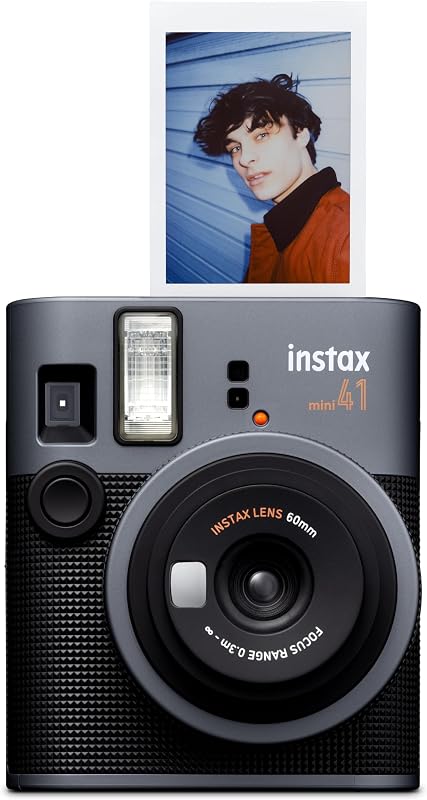
Unboxing the camera reveals an operational setup focused on immediate deployment right out of the packaging, providing the core power and safety accessories needed to start shooting as soon as you load a compatible pack of film.
- Fujifilm Instax Mini 41 camera body finished in classic black styling
- Built-in selfie mirror positioned directly beside the front lens element
- Two standard AA batteries to power the electronic shutter and flash
- Dedicated woven hand strap for wrist security during handheld shooting
- Quick Start Guide outlining immediate setup and basic operation
- One-year limited manufacturer warranty documentation
Key Specifications
| Attribute | Detail |
|---|---|
| Film Format | Instax Mini physical film (2” x 3” print output) |
| Color Type | Colored physical film stock |
| Exposure Control | Automatic exposure and automatic flash control |
| Shutter Type | Electronic shutter mechanism |
| Minimum Shutter Speed | 1/2 second |
| Maximum Shutter Speed | 1/250 second |
| Viewfinder | Optical viewfinder with 0.37x magnification |
| Shooting Modes | Standard mode and Close-up Mode |
| Framing Assist | Parallax correction targeting in Close-up Mode |
| Power Source | Two AA batteries (included) |
| Water Resistance | Not water resistant |
Automated Exposure and Variable Shutter Performance
Understanding the fujifilm instax mini 41 specs begins with its exposure logic. Instant film stocks possess relatively narrow dynamic range compared to modern digital sensors, which means minor light meter miscalculations often lead to blown highlights or muddy, underexposed shadows. The fujifilm instax mini 41 automatic exposure system addresses this challenge by pairing environmental light evaluation with automatic flash control. By balancing the electronic flash output against ambient illumination, the hardware prevents the stark, washed-out subject rendering that plagued earlier vintage instant cameras, yielding balanced physical photos across shifting studio or outdoor conditions.
The internal electronic shutter spans a functional range tailored for hand-held convenience. With a fujifilm instax mini 41 shutter speed floor of 1/2 second and a ceiling of 1/250 second, the unit automatically adapts its timing without requiring user input. When working under bright outdoor sunlight, pushing up to 1/250 second prevents overexposing the sensitive film emulsion. Conversely, in low-light indoor environments, dropping toward 1/2 second pulls in ambient background details rather than rendering the space behind your subject as a pitch-black void. This automatic shift mirrors the operational reliability pioneered on earlier legacy bodies like the instax mini film camera 11, freeing you to focus on scene composition instead of dial adjustments.
Because the flash triggers automatically based on metered values, creators do not need to pause production to calculate guide numbers or bounce angles. The camera meters the background and foreground simultaneously, adjusting the burst strength to fill in shadows on faces while preserving background detail. For creators moving quickly through an event, a studio portrait session, or casual lifestyle documentation, this automation drastically reduces the frequency of ruined exposures, ensuring that every print pulled from the cartridge produces usable, legible visual imagery.
Close-up Mode and Optical Parallax Correction
A primary friction point with analog rangefinder-style cameras has always been parallax error—the optical mismatch between what the separate viewfinder window sees and what the taking lens actually captures. When framing distant subjects, this tiny physical distance between the viewing window and the glass lens is negligible. However, as you move closer to photograph small details, artwork, or personal portraits, parallax causes subjects to shift out of frame, frequently lopping off heads or skewing centered items to one side. The instax mini 41 close up mode solves this persistent issue by integrating mechanical parallax correction directly into the optical viewfinder system.
When the camera engages close-up mode, the optical viewfinder adjusts the position of its framing target mark downward and toward the lower left. This deliberate mechanical compensation of a few millimeters realigns your eye line with the lens trajectory. The result is true-to-frame accuracy on close subjects, making parallax correction instax mini engineering essential for anyone staging detailed tabletop arrangements, product documentation, or tight facial portraits. Unlike older hardware configurations such as the fujifilm instax mini 9 instant camera, which required clipping on an auxiliary plastic close-up lens filter that was easy to misplace, this unit integrates close-range optics smoothly into the primary body structure.
Self-portraiture benefits equally from this precision alignment. Nestled immediately adjacent to the primary lens barrel sits the built-in instax mini 41 selfie mirror. When shooting arm-length frames of yourself or collaborators, the convex reflective surface allows you to center your composition before pressing the shutter release. When combined with close-up mode, the mirror guarantees that facial framing stays balanced without awkward angle cuts. For vloggers documenting behind-the-scenes milestones or sharing collaborative instant keepsakes with talent, this mirror eliminates the blind framing errors common to basic analog equipment.
Creator Workflow and Production Asset Utility
Integrating an analog tool into a modern creative routine requires clear utility, and the instax mini 41 for creators functions as an agile visual documentation asset. On commercial video sets and photography shoots, art directors and stylists frequently snap instant photos to track wardrobe configurations, continuity details, and lighting setups across scenes. Having a 2” x 3” physical print pinned directly to a production clipboard or whiteboard provides instant reference that does not require unlocking a tablet, opening an app, or running through digital camera menus during fast-paced turnarounds.
Beyond technical reference, tangible prints serve as high-impact branding tools. Content creators hosting meetups, running studio tours, or packaging physical merchandise can produce one-of-a-kind physical artifacts that carry substantial sentimental value. While digital images are easily lost in infinite camera rolls, physical film outputs are tactile keepsakes that recipients keep on desks or pin to bulletin boards. The classic black finish of this camera maintains a discreet, professional profile that blends seamlessly into formal commercial workspaces alongside other production gear like the instax mini se camera.
Physical film also imposes creative intentionality. Working with a finite cartridge of ten exposures encourages thoughtful framing, disciplined subject positioning, and deliberate lighting choices. The instantaneous chemical development process delivers finished physical media within minutes, providing creative satisfaction that purely digital tools cannot replicate. Whether you are assembling aesthetic mood boards for client pitches or building tactile scrapbooks of creative projects, this hardware functions as a reliable bridge between physical craftsmanship and digital production.
Portability, Power Management, and Build Quality
Ergonomics and field survivability dictate whether an instant camera stays tucked away in a drawer or travels everywhere in your production kit. The Instax Mini 41 is constructed with a lightweight, molded chassis featuring a textured black finish that offers a secure grip during active shooting. The included wrist strap mounts directly to the body, providing drop protection when operating one-handed in busy environments or leaning over set tables to capture flat-lay arrangements. Its compact footprint slips into standard camera backpacks, production totes, or everyday gear bags alongside microphones and digital lenses without demanding dedicated compartment space.
Power management is anchored by two standard AA batteries, which come included inside the retail packaging. Opting for widely accessible AA cells rather than proprietary lithium-ion rechargeable packs presents distinct workflow advantages for working creators. If your power depletes midway through an event or shoot, you can instantly swap in fresh alkaline cells sourced from any nearby retail store or production supply kit, avoiding downtime spent waiting for an internal battery to recharge via USB. This simple power architecture ensures the camera remains operational across long production days.
It is important to note the operational boundaries outlined in the official technical specifications: the body is not water resistant. The film ejection slot, lens assembly, and battery door do not feature weatherproof rubber gaskets. Consequently, creators working in rain, dense fog, or splash-prone marine environments must take deliberate precautions to shield the camera body from liquid exposure. The camera utilizes standard mini-format cartridges identical to those used across the brand’s ecosystem, including standard fujifilm instax mini 12 instant film packs, ensuring broad supply availability whenever replenishment is necessary.
Check Fujifilm Instax Mini 41 on Amazon
Is the Fujifilm Instax Mini 41 Worth It
Evaluating whether this camera justifies a space in your equipment locker depends primarily on how you approach physical photography. For visual artists, vloggers, and event organizers seeking a dependable, zero-friction path to credit-card-sized prints, the combination of automated exposure calibration, automatic flash output, and parallax correction delivers reliable frame yields. Because the camera handles lighting calculations and framing alignment internally, it minimizes the wasted sheets that turn analog photography into an exercise in frustration.
On the other hand, experienced photographers looking for complete manual mastery over shutter intervals, manual aperture rings, or deliberate multi-exposure overlays will find the automated systems limiting. The camera makes every core exposure decision on your behalf, lacking manual flash override switches or focus-distance dials. If your creative process demands deep technical intervention or deliberate low-key exposure manipulation, an advanced manual analog body or hybrid digital camera might prove more suitable for your specific goals.
Ultimately, if your priority is acquiring a durable, timelessly styled physical snapshot maker that consistently delivers well-balanced 2” x 3” prints without requiring technical troubleshooting, this model fulfills that brief exceptionally well. It strikes a pragmatic balance between classic analog tactility and dependable modern automation, making it a reliable production companion for casual creative documentation, tangible marketing giveaways, and everyday visual journaling.
FAQ
Does the Fujifilm Instax Mini 41 come with film included in the box?
No, the retail package does not include film packs. The box contains the camera body, two AA batteries, a hand strap, the Quick Start Guide, and warranty paperwork. You must purchase Instax Mini format instant film cartridges separately before you can begin exposing prints.
How does parallax correction work in close-up mode?
In close-up mode, the optical viewfinder compensates for the physical gap between the viewfinder window and the camera lens. The targeting mark inside the 0.37x viewfinder shifts slightly to the lower left, allowing you to compose subjects between close working distances accurately without accidentally cropping the top or sides of your subject.
What shutter speeds does the camera utilize?
The electronic shutter operates across an automated range between 1/2 second and 1/250 second. The camera automatically selects the appropriate speed within this spectrum based on ambient light readings to balance background illumination and subject clarity.
Can I use rechargeable batteries with this camera?
The camera listing specifies power delivery via two standard AA alkaline batteries, which are supplied in the box. While standard 1.5V AA cells are the manufacturer-specified power standard, the listing does not specify official support or performance metrics for 1.2V NiMH rechargeable cells.
Is the camera body waterproof or weather sealed?
No, the camera is classified as not water resistant. It features no weather sealing around the lens, film delivery slot, or battery compartment, meaning it should be protected from rain, snow, heavy moisture, and direct water splashes during use.
When organizing portrait sessions or building instant mood boards, coordinating subject attire with the film stock’s distinct contrast profile ensures your physical prints look intentional. Consulting a dedicated Wardrobe Guide helps talent select textures and complementary colors that render sharply under the camera’s built-in flash. Pairing careful outfit planning with the camera’s automated metering maximizes your print yield and keeps material waste to a minimum.


