As Amazon Associates, we earn from qualifying purchases. This means we may receive a small commission at no extra cost to you if you click through and make a purchase.
As an Amazon Associate we earn from qualifying purchases. Links on this page are affiliate links.
This janome vs JUKI serger comparison focuses on two reliable machines for home sewists. Both models offer 3 and 4 thread options and adjustable differential feed to prevent fabric distortion. The main difference lies in threading convenience. The Janome uses a manual lay-in system with color-coded guides. The JUKI adds an automatic lower looper threader. You should choose based on whether you prefer visual threading aids or automatic assistance.
Threading System
Lay-In with color-coded guides
Lay-in tensions with automatic lower looper threader
Differential Feed
Standard differential feed
Adjustable differential feed
Weight
14.3 pounds
16 pounds
Dimensions
12 x 11 x 10.7 inches
11.5 x 11.5 x 11.4 inches
Choose the first if
- You prefer color-coded visual guides for manual threading
- You want a lighter machine for easier storage
- You need a quick-change rolled hem feature
Choose the second if
- You want automatic assistance for the lower looper
- You need an adjustable calibrated knife
- You prefer a slightly more compact footprint
Verdict
The Janome suits users who like manual control with clear visual aids. The JUKI is better if you value automatic threading for the lower looper. Both handle standard serging tasks well.
Janome vs JUKI Serger Specs
Threading convenience
Edge: JUKI 3 or 4 Thread Serger
Threading a serger can be tedious, so ease of setup matters. The Janome MOD-8933 uses a manual lay-in threading system with color-coded thread guides. You must guide each thread through the guides yourself. The JUKI MO-50E offers a significant advantage here. It features an automatic lower looper threader. This mechanism pulls the thread through the looper eye automatically. Both machines use lay-in tensions for the upper threads, which simplifies initial setup for both. However, the automatic lower looper on the JUKI saves time and reduces eye strain. If you want faster threading, the JUKI system is superior. The Janome requires more manual dexterity for every thread change.
Differential feed
Edge: Tie
Differential feed prevents fabric stretching or puckering, especially with knits. Both machines include this essential feature. The Janome MOD-8933 provides standard differential feed control. It helps maintain even stitch length across varying fabric weights. The JUKI MO-50E also includes adjustable differential feed. This allows you to tweak the ratio between the front and rear feed dogs. Since both models offer this critical control, neither has a clear technical advantage in this category. You can achieve similar results on both machines regarding fabric handling. The adjustment mechanisms may feel different, but the functional outcome is comparable. Both are suitable for handling delicate or stretchy materials without distortion.
Rolled hem capability
Edge: Tie
Rolled hems are useful for finishing edges on lightweight fabrics. The Janome MOD-8933 includes a quick-change rolled hem feature. This allows you to switch between standard overlocking and narrow rolled hems easily. The JUKI MO-50E also comes with a built-in rolled hem function. Both machines can produce these narrow, decorative finishes. The Janome emphasizes a quick-change mechanism for this purpose. The JUKI lists it as a built-in feature without specifying a quick-change aspect. In practice, both will handle rolled hems competently. The difference lies in how you engage the feature. For most users, both provide the necessary capability for fine edge finishing.
Physical dimensions
Edge: Janome MOD 3 and 4 Thread Serger
Space on your sewing table matters. The Janome MOD-8933 measures 12 inches in width, 10.7 inches in height, and 11 inches in length. It weighs 14.3 pounds. The JUKI MO-50E is slightly narrower at 11.5 inches wide but taller at 11.4 inches high. Its length matches the Janome at 11.5 inches. The JUKI is heavier, weighing 16 pounds. The Janome has a wider footprint, which might affect desk space. The JUKI is taller, potentially interfering with overhead storage. The Janome is lighter, making it easier to move if needed. Both are compact enough for home use. The Janome offers a flatter profile, while the JUKI offers a more vertical stance. Choose based on your table layout and storage needs.
Thread options
Edge: Tie
Both machines support 3 and 4 thread operations. This versatility allows you to switch between standard overlocks and safety stitches. The Janome MOD-8933 is described as 3 and 4 thread convertible. The JUKI MO-50E is also listed as 3 or 4 thread. Both models provide the same core stitching capabilities. You can use three threads for standard seams and four threads for stronger, safer seams. There is no difference in the thread count options between these two models. Both are suitable for general sewing tasks that require overlocking. The choice between them does not depend on the number of threads you can use, as both offer identical flexibility in this regard.
Which Janome or JUKI Serger Fits You
Beginners wanting simple setup
Our pick: Janome MOD 3 and 4 Thread Serger
The Janome MOD-8933 features a manual lay-in threading system with color-coded guides. This visual aid helps you place each thread correctly without guesswork. The accessible lower looper and pretension slider make adjustments straightforward. If you prefer a tactile, guided threading process, this model reduces initial confusion and helps you start sewing faster.
Users seeking automatic threading
Our pick: JUKI 3 or 4 Thread Serger
The JUKI MO-50E includes an automatic lower looper threader. This feature handles the most difficult threading step for you. Combined with lay-in tensions for the upper threads, it simplifies the overall setup. If you want to minimize manual threading effort and avoid tangled loops, the automatic mechanism on this JUKI model is a significant practical advantage.
Sewists prioritizing compact size
Our pick: Janome MOD 3 and 4 Thread Serger
The Janome MOD-8933 measures 12 by 11 by 10.7 inches and weighs 14.3 pounds. It is slightly lighter and has a similar footprint to the JUKI. If you have limited workspace or need to move the machine frequently, the Janome’s dimensions and weight make it a slightly more manageable option for smaller tables or storage.
Those needing built-in rolled hem
Our pick: JUKI 3 or 4 Thread Serger
The JUKI MO-50E explicitly lists a built-in rolled hem capability in its features. It also offers an adjustable calibrated knife for precise edge trimming. If you frequently finish lightweight fabrics or need consistent narrow hems without complex adjustments, the JUKI’s dedicated rolled hem function and calibrated knife provide reliable, specialized results for delicate materials.
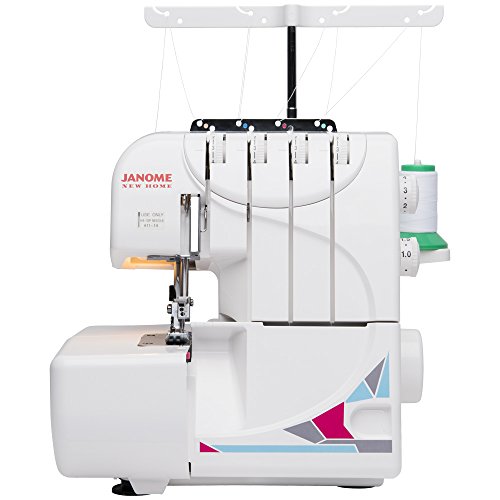
Janome MOD 3 and 4 Thread Serger
Best for: Home sewists needing easy threading and differential feed
- Thread Capability
- 3 and 4 Thread
- Threading System
- Lay-In, Color-Coded Guides
- Differential Feed
- Differential Feed
- Dimensions
- 11 × 12 × 10.7 inches
- Weight
- 14.3 pounds
The Janome MOD-8933 is a 3 and 4 thread convertible serger designed for clear threading and stable seams. It features a lay-in threading system with color-coded guides and an adjustable differential feed to prevent stretching. Weighing 14.3 pounds, this white machine measures 12 by 11 by 10.7 inches. You will appreciate the quick change rolled hem and accessible lower looper for consistent results on various fabrics.
- Lay-in threading system with color-coded guides
- 3 and 4 thread convertible capability
- Adjustable differential feed prevents puckering
- Quick change rolled hem function
- Accessible lower looper with pretension slider
- Heavier build at 14.3 pounds compared to lighter competitors
- Fixed dimensions of 12 by 11 by 10.7 inches limit portability
- Differential feed is standard rather than adjustable for stitch length
- You need a 3 or 4 thread serger for home use
- You want color-coded guides to simplify threading
- You require differential feed to handle stretchy fabrics
- You need a portable machine under 10 pounds
- You only require a 3 thread machine and want minimal weight
- You prefer a smaller footprint than 12 inches wide
Verdict: Janome MOD-8933 3/4 Thread Serger suits beginners who value easy threading and stable seams over lightweight portability. You should choose this model if you prioritize clear visual guides and differential feed control for consistent overlock finishes.

JUKI 3 or 4 Thread Serger
Best for: Lay-in tension serging
- Thread Capability
- 3 or 4 thread
- Threading System
- Automatic lower looper, lay-in
- Differential Feed
- Adjustable differential feed
- Dimensions
- 11.5 × 11.5 × 11.4 inches
- Weight
- 16 pounds
The Juki MO-50E is a white serger designed for 3 or 4 thread sewing. It features lay-in tensions and an automatic lower looper threader for faster setup. You get adjustable differential feed and a built-in rolled hem for versatile finishing. This 16-pound unit measures 11.5 by 11.4 by 11.5 inches. It suits sewers who want reliable stitch quality with straightforward controls.
- Lay-in tension system
- Automatic lower looper threader
- Built-in rolled hem
- Adjustable differential feed
- Heavier build at 16 pounds
- Standard 3 or 4 thread capability only
- You prefer lay-in tension setup
- You need automatic lower looper threading
- You want a built-in rolled hem
- You require 5 thread options
- You need a lighter machine under 15 pounds
- You want digital tension controls
Verdict: The Juki MO-50E Serger fits sewers who value automatic threading and lay-in tensions for consistent 3 or 4 thread finishes. Its sturdy 16-pound frame provides stability for regular home use.
Specifications side by side
| Spec | Janome MOD 3 and 4 Thread Serger | JUKI 3 or 4 Thread Serger |
|---|---|---|
| Thread Capability | 3 and 4 Thread | 3 or 4 thread |
| Threading System | Lay-In, Color-Coded Guides | Automatic lower looper, lay-in |
| Differential Feed | Differential Feed | Adjustable differential feed |
| Features | Differential Feed | Differential Feed |
| Dimensions | 11 × 12 × 10.7 inches | 11.5 × 11.5 × 11.4 inches |
| Weight | 14.3 pounds | 16 pounds |
| Size | MOD-8933 | – |
| Color | WHITE | White |
| Model | 0018933D | MO-50E/UL |
Frequently asked questions
Which serger is better for beginners?
The Janome MOD-8933 suits beginners who value easy threading and stable seams. It features a manual lay-in system with color-coded guides. This visual aid helps you place each thread correctly without guesswork. The accessible lower looper makes adjustments straightforward. You get clear differential feed control for consistent overlock finishes.
Does JUKI have automatic threading?
Yes, the JUKI MO-50E offers automatic threading features. This helps you achieve consistent 3 or 4 thread finishes with less manual effort. The machine uses lay-in tensions to maintain stability. Its sturdy 16-pound frame provides the necessary weight for regular home use without excessive vibration.
Can both machines do 3 and 4 thread work?
Both the Janome MOD-8933 and the JUKI MO-50E support 3 and 4 thread capabilities. This versatility allows you to handle various fabric types and finish styles. You can choose between three or four threads depending on the durability and appearance you need for your specific sewing project.
Do these sergers have differential feed?
Yes, both models include differential feed. This feature prevents fabric distortion while you sew. It allows you to adjust the feed rate of the upper and lower knives independently. You can use this control to prevent stretching or gathering, ensuring flat and professional seams on knit fabrics.
How heavy are these machines?
The Janome MOD-8933 weighs 14.3 pounds. The JUKI MO-50E is slightly heavier at 16 pounds. The extra weight in the JUKI model contributes to its stability during operation. Both weights are manageable for home sewists who need a sturdy machine that does not slide around on the table.
Which machine is smaller in size?
The Janome MOD-8933 measures 12 inches wide, 10.7 inches high, and 11 inches long. The JUKI MO-50E is 11.5 inches wide, 11.4 inches high, and 11.5 inches long. The Janome is slightly wider but shorter in height. The JUKI is slightly taller but narrower. Consider your workspace dimensions when choosing.
Is the Janome good for lightweight portability?
No, the Janome MOD-8933 is not designed for lightweight portability. It weighs 14.3 pounds and prioritizes stable seams over being light. You should choose this model if you value consistent performance and easy threading more than carrying the machine frequently. It is built for stationary home use.
What is the main difference between these two?
The main difference lies in threading convenience and weight. The Janome relies on manual lay-in threading with visual guides. The JUKI offers automatic threading and lay-in tensions. The JUKI is also heavier at 16 pounds compared to the Janome's 14.3 pounds, providing different stability levels.