As Amazon Associates, we earn from qualifying purchases. This means we may receive a small commission at no extra cost to you if you click through and make a purchase.
As an Amazon Associate we earn from qualifying purchases. Links on this page are affiliate links.
The juki single needle quilting machine vs standard arm sewing machine comparison highlights two distinct tools for different tasks. Both models share an automatic needle threader for convenience. The primary difference lies in their design and intended use. The JUKI TL-2010Q is built for quilting with a knee lifter and high presser foot clearance. The Juki HZL-DX5 offers a standard arm with automatic buttonholing and free arm capability. You should choose based on your specific fabric handling needs and project types.
Intended Use
Quilting
General sewing
Arm Type
Not listed
Standard Arm
Key Features
Automatic thread trimmer, Knee lifter lever
Automatic one-step buttonholing, Adjustable presser foot pressure, Free arm sewing
Weight
38 pounds
21.6 pounds
Included Accessories
Not listed
Hard-shell carrying case, Auxiliary bed
Choose the first if
- You need to sew heavy quilting layers with ease
- You want to use a knee lifter for hands-free presser foot control
- You require an automatic thread trimmer for efficiency
Choose the second if
- You need to sew automatic buttonholes accurately
- You want to sew cylindrical items like sleeves or cuffs
- You prefer a lighter machine with a protective carrying case
Verdict
The JUKI TL-2010Q is the better choice for dedicated quilters who need robust fabric handling and speed. The Juki HZL-DX5 is more suitable for general sewers who value versatility, buttonholing, and portability.
JUKI Quilting vs Standard Arm Comparison
Intended Use
Edge: JUKI Single-Needle Quilting Machine
The JUKI TL-2010Q is explicitly designed for quilting and tailoring tasks. Its construction supports handling light to heavyweight materials with ease. In contrast, the Juki HZL-DX5 is a standard arm sewing machine. It focuses on general sewing needs, including collars and cuffs. This model features a free arm for awkward sewing jobs. The auxiliary bed slides off to reveal this free arm. You should choose the TL-2010Q if your primary goal is quilting. Pick the HZL-DX5 for versatile everyday garment construction and general repairs.
Presser Foot Height
Edge: JUKI Single-Needle Quilting Machine
The TL-2010Q offers a presser foot lift of up to 12mm. This height is managed by a knee lifter lever. You can raise and lower the foot without using your hands. This feature is useful for moving bulky quilts in and out of the sewing area. The HZL-DX5 includes adjustable presser foot pressure. This allows for better results on different material types. However, the data does not list a specific maximum lift height for this model. The TL-2010Q provides a clear advantage for users who need significant clearance for thick layers.
Portability
Edge: Juki Standard Arm Sewing Machine
Weight and dimensions differ significantly between these two machines. The TL-2010Q weighs 38 pounds and measures 14 inches wide, 18 inches high, and 25.7 inches long. It is described as portable but is substantially heavier. The HZL-DX5 is much lighter at 21.6 pounds. Its dimensions are 8.2 inches wide, 11.5 inches high, and 17.5 inches long. It also comes with a hard-shell carrying case. This makes the HZL-DX5 a better choice for travel or frequent relocation. The TL-2010Q is better suited for a fixed workspace.
Thread Trimming
Edge: JUKI Single-Needle Quilting Machine
The TL-2010Q features an automatic thread trimming device. You can trim both needle and bobbin threads simultaneously. This is done by lightly pressing a push-button. This saves time and ensures clean finishes on quilts. The data for the HZL-DX5 does not mention an automatic thread trimmer. It does include automatic one-step buttonholing. This feature sews buttonholes to the size of the placed button. If quick thread cutting is a priority, the TL-2010Q is the superior option.
Needle Threading
Edge: Tie
Both machines include an automatic needle threader. The TL-2010Q uses a push lever to thread the needle easily. This reduces eyestrain and helps you start sewing quickly. The HZL-DX5 also features an automatic needle threader with similar benefits. It allows for quick threading without strain. Since both models provide this specific convenience feature, there is no difference in this category. You get the same benefit from either machine when it comes to threading the needle.
Which JUKI model fits your sewing needs
Quilters needing heavy material handling
Our pick: JUKI Single-Needle Quilting Machine
The TL-2010Q features a knee lifter lever that raises the presser foot up to 12mm. This allows you to easily maneuver light to heavyweight fabrics in and out of the sewing area. The automatic thread trimmer also saves time by cutting both needle and bobbin threads with a single button press, streamlining your quilting workflow.
Travelers wanting compact storage
Our pick: Juki Standard Arm Sewing Machine
The HZL-DX5 is significantly lighter at 21.6 pounds compared to the 38-pound TL-2010Q. It measures 17.5 inches in length and includes a hard-shell carrying case for secure transport. Its compact size makes it an ideal companion for taking your sewing projects to classes, retreats, or different locations without bulk.
Garment sewers needing versatility
Our pick: Juki Standard Arm Sewing Machine
This standard arm machine offers adjustable presser foot pressure for better results on various material types. It includes automatic one-step buttonholing that sews holes to the exact size of your button. The removable auxiliary bed converts the machine to a free arm, making it easier to sew collars, cuffs, and other tubular garments.
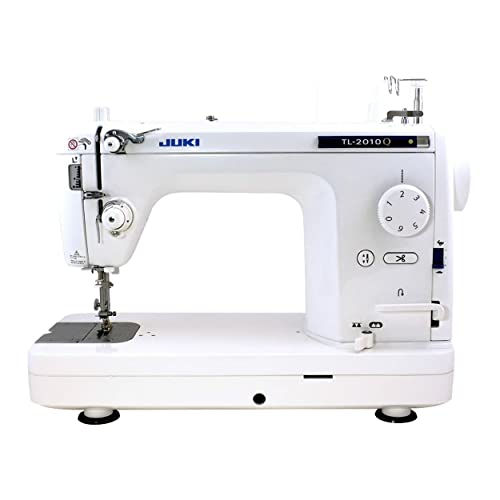
JUKI Single-Needle Quilting Machine
Best for: Dedicated quilting and tailoring projects
- Needle Threader
- Automatic
- Intended Use
- Quilting
- Dimensions
- 25.7 × 14 × 18 inches
- Weight
- 38 pounds
The JUKI TL-2010Q is a portable, single-needle lockstitch machine designed for quilting and tailoring. It features an automatic thread trimmer and an automatic needle threader to speed up your workflow. The knee lifter lever raises the presser foot up to 12mm for easy material handling. Weighing 38 pounds, it remains lightweight for transport while maintaining stability during heavy-duty sewing tasks.
- Automatic thread trimmer for needle and bobbin threads
- Knee lifter lever raises presser foot up to 12mm
- Automatic needle threader for quick setup
- Portable design at 38 pounds
- Heavier build at 38 pounds compared to lighter standard arm models
- Single-needle configuration limits simultaneous stitching options
- You need a dedicated machine for quilting projects
- You want to use a knee lifter for hands-free presser foot control
- You value automatic thread trimming to save time
- You require a multi-needle machine for complex embroidery
- You need a lightweight machine under 30 pounds for frequent travel
- You prefer a standard arm machine for general household sewing
Verdict: JUKI TL-2010Q Quilting Machine suits quilters who need a dedicated, high-performance tool with automatic thread trimming and knee lift functionality. It fits those prioritizing specialized quilting features over general-purpose versatility.
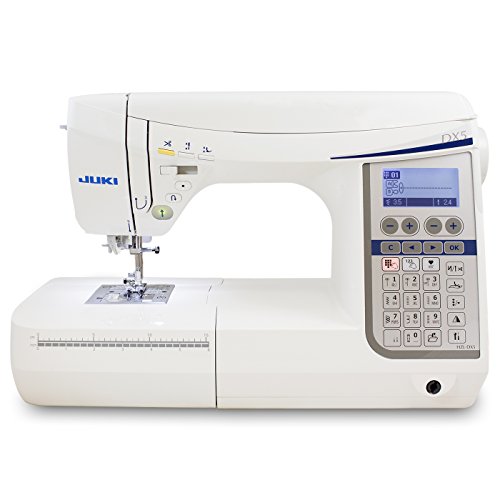
Juki Standard Arm Sewing Machine
Best for: portable standard arm sewing with automation
- Needle Threader
- Automatic
- Dimensions
- 17.5 × 8.2 × 11.5 inches
- Weight
- 21.6 pounds
The Juki HZL-DX5 is a standard arm sewing machine designed for portability. It measures 17.5 inches in length and weighs 21.6 pounds. The unit includes an automatic needle threader and one-step buttonholing. You get adjustable presser foot pressure for different materials. The machine features a free arm with a removable auxiliary bed. It comes with a hard-shell carrying case for travel.
- Automatic needle threader reduces eye strain
- One-step automatic buttonholing
- Adjustable presser foot pressure
- Includes hard-shell carrying case
- Free arm capability with auxiliary bed
- Weighs 21.6 pounds, which is heavier than portable options
- Standard arm size limits workspace compared to larger industrial models
- Length is 17.5 inches, making it bulkier for tight storage
- You need a portable machine with a hard-shell case
- You require adjustable presser foot pressure for various fabrics
- You want automatic buttonholing and needle threading features
- You need a lightweight machine under 15 pounds
- You require a compact free-arm design without a standard arm
- You prefer a machine smaller than 17 inches in length
Verdict: Juki HZL-DX5 Standard Arm Sewing Machine fits quilters who prioritize portability and built-in automation. It suits those who need a sturdy, travel-ready unit with adjustable settings for diverse fabric weights.
Specifications side by side
| Spec | JUKI Single-Needle Quilting Machine | Juki Standard Arm Sewing Machine |
|---|---|---|
| Needle Threader | Automatic | Automatic |
| Intended Use | Quilting | – |
| Dimensions | 25.7 × 14 × 18 inches | 17.5 × 8.2 × 11.5 inches |
| Weight | 38 pounds | 21.6 pounds |
| Color | red | White |
| Model | MO-735 | HZL-DX5 |
| Size | – | Standard Arm |
Frequently asked questions
Which JUKI machine is better for portability?
The Juki HZL-DX5 Standard Arm Sewing Machine is the better choice for portability. It weighs 21.6 pounds and measures 17.5 inches in length. This makes it significantly lighter and more compact than the JUKI Single-Needle Quilting Machine, which weighs 38 pounds and measures 25.7 inches in length. You can easily transport the HZL-DX5 for travel or small workspace setups.
What is the size difference between the two machines?
The JUKI Single-Needle Quilting Machine is larger in every dimension. It measures 25.7 inches in length, 14 inches in width, and 18 inches in height. The Juki HZL-DX5 is more compact, measuring 17.5 inches in length, 8.2 inches in width, and 11.5 inches in height. The standard arm model takes up less floor space and fits into smaller cabinets.
Can the JUKI Single-Needle Quilting Machine handle heavy fabrics?
Yes, the JUKI Single-Needle Quilting Machine is designed for dedicated quilting and tailoring projects. It is built to handle light to heavyweight materials with ease. The robust construction supports intensive quilting tasks. If you frequently sew through thick layers or multiple fabric types, this machine provides the stability and power needed for those demanding projects.
Is the Juki HZL-DX5 suitable for general sewing?
The Juki HZL-DX5 Standard Arm Sewing Machine is ideal for general sewing and portable use. It features adjustable settings for diverse fabric weights. This versatility allows you to switch between different materials without changing machines. It is a sturdy, travel-ready unit that handles everyday sewing tasks alongside more specialized quilting needs.
Which machine has a red color option?
The JUKI Single-Needle Quilting Machine is available in red. The Juki HZL-DX5 Standard Arm Sewing Machine is white. If you prefer a red machine for your sewing room, the single-needle quilting model is your only option among these two. Color does not affect the mechanical performance or specifications of either unit.
Do both machines include an automatic needle threader?
Yes, both models share an automatic needle threader for convenience. This feature simplifies the threading process for you, saving time and reducing eye strain. It is a standard inclusion on both the dedicated quilting machine and the standard arm sewing machine, ensuring ease of use regardless of which model you choose.
Which model is heavier?
The JUKI Single-Needle Quilting Machine is heavier. It weighs 38 pounds, providing a stable base for heavy-duty quilting. The Juki HZL-DX5 Standard Arm Sewing Machine weighs 21.6 pounds. The lighter weight of the DX5 contributes to its portability, while the heavier quilting machine prioritizes stability during intensive use.