
As Amazon Associates, we earn from qualifying purchases. This means we may receive a small commission at no extra cost to you if you click through and make a purchase.
Commercial drone operations live and die by duty cycles, and deploying the mavic 3 enterprise for photogrammetry, thermal inspection, or corridor mapping requires an uninterrupted power pipeline. When working in the field, relying solely on the battery shipped inside the aircraft box halts productivity the moment your first flight concludes. The DJI Mavic 3 Enterprise Battery Kit is configured specifically to solve that operational bottleneck by supplying three high-capacity flight packs alongside a dedicated multi-port charging hub. Whether you are scaling an aerial survey over dozens of acres or conducting repeated surveillance passes, having a structured battery turnover strategy is the single most critical factor in achieving true operational continuity throughout a working day.
Investing in enterprise flight packs requires a careful evaluation of charging logistics, sequential port architectures, and ambient thermal operating limits. This assessment breaks down the real-world operational throughput of the three-battery rotation, analyzes the capabilities of the included 100W charging system, evaluates pack compatibility, and details the key specifications that govern daily commercial deployment. The rest of this guide examines charge timing, thermal constraints, field transport considerations, and whether this power bundle provides the duty cycle endurance necessary to support your commercial aerial missions.

What You Get With the DJI Mavic 3 Enterprise Battery Kit
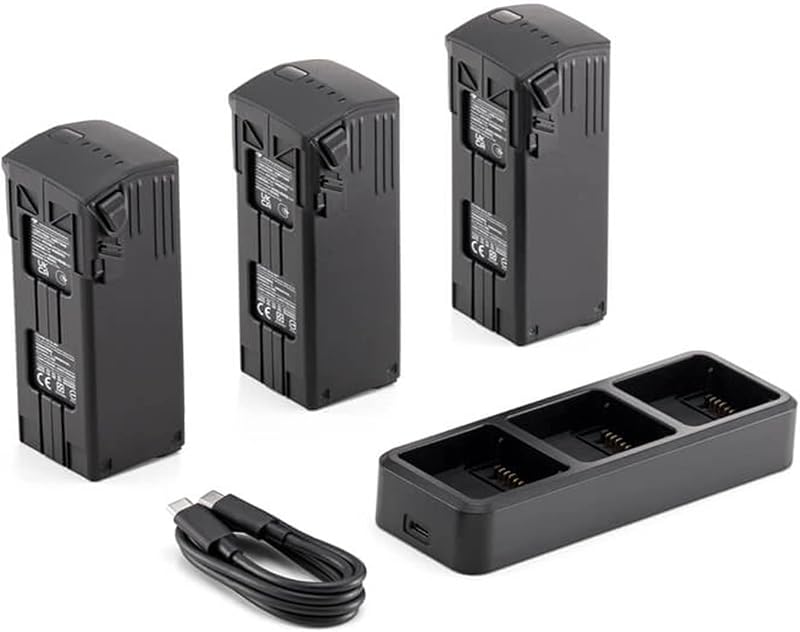
The package provides the core power hardware needed to expand your operational envelope directly out of the box, combining multiple energy storage units with multi-battery management hardware designed specifically for commercial workflows.
- Three Mavic 3 Intelligent Flight Batteries (Model BWX260-5000-15.4)
- One Mavic 3 Battery Charging Hub (100W)
- USB-C power interface connectivity
- UL, CE, and FCC certified components
- Black enterprise-matched casing finish
Key Specifications
| Specification Field | Manufacturer Detail |
|---|---|
| Battery Model Number | BWX260-5000-15.4 |
| Battery Chemistry | LiPo 4S |
| Nominal Capacity | 5000 mAh |
| Single Battery Weight | 335.5 g |
| Charging Hub Power Delivery | 100W |
| Charging Hub Port Count | 3 Ports |
| Single Battery Charge Time | Approximately 70 minutes (1 h 10 mins) |
| Hub Output Voltage | 24V DC |
| Hub Input Voltage | 240V |
| Allowable Charging Temperature | 5° to 40° C (41° to 104° F) |
| Regulatory Certifications | UL, CE, FCC |
Field Rotation Dynamics and Commercial Drone Uptime
Sustaining continuous flight operations across a full workday requires a realistic understanding of how battery depletion matches up against charging recovery. In professional mapping and inspection missions, managing mavic 3 enterprise flight time demands that pilots calculate energy consumption based on payload draw, RTK module power requirements, and wind resistance. When you rotate three 5000 mAh LiPo 4S packs, your operational cadence shifts from a hard stop after the first pack to a staggered rotation cycle. Commercial workflows require far stricter energy planning than recreational flights with consumer platforms like the mavic 3 pro, because surveying grids demand strict route compliance without emergency mid-line battery landfalls.
The primary timing benchmark for this workflow centers on the mavic 3 enterprise charging time. According to the listing specifications, a single BWX260-5000-15.4 battery requires approximately 1 hour and 10 minutes (70 minutes) to reach full charge when connected to the 100W power system. Because the charging hub operates sequentially across its three ports rather than delivering full concurrent 100W power to all three docks simultaneously, replenishing all three batteries from a depleted state takes upwards of three and a half hours. This means that three batteries alone cannot maintain an infinite continuous loop without either a secondary charging station or scheduled operational pauses between mapping blocks.
Understanding this mathematical reality allows enterprise pilots to design smarter field schedules. In a standard workflow, flying two consecutive batteries provides roughly an hour of active mission time depending on mission parameters, while the first depleted pack rests and begins its 70-minute charge cycle. While the kit significantly mitigates downtime compared to single-battery operations, operators planning continuous dawn-to-dusk orthomosaic data collection must synchronize their mission intervals with the 70-minute recharge window per battery to avoid operational bottlenecks.
Charging Hub Architecture and Compatibility Constraints
The included dji 100w charging hub serves as the operational nerve center of this kit, designed to manage energy distribution efficiently across three distinct docks. Operating with a rated direct current output of 24 volts and accommodating a 240-volt input system, the hub is engineered to interface directly with high-capacity enterprise power adapters via USB-C. Rather than attempting to split 100 watts evenly across three drained batteries—which would result in three sluggishly charging packs—the internal logic prioritizes the battery with the highest remaining state of charge, bringing one pack back to operational status as fast as possible.
Compatibility with this charging system is strictly regulated by design. The manufacturer documentation explicitly warns operators not to attempt using the charging hub with unauthorized battery models. The charging dock is engineered exclusively for BWX260-5000-15.4 Intelligent Flight Batteries. While enterprise operations may maintain multi-platform fleets that share physical footprints with agricultural tools like the dji mavic 3m, pilots must verify model codes before inserting packs into the hub to prevent electrical faults, connector damage, or charging refusal.
The physical interface relies on standard modern USB-C power delivery protocols, allowing flexibility when connecting to mobile power stations or field generators. Commercial survey teams frequently operate from mobile field vehicles where inverter power fluctuates. Because the hub is rated for standard 240V input structures and delivers a steady 24V DC charging current, it pairs cleanly with regulated pure sine wave field inverters, ensuring that the intelligent power management circuits inside the flight packs receive clean, stable power during high-wattage input phases.
Thermal Management and Environmental Safety Standards
High-tempo commercial flight creates significant thermal buildup within LiPo 4S chemistry, making thermal regulation a vital consideration for mavic 3 enterprise battery life. The listing establishes an operational charging temperature range between 5° and 40° C (41° to 104° F). Commercial pilots working in hot summer environments must account for this boundary: pulling a pack directly out of the aircraft after a high-speed photogrammetry grid and plugging it immediately into the 100W hub will often trigger an automatic thermal safety delay until the core cells cool below 40° C.
Understanding this internal protection mechanism is essential for field readiness. Intelligent flight batteries incorporate internal thermistors that communicate with the hub logic. If an operator lands a mission at 38° C ambient temperature, the internal battery temperature will likely exceed the 40° C charging threshold. The 70-minute replenishment counter only begins once internal temperatures stabilize within safe margins. Incorporating a mandatory 15-minute passive cooling phase into your operational SOP ensures you do not miscalculate turnaround times in demanding climates.
Safety compliance is verified through official UL, CE, and FCC specifications noted in the product data. For corporate flight departments, utility contractors, and municipal public safety agencies, using power accessories backed by standardized electrical certifications is a mandatory prerequisite for liability compliance. These certifications verify that the internal circuitry protects against overcharging, deep discharge, short circuits, and thermal runaway, ensuring that unattended field charging inside command vehicles remains secure.
Field Portability and Transport Logistics
Transporting commercial flight equipment into rugged environments requires calculating weight and pack space. Each bwx260-5000-15.4 battery weighs exactly 335.5 grams according to official product specifications. When combined with the three-port charging hub, the battery kit adds over one kilogram of dedicated power hardware to your field deployment case. While substantially heavier than lightweight recreational setups like the dji mavic air 3, this mass reflects the robust structural casing and internal safety shielding required for enterprise-grade 5000 mAh LiPo cells.
Managing three separate batteries also requires strict pack indexing in the field. Commercial operators should maintain a rotation sequence—such as marking batteries numerically—to ensure even cell wear and cycle distribution across all packs. Because the charging hub is a lightweight external dock (listed with an overall pack weight around 0.1 kg for the accessory body), it easily slides into standard modular Pelican or flight-ready hard cases without forcing pilots to sacrifice room for secondary payloads, RTK bases, or tablets.
As commercial drone technology advances and pilots prepare for future developments like the dji mavic 4, the standardization of USB-C field charging across enterprise gear represents a major operational improvement. Being able to run the 100W hub directly off enterprise-grade battery banks or standard field power supplies means teams no longer need to haul proprietary, bulky power bricks to remote survey sites, keeping mobile inspection units agile in off-road environments.
Check DJI Mavic 3 Enterprise Battery Kit on Amazon
Is the DJI Mavic 3 Enterprise Battery Kit Worth It
Determining whether this three-battery and hub bundle aligns with your business needs comes down to your daily data collection volume. If your commercial assignments are limited to brief roof inspections, quick real estate marketing shots, or localized structural surveys taking under thirty minutes, the standard battery included with your aircraft may occasionally suffice. However, for professional mapping, municipal surveillance, or critical infrastructure monitoring, answering is mavic 3 enterprise battery kit worth it becomes an unequivocal yes. Operating with only a single flight pack severely cripples the revenue potential of an enterprise airframe by forcing lengthy work stoppages between flights.
For dedicated surveying teams and emergency service providers, having three reliable 5000 mAh packs means you can reliably capture large-acreage tracts without leaving the job site to find grid power. The ability to cycle through three fully certified LiPo 4S packs while prioritizing quick turnover via the 100W hub provides the baseline power stability required to meet client deliverables on schedule. Even when factoring in the sequential nature of the charging hub, the productivity jump over single-pack deployment is substantial.
Ultimately, this battery kit represents an essential operational investment rather than an optional accessory for any serious enterprise pilot. By aligning verified UL, CE, and FCC safety standards with high-capacity 5000 mAh cells and a dedicated 100W sequential management system, the kit delivers the sustained energy needed to transform your enterprise aircraft into an efficient, professional data collection platform.
FAQ
How long does it take to charge a single battery using the 100W hub?
According to the product specifications, charging a single BWX260-5000-15.4 battery from a depleted state takes approximately 1 hour and 10 minutes (70 minutes) when connected via a compatible 100W power source.
Does the charging hub charge all three batteries at the same time?
No, the charging hub operates sequentially. It distributes power to charge the battery with the highest remaining energy level first, bringing individual packs back into service as quickly as possible before moving to the next dock.
What are the specific battery specs included in this kit?
The kit includes three Model BWX260-5000-15.4 Intelligent Flight Batteries. Each battery features a 5000 mAh capacity, LiPo 4S chemistry, an individual weight of 335.5 grams, and an operational charging window of 5° to 40° C.
Can I use this charging hub with other drone battery models?
No. The product instructions explicitly state that you must not attempt to use the charging hub with other battery models. The hub is designed to be compatible solely with BWX260-5000-15.4 Intelligent Flight Batteries.
What safety certifications do these mavic 3 enterprise power accessories carry?
The components in this kit meet standardized commercial electrical safety criteria, holding official UL, CE, and FCC certifications for safe charging and operational deployment.
What type of cable connection is used on the charging hub?
The charging hub utilizes a standard USB-C connector interface to receive power from high-output power adapters, delivering an output voltage of 24V DC directly to the battery docks.


