
As Amazon Associates, we earn from qualifying purchases. This means we may receive a small commission at no extra cost to you if you click through and make a purchase.
As an Amazon Associate we earn from qualifying purchases. Links on this page are affiliate links.
This serger buying guide helps you choose a machine based on published specifications rather than marketing claims. You will compare key features like sewing speed, frame material, and thread capability across 8 selected models. Each pick is ranked by how well its technical data matches specific sewing needs, from heavy denim to stretch fabrics.
You will decide which build quality and stitch type suits your projects. The list covers metal frame durability, differential feed precision, and threading system ease. You can identify the right tool for DIY garment construction or small business use by reviewing these objective details. Focus on what matters for your fabric types and workflow. This guide walks through the essential specs so you can select a serger that performs reliably for your intended tasks.
Key Specs for Choosing a Serger
Intended Use and Fabric
Your primary fabric type dictates the machine's build and power needs. Heavy materials like denim require a sturdy metal frame to prevent vibration and ensure straight seams. The Brother 1034D and Singer HD0420 feature metal frames, making them suitable for thick, durable textiles. Lighter fabrics, such as silks or knits, need precise tension control to avoid puckering. Small business users handling high volumes benefit from robust construction that withstands continuous operation. Home sewers working on DIY garments may prioritize ease of use over raw durability. Match the frame material to your heaviest regular project to ensure longevity and consistent stitch quality.
Look for
- Metal frame for heavy fabrics
- Lightweight plastic for light knits
Sewing Speed
Sewing speed, measured in stitches per minute, determines how quickly you can finish projects. Machines like the Brother 1034D and Singer S14-78 operate at 1300 SPM, offering efficient production for larger tasks. Higher speeds reduce manual effort but require greater hand-eye coordination to maintain even tension. For delicate fabrics or complex curves, lower speeds provide better control and precision. If you are producing garments for sale, higher RPMs increase throughput significantly. However, beginners may find faster machines harder to manage without practice. Select a speed that matches your comfort level and project volume to balance efficiency with stitch accuracy.
Look for
- 1300 SPM for production
- Lower speed for control
Thread Capability
Thread capability defines the number of threads the machine can use, affecting seam strength and finish. Three-thread overlocks are standard for general sewing, while four-thread configurations offer stronger, more durable seams for heavy-duty applications. The VEVOR 336 and Singer S0100 support 2/3/4 thread options, providing versatility for various projects. Five-thread machines, like the Singer 14T968DC, add a safety stitch for maximum durability. More threads require more cones and complex threading paths, which can increase setup time. Choose a capability that matches your most frequent tasks, balancing seam strength with threading simplicity.
Look for
- 3/4 thread for versatility
- 5 thread for durability
Differential Feed
Differential feed controls the relative speed of the upper and lower feed dogs, preventing fabric stretching or puckering. This feature is essential for sewing stretchy materials like knits or slippery fabrics like silk. The Singer HD0420 and VEVOR 336 include differential feed to ensure smooth, even seams on challenging textiles. Without this adjustment, stretch fabrics may gather, while stable fabrics might pucker. It allows you to maintain fabric integrity and professional-looking edges. If you frequently sew varied textile types, this feature is critical for consistent results. Check for adjustable differential feed to handle diverse fabric behaviors accurately.
Look for
- Adjustable differential feed
- Essential for stretch fabrics
Stitch Type
Stitch type determines the final appearance and function of the seam. Overlock sergers trim and wrap edges, while coverstitch machines create professional hems on stretch fabrics. The Brother 2340CV is a coverstitch serger, ideal for finishing garment hems and necklines. Overlock models are better for edge finishing and seaming. Some machines combine both functions, offering flexibility for different project needs. Choose based on whether you need to finish raw edges or create decorative hems. Understanding the stitch type helps you select a machine that matches your specific finishing requirements.
Look for
- Overlock for edge finishing
- Coverstitch for professional hems
Free Arm Design
A free arm design allows you to sew tubular items like sleeves, cuffs, and pant legs easily. The VEVOR 336 and Singer S14-78 feature free arms, making them practical for garment construction. This design reduces bulk and improves access to tight areas, enhancing stitching precision. Machines without free arms may require additional tools or techniques for tubular sewing. If you regularly construct clothing, a free arm is a significant convenience. It simplifies the process of finishing seams on circular or narrow sections of fabric.
Look for
- Free arm for tubular items
- Fixed arm for flat sewing
Threading System
The threading system affects how quickly and easily you can set up the machine. Color-coded threading paths simplify the process, reducing errors and setup time. The Singer HD0420 and S14-78 use color-coded systems to guide users through complex thread paths. Clear diagrams and labeled guides help beginners navigate the multiple threads required for serging. A straightforward system minimizes frustration and ensures correct thread placement for optimal stitch quality. If you frequently change threads or colors, an intuitive system saves valuable time and reduces the risk of machine errors.
Look for
- Color-coded threading paths
- Clear setup diagrams
Included Accessories
Included accessories expand the machine's functionality and ease of use. The Brother 2340CV comes with a snap-on presser foot, facilitating quick changes for different stitch types. Additional feet or tools can enhance specific tasks, such as hemming or edge finishing. Check the package contents to ensure you have the necessary tools for your projects. Accessories like needle sets, screwdrivers, and thread spool caps are often included. Having the right tools on hand reduces downtime and allows for immediate project starts.
Look for
- Snap-on presser foot
- Essential tool kit
Types of Sergers Explained
Standard Overlock Serger
This category covers machines that trim and seam fabric edges simultaneously. Most models, like the Brother 1034D and SINGER S14-78, offer 2, 3, or 4 thread options. You get clean finishes on woven and knit fabrics. Look for differential feed to prevent stretching on jersey. Speeds around 1300 SPM handle most home projects. Metal frames, as seen in the Singer HD0420, reduce vibration. These are versatile tools for garment construction and basic hemming tasks.
Coverstitch Machine
Coverstitch machines create professional hems with parallel rows of stitching on the top and a looper chain on the bottom. The Brother 2340CV is a dedicated example. It uses a metal frame for stability during high-speed operation. This type does not trim fabric edges. It is ideal for finishing t-shirts, activewear, and stretch garments. You get a durable, flat finish that withstands washing. It is less versatile than an overlock for raw edge finishing but essential for ready-to-wear looks.
Coverlock Serger
A coverlock combines overlocking and coverstitching in one unit. The Singer 14T968DC Professional model handles up to five threads. You can switch between finishing edges and creating professional hems without changing machines. This hybrid approach saves space and cost. It suits users who want maximum versatility. The heavy metal frame supports high-speed performance for demanding projects. It is larger and heavier than standard sergers. You gain production capability but lose some portability. It is best for serious home sewers or small businesses.
Common Mistakes To Avoid
Ignoring presser foot pressure adjustment
Fixed pressure often causes puckering on knits or slipping on slippery fabrics. Look for models with adjustable presser foot pressure controls. This feature allows you to tighten or loosen the grip based on your material thickness. Proper adjustment ensures even stitching and prevents fabric distortion during high-speed sewing operations.
Overlooking differential feed range
Without differential feed, stretchy fabrics may gather or stretch unevenly. Check the specified range, such as 0.7 to 1.5. This mechanism adjusts the speed of the upper and lower feed dogs relative to each other. You need this control to maintain consistent seam length on knits and prevent waviness in delicate materials.
Assuming all knives are replaceable
Dull or missing knives result in frayed edges instead of clean cuts. Verify if the machine includes a upper and lower knife set. Confirm that replacement parts are readily available. Sharp knives are essential for trimming fabric simultaneously while sewing. Without them, your overlock stitches will look messy and unfinished on woven fabrics.
Neglecting threading complexity
Complex threading paths cause frequent downtime and frustration. Check the number of threads and the ease of the threading system. Some models use color-coded paths or automatic threaders. Simpler threading reduces setup time and minimizes errors. You should choose a machine with a clear, logical threading diagram that matches your skill level.
| # | Product | Best for | Price |
|---|---|---|---|
| 1 | Brother 3/4 Thread Overlock Serger | heavy fabric durability and easy threading | |
| 2 | SINGER Heavy Duty Overlock Serger | Heavy-duty fabrics and stable construction needs | |
| 3 | VEVOR 2/3/4 Thread Serger Machine | Heavy fabric sewing and small business use | |
| 4 | Singer Free-Arm 2-3-4 Thread Serger | DIY garment construction and stretch fabric handling | |
| 5 | Singer High-Speed Overlock Serger | stable stitching on stretchy and delicate fabrics | |
| 6 | Brother Metal Frame Coverstitch Serger | Durable coverstitching on stretch fabrics and hems | |
| 7 | SINGER Professional 5-Thread Coverlock Serger | Heavy fabrics and high-volume production | |
| 8 | MARGAR Metal Frame 3/4 Thread Serger | Durable metal frame construction and differential feed |

Brother 3/4 Thread Overlock Serger
Best for: heavy fabric durability and easy threading
- Thread Capability
- 3 or 4 thread
- Sewing Speed
- 1,300 stitches per minute
- Threading System
- Color-coded upper thread guide
- Frame Material
- Metal frame
- Dimensions
- 10 × 11 × 13 inches
- Weight
- 8.02 pounds
The Brother 1034D is a serger with a metal frame and interior components. It sews at 1,300 stitches per minute and handles 3 or 4 threads. You get color-coded threading guides and three snap-on feet. This machine suits you if you need durability for heavy fabrics like denim. The included trim trap keeps your workspace clean.
- Metal frame construction for durability
- 1,300 stitches per minute speed
- 3 or 4 thread capability
- Color-coded threading system
- Includes standard, gathering, and blind stitch feet
- 1,300 SPM speed is lower than the 1,250 SPM VEVOR model
- 8.02 pounds weight is heavier than the 13-inch SINGER models
- 3 or 4 thread limit excludes 5-thread users
- You sew heavy materials like denim
- You prefer a metal frame for stability
- You need color-coded threading guides
- You require 5-thread serging
- You need a lightweight portable machine
- You want a speed over 1,300 SPM
Verdict: Brother 1034D Metal Frame Serger fits users who prioritize a sturdy metal build and easy threading for heavy fabrics. It is a solid choice for home sewers handling denim.

SINGER Heavy Duty Overlock Serger
Best for: Heavy-duty fabrics and stable construction needs
- Thread Capability
- 4/3/2 thread
- Stitch Count
- 13
- Threading System
- Color-coded threading
- Differential Feed
- Differential feed
- Frame Material
- Metal frame
- Features
- Metal Frame, LED Light, Differential Feed
The Singer HD0420 is a heavy-duty serger featuring a full metal interior frame and a robust motor. It offers 13 stitch options across 4, 3, or 2-thread capabilities. A large cutting blade handles thicker fabrics, while differential feed control prevents puckering on knits. The color-coded threading system simplifies setup. This machine suits users seeking durable construction for consistent, clean seam finishes on various projects.
- Full metal interior frame for stable support
- 13 stitch options for overlocking and rolled hems
- Large cutting blade for clean trimming on heavy fabrics
- Differential feed control reduces stretching on knits
- 1300 stitches per minute speed is lower than the Brother 1034D
- 11.3 x 12.2 x 10.9 inch footprint is bulkier than the VEVOR 1250 SPM
- 13 stitch count is fewer than the Singer Professional 14T968DC
- You need a durable metal frame for heavy-duty projects
- You work with stretchy knits requiring differential feed
- You want color-coded threading for easier setup
- You require ultra-high speed over 1300 SPM
- You need more than 13 stitch options
- You prefer a compact machine under 11 inches in width
Verdict: Singer HD0420 Serger with Metal Frame fits users who prioritize structural durability and precise feed control for heavy fabrics. It is a solid choice for those who value stability over maximum speed or stitch variety.

VEVOR 2/3/4 Thread Serger Machine
Best for: Heavy fabric sewing and small business use
- Thread Capability
- 2/3/4-thread
- Sewing Speed
- 1,250 SPM
- Threading System
- Color-coded threading
- Differential Feed
- 0.7–2.0
- Features
- LED Light, Free Arm
- Suitable For
- Small Business
The VEVOR serger delivers 1,250 stitches per minute for efficient home or small business use. It supports 2, 3, and 4-thread configurations with a 0.7–2.0 differential feed range. This machine handles up to 6 layers of denim and includes a free arm and LED light. It measures 12.6 x 11 x 12.6 inches and weighs 16.5 pounds.
- 1,250 SPM sewing speed
- 0.7–2.0 differential feed
- 2/3/4-thread flexibility
- Handles up to 6 layers of denim
- Includes LED light and free arm
- 16.5 pounds weight is heavier than many competitors
- 1250 SPM speed is lower than the 1300 SPM on other list models
- You need to sew stretchy fabrics without distortion
- You require a free arm for cuffs and sleeves
- You want color-coded threading for easy setup
- You prioritize maximum speed over 1300 SPM
- You need a lighter machine under 15 pounds
- You only work with very light sheer fabrics
Verdict: The VEVOR 1250 SPM Serger fits users who need a sturdy machine for heavy materials like denim. Its differential feed ensures smooth seams on stretch fabrics, making it a solid option for small business tailoring.

Singer Free-Arm 2-3-4 Thread Serger
Best for: DIY garment construction and stretch fabric handling
- Thread Capability
- 2, 3, and 4 thread
- Sewing Speed
- 1300 stitches/min
- Threading System
- Color coded threading
- Differential Feed
- Differential feed
- Intended Use
- DIY
- Features
- LED Light, Differential Feed
The SINGER S14-78 is a white serger designed for DIY projects. It offers 2, 3, and 4 thread capabilities for versatile seam finishes. The machine runs at 1300 stitches per minute and includes color-coded threading to simplify setup. You get a free arm for cuffs and sleeves, plus differential feed to manage fabric stretch. It weighs 13.9 pounds and includes essential accessories for immediate use.
- 2, 3, and 4 thread stitch capability
- 1300 stitches per minute sewing speed
- Color-coded threading system
- Free arm for hard-to-reach areas
- Differential feed prevents puckering
- Heavier build at 13.9 pounds
- Larger footprint measuring 13.2 inches long
- Standard 1300 SPM speed limit
- You need color-coded threading for easier setup
- You frequently sew stretch fabrics or knits
- You require a free arm for cuffs and sleeves
- You prefer a lighter machine under 13 pounds
- You need a high-speed machine over 1300 SPM
- You want a compact unit smaller than 11 inches wide
Verdict: The SINGER S14-78 Serger fits DIY sewers who value easy threading and fabric control. Its differential feed and free arm make it practical for garments and home décor projects.
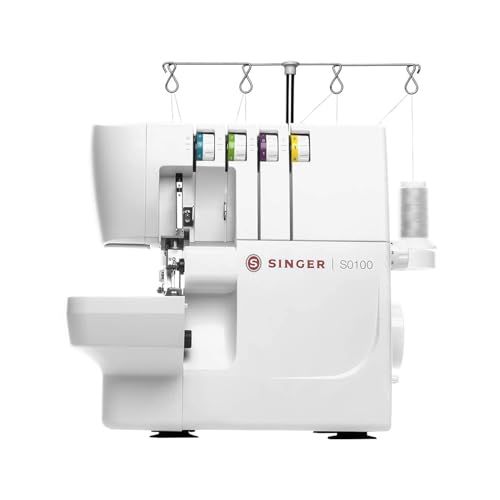
Singer High-Speed Overlock Serger
Best for: stable stitching on stretchy and delicate fabrics
- Thread Capability
- 2-3-4 thread
- Sewing Speed
- 1,300 stitches per minute
- Stitch Count
- 6
- Threading System
- Color-coded threading system
- Differential Feed
- Adjustable
- Frame Material
- Metal frame
The SINGER S0100 is a white serger with a metal frame and adjustable differential feed. It offers 2, 3, or 4 thread capabilities and 6 built-in stitches. The machine runs at 1,300 stitches per minute. Color-coded threading simplifies setup. It includes accessories like a foot controller and tweezers. This model suits you if you need a durable machine for stretchy or delicate fabrics.
- 1,300 stitches per minute speed
- Metal frame construction
- Adjustable differential feed
- Color-coded threading system
- 2-3-4 thread capability
- Lower stitch count than some competitors
- Heavier build at 13.5 pounds
- You sew stretchy knits or delicate sheers
- You want a metal frame for stability
- You prefer color-coded threading guides
- You need more than 6 built-in stitches
- You prefer a lighter machine under 10 pounds
- You require a computerized threading system
Verdict: SINGER S0100 High Speed Serger is a solid choice for sewers who prioritize a metal frame and adjustable differential feed for stable stitching on various fabrics.

Brother Metal Frame Coverstitch Serger
Best for: Durable coverstitching on stretch fabrics and hems
- Thread Capability
- 2-3-4
- Sewing Speed
- 1,100 stitches per minute
- Needle Count
- 2 needle
- Threading System
- Lay-in, color-coded guides
- Differential Feed
- 0.7 – 2.0 millimeter
- Frame Material
- Metal frame
The Brother 2340CV is a coverstitch serger built with a metal frame for durability. It sews at 1,100 stitches per minute, which is slower than many competitors on this list. It handles 2-3-4 thread configurations with a differential feed range of 0.7 to 2.0. The machine uses color-coded lay-in threading for easier setup. It suits users who need sturdy construction for stretch fabrics and hems.
- Metal frame construction for stability
- 1,100 stitches per minute maximum speed
- Color-coded lay-in threading system
- Differential feed adjustable from 0.7 to 2.0
- 1,100 stitches per minute is slower than the 1,250 to 1,300 SPM found on other models
- 13-pound weight makes it heavier than some lighter alternatives
- You need a dedicated machine for hemming and stretch fabrics
- You prefer a metal frame for long-term durability
- You want color-coded guides to simplify threading
- You require the highest possible sewing speed available
- You need a lightweight machine for easy transport
- You are looking for a multi-function serger with coverstitch capabilities
Verdict: Brother 2340CV Coverstitch Serger is a sturdy, metal-frame option for users prioritizing build quality over raw speed. It fits those who need reliable coverstitch performance for hems and stretch materials.

SINGER Professional 5-Thread Coverlock Serger
Best for: Heavy fabrics and high-volume production
- Thread Capability
- 2-3-4-5
- Sewing Speed
- 1,300 stitches per minute
- Threading System
- Threading diagram
- Frame Material
- Metal frame
- Dimensions
- 12.5 × 11 × 14 inches
- Weight
- 18.6 pounds
The Singer 14T968DC is a coverlock serger with a metal frame and 1,300 stitches per minute speed. It supports 2-3-4-5 thread capabilities for versatile stitching. The automatic tension system adjusts itself for balanced results. It includes a full accessory kit for setup and maintenance. This machine suits users who need durable construction and high-speed performance for heavy fabrics or large projects.
- 1,300 stitches per minute sewing speed
- 2-3-4-5 thread capability for versatile stitching
- Fully automatic self-adjusting tension system
- Metal frame for durability
- Includes comprehensive accessory kit
- Heavier at 18.6 pounds compared to lighter competitors
- Uses a threading diagram instead of a visual color-coded system
- Larger footprint at 12.5 inches in length
- You need a heavy-duty machine for thick materials
- You want automatic tension adjustments to simplify setup
- You prefer a metal frame for long-term stability
- You need a portable machine for travel
- You prefer a lighter unit under 15 pounds
- You want a machine with fewer than five thread options
Verdict: The Singer 14T968DC Heavy-Duty Serger fits users who prioritize a robust metal frame and high-speed performance for demanding projects. Its heavy build and large size make it a stationary workhorse rather than a portable tool.

MARGAR Metal Frame 3/4 Thread Serger
Best for: Durable metal frame construction and differential feed
- Thread Capability
- 3/4 thread
- Sewing Speed
- 1250 stitches per minute
- Stitch Count
- 12
- Threading System
- Color-coded guidelines
- Differential Feed
- Differential feed system
- Frame Material
- Metal frame
The MARGAR serger uses a metal frame for stability and reaches 1250 stitches per minute. It handles 3-thread and 4-thread overlocking with 12 stitch patterns. A differential feed system manages fabric stretch and wrinkling. Color-coded threading guides simplify setup. This machine suits sewers needing durable construction and versatile stitching options for various materials.
- Metal frame construction for durability
- 1250 stitches per minute speed
- Differential feed system prevents fabric distortion
- Color-coded threading guidelines
- Supports 3-thread and 4-thread capabilities
- 1250 stitches per minute is slower than the 1300 stitches per minute found in other models
- 19.8 pounds weight makes it heavier than lighter alternatives
- Limited to 12 stitch patterns compared to higher counts in other picks
- You need a metal frame for heavy-duty stability
- You require differential feed for knit fabrics
- You want 3-thread and 4-thread overlocking options
- You need speeds above 1250 stitches per minute
- You prefer a lightweight machine under 15 pounds
- You require more than 12 stitch patterns
Verdict: The MARGAR Metal Frame Serger fits sewers who prioritize a sturdy metal build and differential feed for handling stretch fabrics. It is a solid choice for those who do not require the highest speed or the widest variety of stitch patterns.
Specifications side by side
| Spec | Brother 3/4 Thread Overlock Serger | SINGER Heavy Duty Overlock Serger | VEVOR 2/3/4 Thread Serger Machine | Singer Free-Arm 2-3-4 Thread Serger | Singer High-Speed Overlock Serger | Brother Metal Frame Coverstitch Serger | SINGER Professional 5-Thread Coverlock Serger | MARGAR Metal Frame 3/4 Thread Serger |
|---|---|---|---|---|---|---|---|---|
| Thread Capability | 3 or 4 thread | 4/3/2 thread | 2/3/4-thread | 2, 3, and 4 thread | 2-3-4 thread | 2-3-4 | 2-3-4-5 | 3/4 thread |
| Sewing Speed | 1,300 stitches per minute | – | 1,250 SPM | 1300 stitches/min | 1,300 stitches per minute | 1,100 stitches per minute | 1,300 stitches per minute | 1250 stitches per minute |
| Stitch Count | – | 13 | – | – | 6 | – | – | 12 |
| Needle Count | – | – | – | – | – | 2 needle | – | – |
| Threading System | Color-coded upper thread guide | Color-coded threading | Color-coded threading | Color coded threading | Color-coded threading system | Lay-in, color-coded guides | Threading diagram | Color-coded guidelines |
| Differential Feed | – | Differential feed | 0.7–2.0 | Differential feed | Adjustable | 0.7 – 2.0 millimeter | – | Differential feed system |
| Frame Material | Metal frame | Metal frame | – | – | Metal frame | Metal frame | Metal frame | Metal frame |
| Intended Use | – | – | – | DIY | – | – | – | – |
| Stitch Type | – | – | – | – | – | Coverstitch | – | – |
| Features | – | Metal Frame, LED Light, Differential Feed | LED Light, Free Arm | LED Light, Differential Feed | Metal Frame, Differential Feed | – | Metal Frame | Metal Frame, LED Light |
| Suitable For | – | – | Small Business | DIY Projects | – | – | – | – |
| Dimensions | 10 × 11 × 13 inches | 11.3 × 10.9 × 12.2 inches | 11 × 12.6 × 12.6 inches | 13.2 × 11.3 × 12.4 inches | 4.33 × 3.94 × 4.33 inches | 15 × 14 × 12.9 inches | 12.5 × 11 × 14 inches | 10.2 × 11.8 × 10.2 inches |
| Weight | 8.02 pounds | – | 16.5 pounds | 13.9 pounds | 13.5 pounds | 13 pounds | 18.6 pounds | 19.8 pounds |
| Size | 10.98 x 11.73 x 13.19 inches | 11.3" x 12.2" x 10.9" | 12.6 x 11 x 12.6 in | Large | Serger | 2340CV + Snap-on Presser Foot | Coverlock | Large |
| Color | White | Beige | Cream | White01 | White | Trim Trap | White. | Orange |
| Model | 1034D | HD0420 | 336 | 14T968DC | S0100 Overlock Serger | 2340CV | 14T968DC | Large |
If you sew heavy outdoor materials for shade structures, you can read the canopy buying guide for frame specifications.
Frequently asked questions
What is the fastest sewing speed for a home serger?
Most models in this guide operate at 1300 stitches per minute. This speed supports efficient seam finishing for both home and small business use. The Brother 1034D, SINGER S14-78, and Singer Professional 5-Thread models all share this maximum rate. Higher speed helps you complete projects faster without sacrificing stitch quality on standard fabrics.
Do I need a metal frame for heavy fabrics?
Yes, a metal frame provides the stability needed for thick materials like denim. It reduces vibration and ensures straight seams during high-speed operation. The Brother 1034D, Singer HD0420, Singer S0100, and MARGAR models all feature metal frames. This construction is essential for maintaining precision when sewing dense textiles.
Which serger is best for stretch fabrics?
Look for a machine with differential feed to handle stretchy materials. This feature adjusts the feed rate to prevent puckering or stretching. The Singer HD0420, VEVOR 2/3/4 Thread, SINGER S14-78, and MARGAR models include differential feed. It ensures smooth, even seams on knits and jersey fabrics.
Can a serger sew 4 threads?
Several models support 2, 3, or 4 thread configurations. This flexibility allows you to choose the appropriate stitch strength and finish for your project. The VEVOR 2/3/4 Thread, SINGER S0100, and Brother 1034D all offer this capability. Four threads provide a stronger seam than three threads.
Is a free arm useful for garment construction?
A free arm makes it easier to sew tubular items like sleeves and pant legs. It allows you to work on circular seams without flattening the fabric. The VEVOR 2/3/4 Thread and SINGER S14-78 models feature free arms. This design simplifies fitting and hemming for DIY garment projects.
What is the weight range for these sergers?
Weights vary from 8 pounds to nearly 20 pounds depending on the build. Heavier machines with metal frames tend to be more stable but less portable. The Brother 1034D weighs 8.02 pounds, while the MARGAR model weighs 19.8 pounds. Consider your workspace and need for mobility when choosing.
How does color-coded threading help beginners?
Color-coded threading guides simplify the setup process by matching thread paths to visual cues. This reduces errors and saves time when threading multiple loops. The Singer HD0420, SINGER S14-78, and SINGER S0100 models feature this system. It is particularly helpful for new users learning complex thread configurations.
What size is a coverstitch serger?
Coverstitch models are generally larger and heavier than standard overlockers. The Brother 2340CV measures 14 inches wide and weighs 13 pounds. These machines are designed for stationary use on hems and stretch fabrics. Their larger footprint accommodates the additional mechanisms required for professional coverstitching.


