As Amazon Associates, we earn from qualifying purchases. This means we may receive a small commission at no extra cost to you if you click through and make a purchase.
As an Amazon Associate we earn from qualifying purchases. Links on this page are affiliate links.
You are comparing the SINGER vs JUKI serger for overlocking tasks. Both machines handle knit and woven fabrics with differential feed to prevent stretching or puckering. The main difference lies in their construction and threading systems. SINGER uses a metal frame with color-coded threading, while JUKI features lay-in tensions and automatic looper threading. You need to decide which setup fits your workflow.
Stitch Count
13
not listed
Frame Material
Metal frame
not listed
Threading System
Color-coded threading
Automatic lower looper, lay-in
Included Accessories
Includes presser foot, spool holders, tweezers, 2-thread converter, screwdriver, lint brush, oil, spare blade, needles, dust cover
not listed
Special Features
Large cutting blade
Built in rolled hem, adjustable calibrated knife
Choose the first if
- You prefer a metal frame for stability on heavy fabrics
- You want color-coded threading for easier setup
- You need a large cutting blade for thick layers
Choose the second if
- You want automatic lower looper threading
- You need built-in rolled hem capability
- You prefer lay-in tension settings
Verdict
Choose the SINGER if you value a metal frame and color-coded threading for heavy-duty stability. Pick the JUKI if you prefer automatic looper threading and built-in rolled hem features. Both machines offer differential feed for balanced seams on knits and wovens.
SINGER vs JUKI Serger Specs
Stitch versatility
Edge: SINGER Heavy Duty Overlock Serger
The SINGER Heavy Duty Overlock Serger offers 13 distinct stitch options. It supports 4, 3, or 2-thread configurations, allowing for overlocking, flatlocking, and rolled hems. This variety helps you handle garments, linens, and crafts with clean finishes. The JUKI MO-50E focuses on 3 or 4-thread capabilities. While it includes a built-in rolled hem, it does not list the same breadth of stitch types as the SINGER. If you need diverse decorative or structural seams, the SINGER provides more choices. The JUKI sticks to standard serger functions.
Build and stability
Edge: SINGER Heavy Duty Overlock Serger
Construction quality often dictates long-term reliability. The SINGER model features a full metal interior frame and a heavy-duty motor. This setup delivers strong piercing power and keeps the machine steady during heavy use. It supports thicker layers and home décor projects without wobbling. The JUKI MO-50E weighs 16 pounds, suggesting a solid build, but the data does not specify its internal frame material. SINGER explicitly highlights its metal frame and motor strength. For users prioritizing rigid stability and heavy-duty performance, the SINGER’s construction details offer clearer assurance.
Threading ease
Edge: Tie
Threading can be the most tedious part of serger use. The SINGER uses a color-coded threading system to guide you through setup. This visual aid helps prevent errors when loading threads. The JUKI MO-50E takes a different approach with lay-in tensions and an automatic lower looper threader. The automatic threader can significantly reduce setup time for the lower looper. If you prefer visual guides, SINGER is better. If you want mechanical assistance to speed up threading, the JUKI’s automatic feature is a practical advantage.
Cutting performance
Edge: SINGER Heavy Duty Overlock Serger
The blade design affects seam edge quality. The SINGER Heavy Duty Overlock Serger includes a large cutting blade. This feature enhances cutting performance, especially when working with heavier fabrics or thick layers. It helps trim excess fabric cleanly for neat edges. The JUKI MO-50E features an adjustable calibrated knife. This allows for precise blade positioning, which is useful for specific stitch widths. The data does not specify the blade size for the JUKI. SINGER’s large blade is explicitly noted for handling tough materials, giving it an edge in heavy fabric scenarios.
Included accessories
Edge: SINGER Heavy Duty Overlock Serger
What comes in the box matters for immediate use. The SINGER package includes a standard presser foot, spool holders, tweezers, a 2-thread converter, screwdriver, lint brush, sewing machine oil, a spare lower-cutter knife blade, needles, and a soft dust cover. These items support setup, maintenance, and storage. The JUKI MO-50E data does not list included accessories. You may need to purchase additional tools or consumables separately for the JUKI. The SINGER provides a comprehensive kit that covers most basic needs right out of the box.
Which serger fits your workflow best
You need stitch variety and metal durability
Our pick: SINGER Heavy Duty Overlock Serger
The SINGER model features a full metal interior frame for stable operation on thick layers. It offers 13 stitch options across 4, 3, or 2-thread configurations. The large cutting blade handles heavier fabrics cleanly. Color-coded threading simplifies setup. You get differential feed to manage knits without stretching.
You prefer automatic threading for speed
Our pick: JUKI 3 or 4 Thread Serger
The JUKI serger includes an automatic lower looper threader to save time during setup. It supports 3 or 4-thread capabilities with lay-in tensions for quick adjustments. The adjustable calibrated knife ensures precise trimming. Built-in rolled hem functionality is ready for immediate use without extra converters or complex modifications.
You want simple controls and compact size
Our pick: JUKI 3 or 4 Thread Serger
The JUKI MO-50E has a compact footprint measuring 11.5 by 11.5 inches. Its lay-in tension system allows for straightforward manual adjustments without complex dials. The adjustable differential feed helps prevent puckering on delicate fabrics. This model focuses on essential serging functions with a straightforward interface for consistent results.

SINGER Heavy Duty Overlock Serger
Best for: Heavy fabric sewing and durable construction
- Thread Capability
- 4/3/2 thread
- Stitch Count
- 13
- Threading System
- Color-coded threading
- Differential Feed
- Differential feed
- Frame Material
- Metal frame
- Features
- Metal Frame, LED Light, Differential Feed
The Singer Heavy Duty 0420 serger features a full metal frame and a heavy-duty motor for stable stitching on thick layers. It offers 13 stitch options with 4, 3, or 2-thread capability. The large cutting blade trims heavier fabrics cleanly, while differential feed control prevents puckering on knits. This machine suits sewers who need durable construction and versatile finishing options for garments and home décor projects.
- Full metal interior frame for stable support
- 13 stitch options including rolled hems
- Large cutting blade for clean edges
- Differential feed control reduces stretching
- Fewer stitch options than the Juki MO-50E
- Larger physical footprint than compact alternatives
- You sew heavy fabrics like denim or canvas
- You need a durable metal-frame machine
- You want 13 stitch variations for finishing
- You require more than 13 stitch patterns
- You need a compact machine for small spaces
- You prefer a simpler 2-thread only setup
Verdict: The Singer Heavy Duty 0420 Serger is a robust option for users who prioritize a metal frame and strong motor power for heavy fabrics. It fits those who need a versatile range of 13 stitches and clean trimming on thick materials.

JUKI 3 or 4 Thread Serger
Best for: stable home serging with automatic threading
- Thread Capability
- 3 or 4 thread
- Threading System
- Automatic lower looper, lay-in
- Differential Feed
- Adjustable differential feed
- Dimensions
- 11.5 × 11.5 × 11.4 inches
- Weight
- 16 pounds
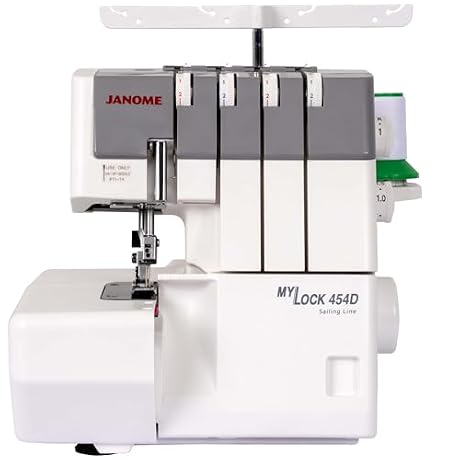
The Juki MO-50E is a white serger weighing 16 pounds with dimensions of 11.5 by 11.4 by 11.5 inches. It handles 3 or 4 thread projects using a lay-in tension system and an automatic lower looper threader. You get adjustable differential feed and a built-in rolled hem function. This machine suits users who need reliable automatic threading and versatile stitch options for home sewing tasks.
- Automatic lower looper threader
- Built-in rolled hem
- Adjustable differential feed
- Lay-in tension system
- Heavier at 16 pounds compared to the 13-pound SINGER model
- Fewer thread options than the SINGER 420 Next Evolution
- You want automatic lower looper threading
- You need a built-in rolled hem
- You prefer a heavier, stable machine
- You need the lightest possible serger
- You require more than 3 or 4 thread capabilities
- You prefer a more compact footprint
Verdict: The Juki MO-50E Serger is a solid choice for sewers who value automatic threading and stable performance over portability.
Specifications side by side
| Spec | SINGER Heavy Duty Overlock Serger | JUKI 3 or 4 Thread Serger |
|---|---|---|
| Thread Capability | 4/3/2 thread | 3 or 4 thread |
| Stitch Count | 13 | – |
| Threading System | Color-coded threading | Automatic lower looper, lay-in |
| Differential Feed | Differential feed | Adjustable differential feed |
| Frame Material | Metal frame | – |
| Features | Metal Frame, LED Light, Differential Feed | Differential Feed |
| Dimensions | 11.3 × 10.9 × 12.2 inches | 11.5 × 11.5 × 11.4 inches |
| Weight | – | 16 pounds |
| Size | 11.3" x 12.2" x 10.9" | – |
| Color | Beige | White |
| Model | HD0420 | MO-50E/UL |
Frequently asked questions
Which serger is better for heavy fabrics?
The SINGER Heavy Duty Overlock Serger is the better choice for thick materials. It features a metal frame and a strong motor designed for durability. This construction helps it handle heavy fabrics without wobbling or straining the machine during use.
Does the JUKI serger have automatic threading?
Yes, the JUKI 3 or 4 Thread Serger includes automatic threading capabilities. This feature simplifies setup and reduces frustration for users who want to start sewing quickly without manually guiding threads through multiple guides and tension discs.
How do the dimensions compare between these two models?
The SINGER model measures 11.3 inches in length, 12.2 inches in height, and 10.9 inches in width. The JUKI unit is slightly wider at 11.5 inches square with a height of 11.4 inches. Both require a stable table space for operation.
What threading system does the SINGER serger use?
The SINGER Heavy Duty Overlock Serger utilizes a color-coded threading system. This visual aid helps you identify the correct path for each thread, reducing errors during setup and ensuring proper tension for clean overlock stitches on various fabric types.
Is differential feed available on both machines?
Yes, both the SINGER and JUKI sergers include differential feed. This mechanism allows you to adjust the feed dogs relative to each other, preventing fabric stretching or puckering, which is essential for maintaining consistent stitch quality on knit and woven materials.
Which serger is heavier and more stable?
The JUKI 3 or 4 Thread Serger weighs 16 pounds, providing significant mass for stability. The SINGER model emphasizes a metal frame for rigidity. Both designs aim to minimize vibration, though the JUKI relies on its overall weight for steady performance.
What stitch options does the SINGER model offer?
The SINGER Heavy Duty Overlock Serger provides 13 distinct stitch options. It supports 4, 3, or 2-thread configurations, allowing for versatile finishes including overlocking, flatlocking, and rolled hems. This variety suits a wide range of garment and craft projects.