As Amazon Associates, we earn from qualifying purchases. This means we may receive a small commission at no extra cost to you if you click through and make a purchase.
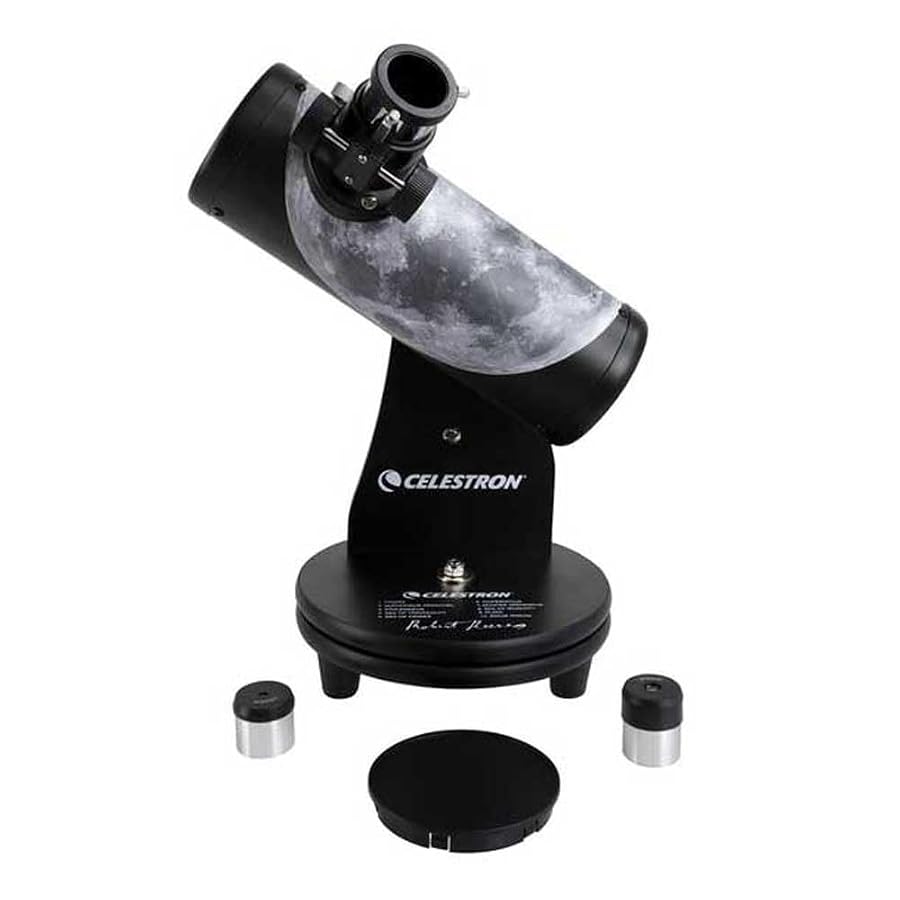
For hobbyists looking into a compact celestial instrument, finding a grab-and-go optical tube that does not require tedious tripod assembly is a major priority. If you have been researching a compact setup or looking up the celestron moon tabletop dobsonian line, the Celestron FirstScope Moon serves as an accessible entry point centered specifically on effortless lunar exploration. Featuring a custom lunar surface wrap designed in collaboration with master lunar photographer Robert Reeves, this signature tabletop reflector strips away the mechanical friction of computerized tracking, counterweights, and polar alignment. Instead, it delivers a direct, wide-field optical window designed to sit on a patio table, bench, or railing, letting you study lunar Maria and prominent craters within moments of stepping outside.
Choosing the right compact telescope comes down to understanding the realistic optical ceiling of a 76mm reflector and whether manual tabletop navigation matches your observing habits. Rather than overpromising on deep-space imaging capabilities, this guide breaks down the core optical mechanics, build quality, included 20mm and 4mm eyepieces, and real-world tabletop handling. In the following sections, we examine the telescope’s specifications, unpack the box contents, evaluate field portability, and determine how this specialized signature edition performs for casual backyard observers.
What You Get With the Celestron FirstScope Moon
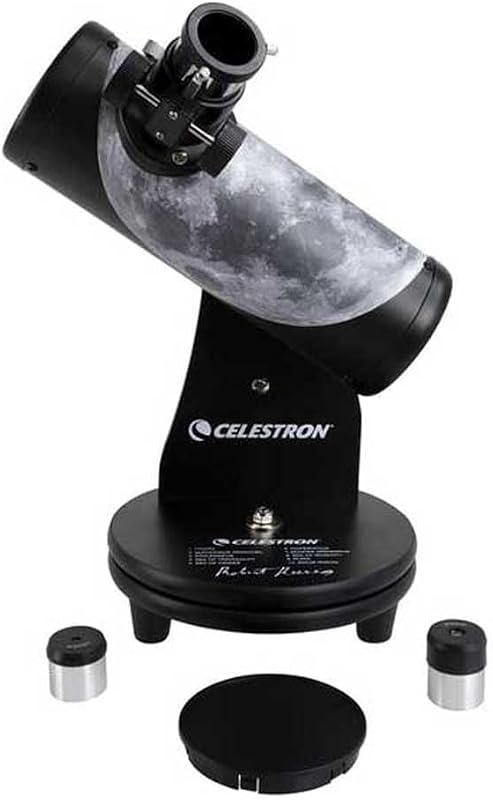
The Celestron FirstScope Moon arrives as an all-in-one package designed for immediate deployment straight out of the box without complicated assembly tools or auxiliary mounting hardware.
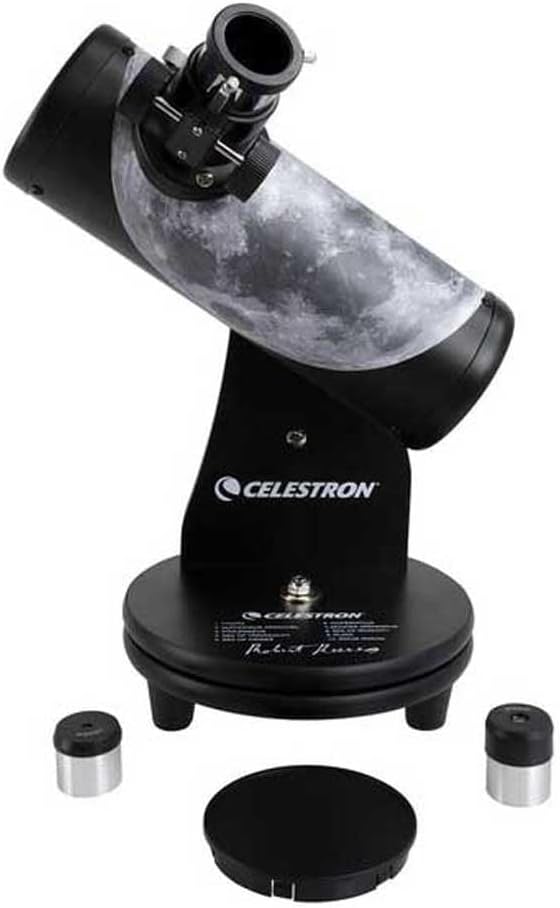
- Celestron 76mm tabletop telescope optical tube assembly featuring custom Robert Reeves Moon map artwork
- Pre-assembled manual tabletop Dobsonian mount with smooth 360-degree azimuth rotation
- 20mm eyepiece providing wide-field viewing at 15x magnification
- 4mm eyepiece delivering higher-power lunar detail at 75x magnification
- High-reflectivity primary spherical mirror treated with protective aluminum and silicon dioxide (SiO2) optical coatings
- Manual rack-and-pinion focuser mechanism compatible with standard 1.25-inch eyepieces
- Celestron 2-year US warranty backed by unlimited support from US-based technical experts
Key Specifications
| Specification Attribute | Manufacturer Detail |
|---|---|
| Optical Design | Tabletop Dobsonian Reflector (Spherical Glass Mirror) |
| Objective Lens Diameter | 7.6 cm (76 mm) |
| Focal Length | 300 mm (12 inches) |
| Optical Tube Length | 26.6 cm (10.5 inches) |
| Mount Type | Manual Tabletop Dobsonian |
| Included Eyepieces | 20 mm (15x) and 4 mm (75x) |
| Field of View | 1.3 degrees |
| Dawes Limit | 1.53 arc seconds |
| Optical Coatings | Aluminum with SiO2 Protective Overcoat |
| Total Weight | 4.3 lbs (1.95 kg) |
| Base Dimensions | 9″ D x 9″ W x 18″ H |
| Power Source | Fully Manual Operation |
Optical Performance for Tabletop Lunar Observing
Tabletop dobsonian lunar observing requires clear expectations regarding aperture, mirror shape, and focal length. At 76mm of aperture, the primary spherical glass mirror collects sufficient light to deliver crisp, bright views of our nearest celestial neighbor. Prominent impact craters such as Tycho and Copernicus, the expansive basaltic plains of the lunar Maria, and the stark shadow play along the lunar terminator line present themselves with satisfying visual contrast. Because the optical assembly utilizes an aluminum reflective coating protected with silicon dioxide (SiO2), the internal mirror surfaces resist oxidation and environmental degradation over years of casual porch viewing. The 1.53 arc-second Dawes limit establishes a respectable resolving threshold, making it easy to identify individual mountain ridges and distinct crater floors along the lunar surface.
While engineered as a portable moon observation telescope, the 300mm focal length creates a fast optical system that yields a panoramic 1.3-degree field of view with the included low-power optic. This wide vantage makes scanning rich star fields straightforward even without motorized guiding. The manufacturer notes that observers can pan through the dense star clouds of the Milky Way, resolve sparkling open clusters like the Pleiades, or glimpse bright emission targets like the Orion Nebula under darker skies. You can also catch glimpses of Saturn’s ring system, though observers should understand that a 76mm reflector renders Saturn as a tiny, bright disc with an encircling ring rather than a high-definition planetary portrait. Those curious about comparing optical configurations in this footprint can reference our analysis of the classic celestron firstscope 76 to understand how entry-level Newtonian mirrors handle varied deep-sky targets.
The visual presentation benefits directly from the educational wrap adorning the exterior of the optical tube. Designed in partnership with veteran astrophotographer Robert Reeves, this signature wrap acts as a real-time field guide to lunar geography. Key craters, mountain ranges, and Apollo landing sites are marked along the tube exterior. Instead of juggling a smartphone screen that destroys your night vision or managing oversized paper charts in a dark yard, you can cross-reference the lunar features visible through the eyepiece against the illustrated optical tube in real time. This Robert Reeves firstscope review highlight elevates the unit beyond a simple optic into an interactive educational map.
Portability and Tabletop Mechanical Stability
Weighing in at just 4.3 pounds and measuring 9 inches deep by 9 inches wide by 18 inches high, the entire instrument embodies grab-and-go convenience. The optical tube length measures only 26.6 centimeters, making the complete assembly compact enough to sit on an office desk, tuck into a travel duffel, or rest on an outdoor picnic bench. Unlike full-sized equatorially mounted telescopes that require counterweights, tripod legs, and multi-step balance routines, this unit moves as a single unified piece. For apartment dwellers with modest balconies or travelers packing gear for weekend getaways, the minimal physical footprint eliminates the logistical hurdles that often keep heavier telescope gear sitting unused indoors.
The manual Dobsonian base relies on a smooth-rotating azimuth turntable and an altitude pivot knob. Because the center of mass remains low to the mounting surface, the base naturally dampens the high-frequency vibrations that frequently plague budget tripods. When placed on a rigid exterior surface—such as a concrete picnic table, a sturdy deck railing, or a flat stone garden wall—the mount holds its position reliably during manual tracking. However, because the unit lacks extending tripod legs, finding a solid, level surface at a comfortable viewing height is mandatory. Operating the telescope from an unstable camp table or the uneven ground will cause frustrating visual wobble and neck fatigue.
When evaluated against larger tabletop instruments such as the sky watcher heritage 150p, the FirstScope Moon deliberately prioritizes extreme portability over sheer light grasp. While larger truss-tube tabletop telescopes pull in fainter deep-sky fuzzies, they add substantial weight, mechanical complexity, and bulk. This 76mm signature edition keeps mechanical mass to an absolute minimum, ensuring that taking the telescope outside for a fifteen-minute look at the moon after dinner requires zero mental hesitation.
Celestron FirstScope Moon Edition Setup and Usability Workflow
The celestron firstscope moon edition setup represents one of the fastest workflows available in consumer observational astronomy. The telescope arrives fully assembled in the box, requiring no tools, batteries, or polar alignment. To begin observing, you place the circular base onto a stable elevated platform, remove the protective front dust cap from the optical tube, and insert your chosen 1.25-inch eyepiece into the focuser drawtube. Operating the mount is purely manual: you gently push the optical tube sideways to rotate along the azimuth axis and tilt it up or down to set the viewing altitude. A large tension knob on the side allows you to tighten or loosen altitude friction to prevent the tube from sagging when pointing upward.
One critical detail found in the celestron firstscope moon specs is that a finderscope is not included with this telescope. On narrow-field optical tubes, pointing without an aiming sight can be challenging. However, with the 300mm focal length paired with the 20mm eyepiece, the telescope yields a broad 1.3-degree field of view that makes direct tube sighting practical for bright targets. By sighting along the top edge of the optical tube like a gun sight, centering the Moon or a bright planet like Jupiter requires only a few moments of manual adjustment. For scanning wider constellations or finding faint reference stars before pointing the telescope, observers often supplement their workflow with wide-angle handheld optics like the celestron nature dx 12×56 binoculars to plan their path across the night sky.
This intuitive, friction-based navigation makes the instrument an outstanding celestron moon telescope for beginners and young learners. There are no delicate motorized gears that risk stripping if someone bumps the optical tube, and no complicated alignment stars to calibrate before the Moon comes into focus. The smooth manual focus wheels move the eyepiece drawtube predictably, providing sufficient tactile sensitivity to snap lunar crater rims and mountain shadows into sharp focus even when wearing thin winter gloves on chilly evenings.
Managing Eyepieces and Magnification Limits
Celestron supplies two distinct eyepieces with this signature telescope: a 20mm eyepiece and a 4mm eyepiece. Because telescope magnification is calculated by dividing the optical tube focal length by the eyepiece focal length, the included optics produce 15x and 75x magnification respectively. The 20mm eyepiece is the workhorse optic for this instrument. At 15x, it produces a wide, bright image with a comfortable 3.17mm exit pupil diameter. This configuration captures the entire lunar disc within the field of view, presenting a sharp, high-contrast portrait where the Moon floats against a rich black backdrop. The wide exit pupil also makes eye placement forgiving, preventing the distracting blackouts that novice observers often encounter with high-power lenses.
Stepping up to the 4mm eyepiece boosts the magnification to 75x, pulling the observer directly into individual crater walls, central peaks, and dramatic crater complexes along the terminator. However, pushing a 76mm reflector to 75x introduces real optical and mechanical compromises. The exit pupil narrows significantly, requiring very steady, centered eye alignment to maintain the image. Additionally, overall image brightness decreases, and the natural rotation of the Earth causes targets to drift across the narrow field of view quickly. Keeping the Moon centered at 75x demands frequent, gentle manual nudges on the optical tube, which can introduce momentary vibrations until the mount settles.
To maximize optical clarity and avoid frustration, observers should always adopt a disciplined workflow. Begin every observing session with the 20mm eyepiece to locate, center, and appreciate the broad lunar landscape. Once your target crater or mountain range is perfectly centered in the middle of the field, swap in the 4mm eyepiece and gently readjust the manual focus knobs. Reserving the 4mm optic for nights with calm atmospheric seeing will yield the cleanest high-magnification views of lunar topography.
Check Celestron FirstScope Moon on Amazon
Is the Celestron FirstScope Worth It
Answering whether the Celestron FirstScope Moon is worth it depends heavily on your expectations and intended use case. If you are searching for an optical powerhouse capable of resolving distant planetary nebulae, splitting tight binary stars, or conducting long-exposure astrophotography, this 76mm tabletop telescope is not the correct tool. Its compact spherical mirror, manual tracking, and modest light grasp are fundamentally tailored for bright sky objects and wide-angle browsing rather than deep-sky research.
However, for creators, hobbyists, families, and casual skywatchers who want an accessible, dependable telescope that can be set up in under sixty seconds, this instrument offers exceptional practical value. The collaboration with Robert Reeves elevates the aesthetic appeal, turning the telescope into an attractive display piece for an office, studio, or bookshelf when not in use under the stars. The solid wooden Dobsonian base, durable aluminum with SiO2 mirror coatings, and standard 1.25-inch eyepiece compatibility ensure long-term utility without mechanical headaches.
Ultimately, the most effective telescope is the one that gets used regularly rather than stored away in an attic. Where complex tripod systems often discourage quick observing sessions due to cumbersome breakdown procedures, the 4.3-pound FirstScope Moon can be carried outside in one hand whenever the sky clears. For hassle-free lunar viewing, casual planetary checks, and introducing newcomers to the basics of stargazing, it remains a charming and functional tabletop companion.
FAQ
Does the Celestron FirstScope Moon include a finderscope?
No, the listing specifies that a finderscope is not included in the package. Because the telescope features a short 300mm focal length, pairing it with the included 20mm eyepiece delivers an expansive 1.3-degree field of view. This wide vantage allows observers to aim the optical tube toward bright targets like the Moon by sighting along the tube barrel directly.
Can I use standard aftermarket eyepieces with this telescope?
Yes. The manual focuser on the Celestron FirstScope Moon accommodates standard 1.25-inch eyepieces. While the included 20mm and 4mm eyepieces cover 15x wide-angle and 75x high-magnification viewing, you can insert any standard 1.25-inch astronomical eyepiece or Barlow lens to customize your magnification range.
Does this tabletop Dobsonian require batteries or power cords?
No external power source, motor drive, or battery pack is required. The Celestron FirstScope Moon operates entirely through manual mechanical motion. You navigate the night sky by hand, rotating the base horizontally along the azimuth axis and tilting the optical tube vertically along the altitude axis.
What celestial objects can you see besides the Moon?
In addition to detailed views of lunar craters and mountain ranges, the 76mm aperture and wide field of view allow you to view bright open star clusters like the Pleiades, pan the dense star clouds of the Milky Way, spot the Orion Nebula, and observe the distinct shape of Saturn’s rings as a compact disc.
How much does the telescope weigh for travel and storage?
The entire assembled telescope weighs just 4.3 pounds (approximately 1.95 kilograms). With physical base dimensions of 9 inches deep by 9 inches wide and a total height of 18 inches, the unit is easily portable in a small duffel bag or backpack for camping trips and balcony observing.


