As Amazon Associates, we earn from qualifying purchases. This means we may receive a small commission at no extra cost to you if you click through and make a purchase.
Selecting full-sized observation optics comes down to balancing raw light-gathering capability with practical handling in the field. The Celestron Nature DX 12×56 is designed specifically for outdoor observers who need extended reach and superior twilight performance without moving up to a dedicated spotting scope. By pairing a powerful 12x magnification with massive 56mm objective lenses, this model targets distant wildlife scouting, dawn-to-dusk bird monitoring, and open-terrain glassing where standard compact binoculars run out of resolving power. Buyers should expect a specialized optical configuration that prioritizes brightness and subject detail over pocket-sized convenience, making it a distinct choice within the broader Nature DX series.
This Celestron Nature DX 12×56 review examines how the optical layout, housing construction, and mechanical specifications translate to real-world stationary viewing workflows. We researched the listing, the specifications, and intended use cases to evaluate how the physical dimensions and 12x magnification affect handheld stability, image clarity, and long-range scanning. In the sections below, you will find a full breakdown of the included hardware, an itemized specifications table, an assessment of field tracking trade-offs, and clear guidance on whether this high-magnification binocular matches your observation style.
What You Get With the Celestron Nature DX 12×56

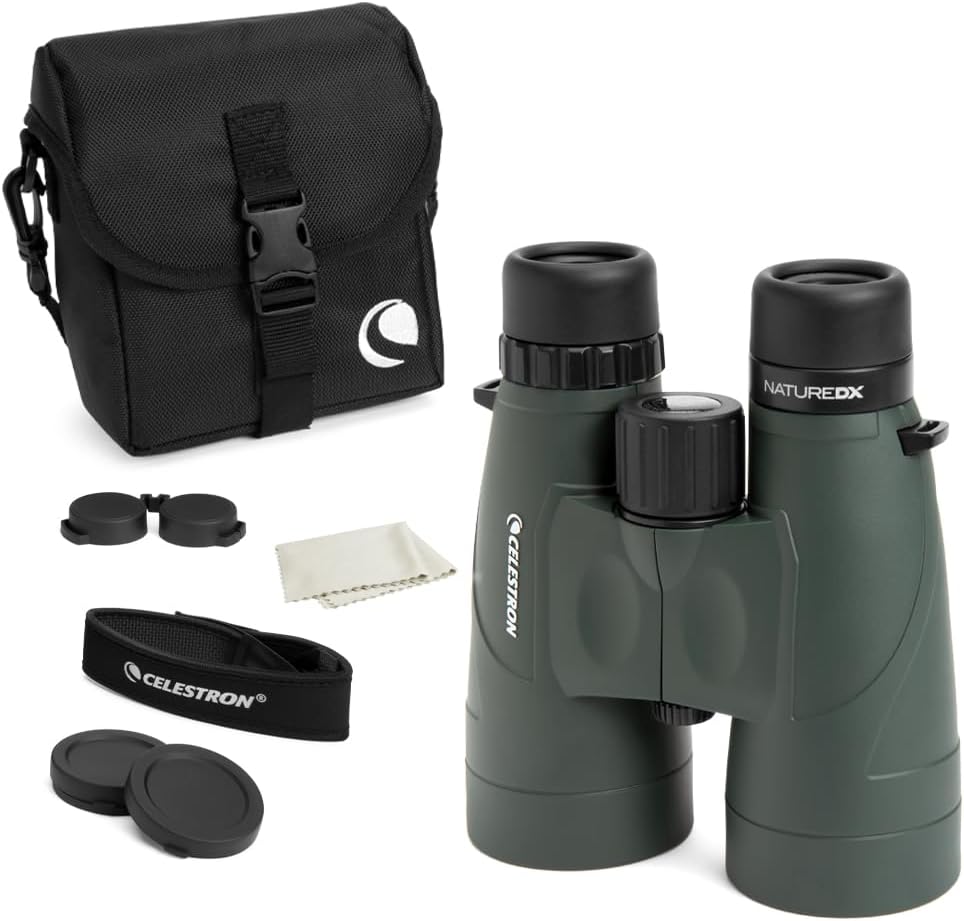
Based on the manufacturer listing, the binocular is built as a complete observation instrument supported by dedicated factory backing. While the listing does not specify individual soft accessories such as carry pouches, lens covers, or neck straps in its itemized feature list, it highlights the primary physical chassis and core warranty protections included with your purchase.
- Celestron Nature DX 12×56 binocular optical assembly with 56mm objective lenses and rubber-armored housing
- Fully multi-coated glass elements engineered to maximize light transmission across variable field conditions
- Phase-coated BaK-4 prisms designed to boost contrast, resolution, and true-to-life color rendering
- Nitrogen-purged optical barrels providing internal fog resistance in humid or rapidly changing weather
- Integrated center focus wheel and a dedicated ±3 right-eye diopter adjustment ring for individual eye calibration
- Built-in threaded tripod adapter socket for mounting the chassis to stationary field supports
- Celestron Limited Lifetime US Warranty covering manufacturing defects and long-term durability
- Access to US-based expert technical support directly from Celestron
Key Specifications
| Attribute | Detail |
|---|---|
| Magnification | 12x |
| Objective Lens Diameter | 56 mm (5.6 cm) |
| Prism System | BaK-4 (Phase-Coated) / Porro Prism listed in specs |
| Lens Coating | Fully Multi-Coated |
| Field of View | 289 feet (5.5° angular field of view) |
| Exit Pupil | 4.6 mm |
| Eye Relief | 16 mm |
| Relative Brightness | 21.16 |
| Focus System | Center focus (manual) with ±3 diopter range |
| Weatherproofing | Waterproof and nitrogen-purged |
| Dimensions | 5 inches L x 4.9 inches W x 1.8 inches H |
Low-Light Performance and Optical Brightness
The defining design element of this optic is the pairing of large 56mm objective lenses with specialized glass treatments. In field environments where available ambient illumination drops rapidly, such as heavy forest canopies or open valleys at sunset, larger objectives collect significantly more photons than standard compact lenses. Observers who regularly evaluate smaller models like the Celestron Nature DX ED 8×42 will note that while 42mm lenses are easier to carry, the jump to 56mm glass provides a wider light cone that maintains viewable clarity deeper into twilight. The manufacturer lists an exit pupil diameter of 4.6 millimeters and a relative brightness rating of 21.16, confirming that this optical design aims directly at high-efficiency twilight transmission.
Raw objective size only matters if the internal elements preserve that incoming light, which is where the Celestron Nature DX 12×56 BaK-4 prisms come into play. Prisms made from dense barium crown glass minimize internal light scatter and prevent edge distortion across the field. Celestron enhances these prisms with specialized phase coatings, a crucial treatment that corrects the phase shifts that naturally occur when light waves reflect inside roof or Porro prism assemblies. As a result, the optical path maintains crisp edge definition and color fidelity, preventing the washed-out or hazy look that can plague budget high-magnification instruments.
In addition to prism coatings, the optical stack features fully multi-coated surfaces on all air-to-glass boundaries. Multiple anti-reflective coatings ensure that light passes cleanly through the objective lenses to your eyes rather than reflecting off the glass faces. For observers engaged in Celestron Nature DX 12×56 low light observation, this combination of coatings and glass diameter translates to high-contrast views of subtle animal plumage, antler structure, or distant treeline movements when lesser optics render the scene in muddy gray tones.
Magnification Stability and Tripod Workflow
A 12x magnification provides substantial pulling power, bringing faraway subjects into sharp relief. However, higher magnification inevitably introduces physical handling challenges that every field observer must navigate. At 12x, the natural micro-tremors of your hands, arms, and breathing are magnified twelve times over, creating visible image jitter that can obscure fine details during handheld scanning. While short bursts of handheld viewing are entirely feasible for quick checks, sustained observation of a distant hillside requires either a steady resting position or dedicated hardware support.
This dynamic makes the Celestron Nature DX 12×56 tripod mount capability a central feature of the overall workflow. The housing incorporates a built-in tripod adapter socket located at the front of the central hinge bridge. By attaching a standard binocular tripod adapter (which the listing notes is sold separately), you can lock the optic onto a fluid head or photo tripod. Much like the stationary stability required when glassing with premium long-range gear such as Vortex Razor UHD binoculars, mounting this binocular transforms the user experience from fighting hand fatigue to executing methodical, shake-free scans across distant ridgelines.
Mechanical adjustments on the binocular support this steady, focused viewing style. The center focus wheel allows for smooth manual adjustments across the focal range, while the right-eye diopter adjustment ring offers a ±3 range to compensate for natural vision discrepancies between your eyes. With 16 millimeters of eye relief, observers who wear eyeglasses can maintain the full viewing circle without removing their correction lenses, making extended stationary viewing sessions comfortable and ergonomically sustainable.
Field of View and Moving Subject Tracking
Optical design is always an exercise in balancing magnification against spatial awareness. The Celestron Nature DX 12×56 field of view measures 289 feet across at standard distances, correlating to an angular field of view of 5.5 degrees. When compared to lower-power 8x or 10x models, a 5.5-degree field represents a tighter observation window. You see greater detail on a specific subject, but you see less surrounding landscape in a single glance. Understanding this trade-off is critical for determining whether this optic suits your scouting cadence.
For birding enthusiasts, using the Celestron Nature DX 12×56 for birding presents clear operational strengths and distinct limitations. When tracking small songbirds that dart rapidly through thick brush, the narrower 5.5-degree frame makes rapid subject acquisition more challenging. However, when observing raptors perched on high telephone poles, waterfowl congregated on expansive lakes, or shorebirds across wide mudflats, the 12x magnification delivers critical identification detail on feather patterns and bill shapes that an 8x binocular simply cannot resolve without heavy cropping from a camera.
The extended reach also makes this model a powerful candidate for Celestron Nature DX 12×56 wildlife spotting across agricultural fields, clear-cuts, and desert washes. Stationary scouts scanning a far tree line can systematically grid the terrain without moving their post. Outdoor observers who also enjoy wide-field astronomy can sweep star clusters and lunar craters with this setup, functioning in a supportive role alongside specialized sky instruments such as the Celestron StarSense DX 102AZ when planning nocturnal viewing sessions.
Weather Resistance and Chassis Durability
Field optics must endure harsh outdoor environments, and Celestron built this chassis to withstand routine trail exposure. The exterior shell is constructed from a lightweight polycarbonate housing encased in protective rubber armoring. This rubber coating serves a dual purpose: it provides a tactile, non-slip grip in wet or cold conditions, and it buffers internal optical alignments against the inevitable bumps, knocks, and vibrations that happen when transporting gear in a pack or vehicle.
Environmental sealing is another essential component of the Celestron Nature DX 12×56 specs. The optical barrels are waterproofed against direct moisture exposure, including steady rain, melting snow, and heavy dew. Furthermore, the internal air has been evacuated and replaced with dry nitrogen gas. Nitrogen purging eliminates internal moisture, ensuring that the internal glass elements will not fog over when you transition rapidly between warm vehicle interiors and cold dawn air, or when moving through humid marshlands.
Despite housing 56mm objective lenses, the listing specifies compact exterior measurements of 5 inches in length, 4.9 inches in width, and 1.8 inches in height. This form factor keeps the chassis relatively manageable for storage inside a daypack or chest harness compared to bulky vintage Porro designs. While the large glass front elements give it front-weighted balance, the durable polycarbonate skeleton keeps overall bulk in check for observers who prefer to travel light while maintaining serious low-light optical power.
Check Celestron Nature DX 12×56 on Amazon
Is the Celestron Nature DX 12×56 Worth It
Deciding if the Celestron Nature DX 12×56 is worth it depends entirely on your primary observation discipline and whether your workflow accommodates stationary glassing. If your outdoor activities focus on dawn and dusk scouting, observing distant waterfowl across open water, monitoring distant game across open meadows, or stationary viewing from a blind, this binocular delivers exceptional light-gathering capability and sharp 12x magnification that outclasses typical 42mm optics in dim conditions.
Conversely, mobile hikers, active stalkers, and deep-woods birders who prioritize fast hand-tracking and lightweight packability may find the 12x magnification and narrower field of view cumbersome. For fast-moving subjects at close quarters, an 8x or 10x binocular with a broader field of view offers quicker target acquisition and less hand-induced jitter without the need to carry a tripod adapter or stationary support.
When evaluated strictly against its intended purpose, the Nature DX 12×56 fills a valuable niche between standard handheld binoculars and dedicated spotting scopes. The combination of fully multi-coated optics, phase-corrected BaK-4 prisms, rugged nitrogen-purged weatherproofing, and Celestron’s limited lifetime warranty makes it a high-value tool for dedicated stationary observers who refuse to let fading daylight end their viewing sessions.
FAQ
Can the Celestron Nature DX 12×56 be used handheld without a tripod?
Yes, the binocular can be operated handheld for quick scans and immediate subject checks. However, because 12x magnification amplifies minor hand movements, extended viewing sessions will cause noticeable image shake. To resolve fine details over long periods, resting your elbows on a solid surface or mounting the unit to a tripod is highly recommended.
How well does the Celestron Nature DX 12×56 perform in low light?
The unit excels in low light thanks to its large 56mm objective lenses, fully multi-coated glass, and phase-coated BaK-4 prisms. With a relative brightness factor of 21.16 and a 4.6mm exit pupil, it gathers substantial light, delivering bright, high-contrast images during dawn, dusk, and beneath heavy forest canopies.
Does the Celestron Nature DX 12×56 come with a tripod adapter included?
No, the listing specifies that while the binocular features a built-in tripod adapter socket, the tripod adapter itself is sold separately. Observers planning stationary field workflows will need to purchase a compatible binocular tripod adapter to attach the chassis to a standard tripod head.
Is the Celestron Nature DX 12×56 suitable for eyeglass wearers?
Yes, the binocular offers 16 millimeters of eye relief, which is generally sufficient for observers wearing eyeglasses. In addition, the right-eye diopter adjustment ring provides a ±3 range of focus correction, allowing you to fine-tune the optics to your specific prescription.
What makes the phase-coated BaK-4 prisms important?
BaK-4 glass provides high optical density for superior light transmission and sharp edge-to-edge resolution. The addition of phase coatings corrects internal light wave phase shifts, directly enhancing contrast, eliminating fringing, and ensuring accurate color rendition across all lighting conditions.