As Amazon Associates, we earn from qualifying purchases. This means we may receive a small commission at no extra cost to you if you click through and make a purchase.
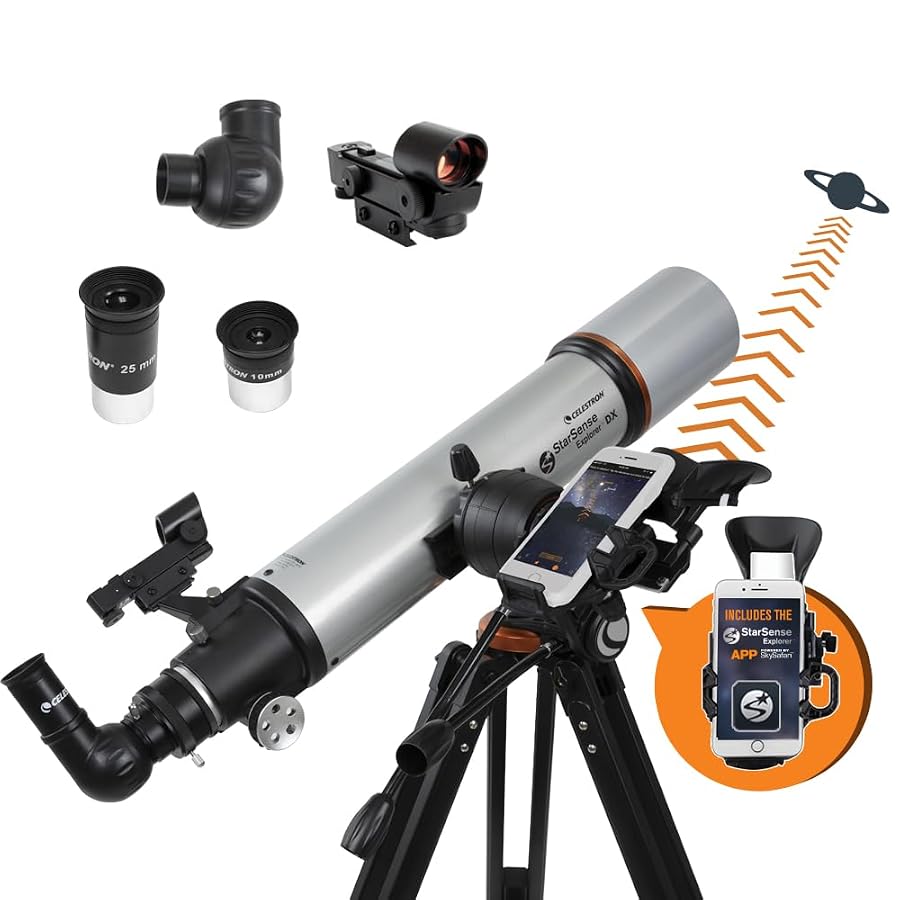
The Celestron StarSense DX 102AZ bridges the gap between complicated computerized mounts and tedious manual star hopping by using your smartphone for real-time sky recognition. If you are debating whether to purchase this setup, the core question is whether the app-guided navigation justifies choosing a manual refractor over motorized systems or compact tabletop reflectors like the celestron moon mission 100mm tabletop dobsonian. This telescope package pairs a 102mm refractor optical tube with an altazimuth mount featuring dual-axis slow-motion controls and Celestron’s patented smartphone dock. For hobbyists seeking a streamlined path to locating celestial objects without memorizing star charts or dealing with heavy external battery packs, this system aims to modernize visual observing.
In this Celestron StarSense Explorer DX 102AZ review, we examine how the mechanical hardware, optical performance, and digital plate-solving software operate together in the field. We evaluate the telescope’s target acquisition workflow, assess the stability of the mount during manual tracking, and examine what realistic views you can expect through the included eyepieces. The following breakdown covers key hardware specifications, daytime alignment steps, planetary and deep-sky performance, and the practical trade-offs you should understand before deciding if it matches your observing style.

What You Get With the Celestron StarSense DX 102AZ
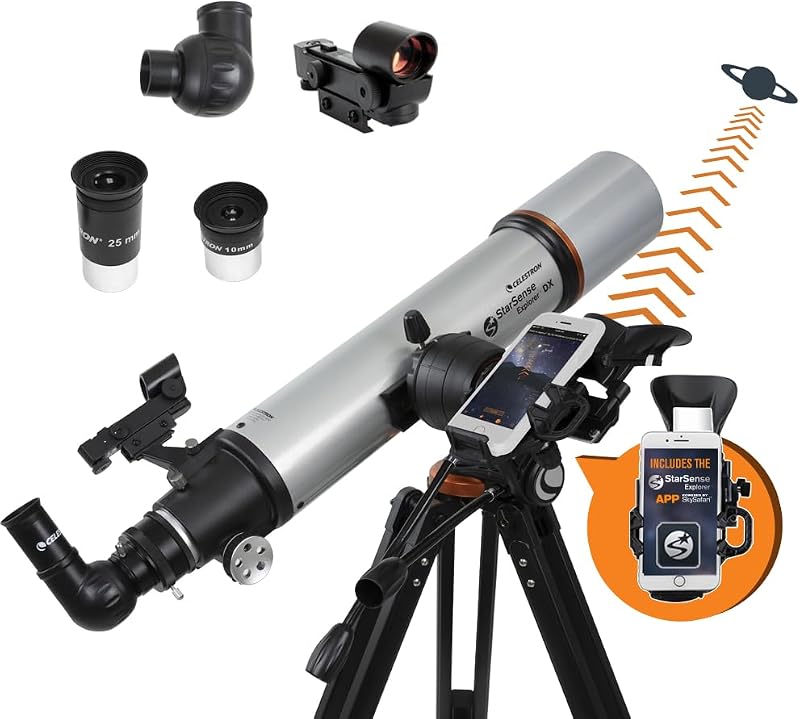
The telescope arrives as a complete observing kit designed for immediate field deployment without requiring third-party tools or additional hardware purchases.
- Celestron 102mm refractor optical tube assembly with 650mm focal length
- Manual altazimuth mount with dual-axis slow-motion control cables
- Full-height aluminum tripod with an integrated accessory tray
- Patented StarSense Explorer smartphone dock with internal alignment mirror
- 25mm eyepiece delivering 26x magnification
- 10mm eyepiece delivering 65x magnification
- StarPointer red dot finderscope with included lithium metal battery
- Erect-image 90-degree star diagonal for daytime and nighttime viewing
- StarSense Explorer app unlock code for compatible iOS and Android devices
Key Specifications
| Attribute | Specification Detail |
|---|---|
| Optical Design | Refractor |
| Aperture | 102 mm (4 inches) |
| Focal Length | 650 mm |
| Focal Ratio | f/6.37 |
| Optical Coatings | Fully XLT Coated glass optics |
| Mount Type | Manual Altazimuth Mount |
| Tracking Controls | Dual-axis slow-motion cables |
| Included Eyepieces | 25mm (26x) and 10mm (65x) |
| Finderscope | StarPointer red dot finderscope |
| Total Assembled Weight | 14.2 pounds |
| Optical Tube Length | 81.3 centimeters |
StarSense App Setup and Sky Recognition Workflow
The primary appeal of the Celestron StarSense DX 102AZ lies in its smartphone-driven target acquisition system. Rather than relying solely on the internal compass and gyroscope sensors found inside smartphones, which frequently drift or suffer from magnetic interference, the StarSense Explorer app uses plate solving. Celestron calls this the Lost in Space Algorithm, or LISA. Once you place your phone into the specialized dock, the phone camera looks into a small angled mirror that reflects the night sky overhead. The app snaps real-time images, analyzes the star patterns against an onboard internal database, and pinpoints exactly where the optical tube is pointing with exceptional precision.
Completing the initial celestron starsense app setup takes only a few minutes and is best performed during daylight or early dusk. You insert your smartphone into the dock, clamp it securely, and align the phone camera with the dock mirror using the built-in adjustment screws. You then center a distant terrestrial landmark in the telescope eyepiece and adjust the on-screen crosshairs in the app until they match the optical center of the telescope. Once that single daytime calibration is complete, the app maintains alignment throughout the observing session, enabling seamless transitions from one celestial coordinate to another without repetitive recalibration.
In field use, target acquisition is remarkably fast compared to manual star charts. The app automatically compiles a curated list of tonight’s best targets based on your exact geographical location and the current time. When you select an object from the list, the screen displays directional navigation arrows. You manually push the telescope along its altitude and azimuth axes toward the indicated coordinates. As you approach the target, the interface shifts from large directional arrows to a precise bullseye target. When the bullseye turns green, the object is positioned directly inside the field of view of the eyepiece. For observers accustomed to wide-angle scanning with instruments like the celestron nature dx ed 8×42, this visual targeting brings a similar level of immediacy to high-magnification telescopic observation.
Mount Stability and Manual Slow-Motion Tracking
Unlike motorized GoTo mounts that use electric motors and battery packs to track objects across the sky, this telescope operates entirely under manual human power. The altazimuth mount features starsense explorer dx 102az slow motion controls on both axes. These flexible control cables allow you to make minute adjustments in altitude up and down and azimuth left and right without grasping the optical tube itself. Because the Earth’s rotation causes celestial targets to drift out of view quickly at higher magnifications, smooth fine-adjustment cables are essential for keeping objects centered during extended viewing sessions.
The mount and tripod assembly weighs 14.2 pounds in total, providing a balanced compromise between portable carrying weight and structural rigidity. When adjusting the slow-motion controls at 65x magnification with the included 10mm eyepiece, minor vibrations will occur in the optical tube, typically settling within two to three seconds once your hand leaves the cable. The tripod includes an aluminum accessory tray that braces the legs, helping to stabilize the system against light wind. Because there are no motors humming or searching for alignment stars, the telescope operates in absolute silence and requires zero external power, eliminating the cords, power tanks, or dead battery issues common to automated systems.
The manual nature of the mount does mean that observing is an active process. You cannot walk away from the eyepiece for ten minutes and expect the target to remain in view. Observers who prefer automated planetary tracking may find the constant turning of the slow-motion dials demanding during high-power sessions. However, for stargazers who enjoy the tactile, hands-on rhythm of piloting a telescope, the combination of digital on-screen guidance and manual mechanical control delivers an engaging, responsive field workflow.
Optical Performance for Lunar, Planetary, and Deep-Sky Viewing
The optical core of this system is an achromatic doublet refractor featuring an objective lens diameter of 102 millimeters and a focal length of 650 millimeters, resulting in a focal ratio of f/6.37. The lenses are treated with Celestron’s Fully XLT Coated glass optics to maximize light transmission and contrast. A 4-inch refractor captures substantial light, making the celestron 102az refractor telescope well suited for high-contrast views of bright objects from suburban backyards as well as deep-sky favorites under darker skies.
When evaluated for celestron starsense dx 102az planetary viewing, the optical tube delivers sharp, satisfying details on major solar system targets. Through the included 10mm eyepiece, the Moon displays crisp shadow detail along the lunar terminator, with crater walls, rilles, and mountain peaks rendered cleanly. Jupiter shows its primary equatorial cloud belts alongside the four Galilean moons, while Saturn displays its iconic ring system and brightest moon, Titan. Because this is a fast achromatic refractor rather than an expensive apochromat, you will notice a mild violet halo, known as chromatic aberration, around extremely bright targets like the lunar limb, Venus, and bright first-magnitude stars. For general visual observation, this false color remains unobtrusive and does not obscure key surface features.
For deep-sky viewing, the 102mm aperture and relatively wide 1.05-degree field of view provide expansive vistas of star clusters, nebulae, and nearby galaxies. From dark-sky sites, popular targets such as the Orion Nebula, the Pleiades open cluster, the Double Cluster in Perseus, and the core of the Andromeda Galaxy stand out vividly against a dark backdrop. The included 25mm eyepiece yields a wide exit pupil of approximately 3.9 millimeters and 26x magnification, making it the ideal tool for framing large star fields and faint emission nebulae before switching to the 10mm eyepiece for closer inspection.
Astrophotography Potential and Limitations
Many new hobbyists inquire about using the celestron starsense dx 102az for astrophotography. While the telescope is an exceptional visual instrument, it is essential to align expectations regarding imaging capabilities. Because the system utilizes a manual altazimuth mount without motor drives, long-exposure deep-sky astrophotography is not possible. Long exposures required for faint nebulae and distant galaxies demand an equatorial motorized mount capable of tracking celestial motion without field rotation.
However, the telescope performs admirably for short-exposure planetary and lunar snapshot photography. By attaching a smartphone adapter to the eyepiece, you can capture detailed images and high-definition video clips of the Moon’s cratered surface and the bright discs of Jupiter and Saturn. The erect-image diagonal also makes the telescope completely functional for daytime terrestrial photography, allowing you to photograph distant wildlife or landscapes through your phone camera. The StarSense dock itself holds the smartphone for navigation purposes; imaging requires repositioning your phone over the eyepiece using a separate mounting bracket.
Viewing this instrument as a visual-first telescope that supports casual lunar photography prevents disappointment. Those seeking deep-space imaging capabilities will ultimately need dedicated equatorial tracking platforms, but for capturing striking lunar details or sharing planetary snapshots with friends and family, the optical tube produces bright, crisp source imagery.
Check Celestron StarSense DX 102AZ on Amazon
Is the Celestron StarSense DX 102AZ Worth It
Determining whether the Celestron StarSense DX 102AZ is worth it depends largely on how you prioritize navigation speed versus automated tracking. For beginner and intermediate stargazers, the biggest obstacle in amateur astronomy has always been finding objects in the sky. Traditional manual star hopping using paper star charts can be frustrating, especially in light-polluted urban or suburban backyards where reference stars are invisible to the naked eye. The StarSense smartphone navigation eliminates this hurdle completely, allowing users to locate faint nebulae and star clusters in seconds without technical frustration.
If you are considering a celestron starsense dx 102az beginner telescope, this package represents one of the most user-friendly entry points on the market. When compared to small starter instruments like the celestron firstscope 76, the DX 102AZ offers vastly superior light gathering, better mechanical stability, and a modern app-guided interface. It requires no complex multi-star polar alignment routines, no leveling sensors, and no external power cables, making it an outstanding grab-and-go instrument that you can carry outside and begin observing with in under five minutes.
On the other hand, if your observing style requires motorized tracking that keeps objects centered automatically for hands-free viewing or extended group sessions, a fully motorized GoTo telescope may better match your needs. However, for hobbyists who appreciate an engaging manual observing workflow paired with cutting-edge digital plate solving, the StarSense DX 102AZ delivers a well-engineered balance of optical quality, mechanical simplicity, and effortless navigation.
FAQ
Does the Celestron StarSense DX 102AZ require internet or cellular service in the field?
No, the StarSense Explorer app does not require a cellular connection or active internet service to calculate its position or locate objects in the night sky. The celestial database and the Lost in Space plate-solving algorithm are stored locally on your smartphone once the app is downloaded. You can take the telescope into remote dark-sky locations completely off the grid, and the sky recognition technology will function seamlessly.
Can the StarSense dock accommodate any modern smartphone?
The StarSense dock is designed with an adjustable spring-loaded clamp and positional sliders that accommodate a wide variety of smartphone shapes and sizes, including standard and plus-sized iOS and Android devices. As long as your phone’s camera lens can be aligned over the dock’s internal reflection mirror, the plate-solving technology will operate properly.
What planetary details can you expect to see through the telescope?
With the included 10mm eyepiece delivering 65x magnification, you can clearly see the rings of Saturn, the four Galilean moons orbiting Jupiter, and Jupiter’s prominent equatorial cloud belts. The phases of Venus and Mercury are easily visible, as is the orange disc of Mars during favorable oppositions. The Moon reveals intricate details including crater central peaks, impact ejecta rays, and vast lava plains.
Does the telescope require external batteries or an AC power adapter to operate?
The telescope itself operates entirely without external electrical power, cords, or AC adapters. The manual altazimuth mount is guided by hand using slow-motion cables. The only battery used by the system is a single standard lithium metal coin cell inside the StarPointer red dot finderscope, which is included in the box. Your smartphone runs on its own internal battery while resting in the StarSense dock.
Can you use standard 1.25-inch astronomical eyepieces and filters with this telescope?
Yes, the telescope features a standard 1.25-inch focuser and star diagonal, making it fully compatible with the vast ecosystem of standard 1.25-inch astronomical eyepieces, Barlow lenses, and planetary filters. While the included 25mm and 10mm eyepieces provide practical starting magnifications of 26x and 65x, adding a higher-power eyepiece or Barlow lens can push the optics closer to their maximum useful magnification for planetary observing.


