
As Amazon Associates, we earn from qualifying purchases. This means we may receive a small commission at no extra cost to you if you click through and make a purchase.
Choosing a dedicated camera for stills-first photography often leads creators back to the foundational tools of modern mirrorless systems. The Fujifilm X-Pro 1 represents the original starting point of the X-mount family, engineered with a rangefinder aesthetic and an interchangeable lens mount. If you are wondering whether this camera remains a practical choice today, the answer depends on your shooting pace. It offers a mechanical, deliberate experience for stationary subjects, but it cannot match the rapid autofocus tracking or video versatility found on modern hybrid bodies.
In this guide, we analyze the official listing data, technical specifications, and physical shooting design of this classic camera to help you determine if it fits your workflow. We examine the characteristics of the APS-C sensor, the mechanics of the hybrid optical and electronic viewfinder, contrast detection autofocus limits, exposure controls, and raw file flexibility. Understanding the genuine trade-offs of this early mirrorless body will help you decide whether its deliberate personality matches your creative vision or if modern speed is necessary for your photography.

What You Get With the Fujifilm X-Pro 1
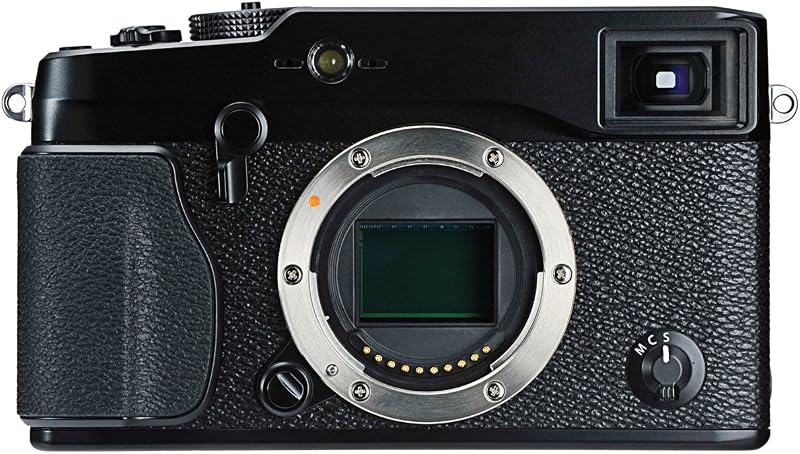
The Fujifilm X-Pro 1 listing details a standalone mirrorless camera body designed for photographers building a custom setup, with lenses sold separately. The manufacturer highlights the core photographic hardware and connection points integrated into the camera.
- Fujifilm X-Pro 1 mirrorless camera body in black finish
- 16.3-megapixel APS-C X-Trans CMOS sensor without an optical low-pass filter
- Hybrid optical and electronic viewfinder system
- 3.0-inch rear LCD display with 1,230,000 dots of resolution and Live View
- 49-area contrast detection autofocus system
- Dedicated flash hotshoe on the top plate
- Single memory card slot supporting SD, SDHC, and SDXC media
- ISO sensitivity from ISO 200 to 6400, expandable from ISO 100 to 25,600
- Full 1080 HD video recording capability
- File format support for RAW (RAF format), JPEG (Exif 2.3), and RAW plus JPEG
Key Specifications
| Specification | Manufacturer Detail |
|---|---|
| Sensor Resolution and Format | 16.3 MP APS-C X-Trans CMOS sensor (3:2 aspect ratio) |
| Lens Mount System | Fujifilm X mount |
| Viewfinder Architecture | Hybrid optical and electronic viewfinder |
| Rear Monitor Display | 3.0-inch LCD screen with 1,230,000 dots and Live View |
| Autofocus Configuration | 49-area contrast detection AF system |
| ISO Sensitivity Range | ISO 200 to 6400 (expandable from ISO 100 to ISO 25,600) |
| Shutter Speed Range | 1/4000 second maximum to 30 seconds minimum |
| Continuous Burst Rate | 6 frames per second (not suggested for moving objects) |
| Still File Formats | RAW (RAF), JPEG (Exif 2.3), RAW plus JPEG |
| Image Stabilization | No built-in image stabilization |
Autofocus Performance and Everyday Handling
Assessing the Fujifilm X-Pro 1 autofocus performance requires aligning expectations with early mirrorless contrast detection architecture. The camera utilizes a 49-area contrast detection AF system rather than the hybrid phase-detection sensors found on contemporary cameras. When composing stationary subjects, architectural scenes, or environmental portraits, the system locks accurately whenever your focus point covers a region with well-defined contrast. However, focus acquisition takes deliberate time, exhibiting a back-and-forth hunt as the contrast algorithm confirms critical sharpness. Photographers accustomed to modern instant lock systems, such as the mechanism on the fujifilm xt30 ii, will immediately notice the measured rhythm required here.
The operational pacing of this camera reinforces a disciplined approach to subject capture. Because the autofocus mechanism relies strictly on contrast evaluation across 49 selectable zones, attempting to track erratic or fast-moving subjects frequently results in missed focus. The manufacturer listing directly addresses this characteristic by noting that continuous burst shooting is not suggested for moving objects. This constraint means sports, active wildlife, and fast documentary action encounter the physical boundaries of the system. Instead, creators who pre-focus on anticipated marks, use single-point AF, or employ manual zone focusing techniques will find the camera predictable and rewarding.
In terms of physical operation, the camera relies on direct mechanical dials that dictate the pace of shooting. Exposure control modes cover Aperture Priority, Shutter Priority, Manual, and Program AE, giving shooters physical dials on the body and aperture rings on compatible lenses. Because there is no built-in image stabilization inside the body, maintaining sharp results in handheld shooting demands strict attention to shutter speed. This physical layout encourages you to evaluate lighting and set your exposure values thoughtfully before pressing the shutter release.
Using the Hybrid Viewfinder for Street Photography
The tactile Fujifilm X-Pro 1 hybrid viewfinder gives photographers a versatile choice between traditional rangefinder composition and precise electronic framing. By integrating both an optical window and an electronic display into a single housing, the camera lets you switch viewing modes at the flick of a lever depending on ambient conditions. In optical mode, you look directly through glass that displays electronic framelines overlaid on the scene. This setup enables you to monitor the perimeter outside the frame, allowing you to anticipate subjects before they enter your composition. For creators considering the Fujifilm X-Pro 1 for street photography, this expansive optical vantage point provides an immersive, connected shooting experience.
When precise framing, depth of field preview, or exposure verification is critical, switching over to the electronic viewfinder or utilizing the 3.0-inch rear LCD with 1,230,000 dots provides an accurate sensor-level preview. The rear screen features Live View functionality, which simplifies tripod work, macro positioning, and low-angle framing. While cutting-edge fixed-lens options like the fuji x100vi camera offer high-density electronic displays and automated subject recognition, the dual-viewfinder execution on this original body retains a mechanical feel that many purists appreciate for traditional street documentation.
Working with the optical viewfinder also requires an understanding of parallax compensation, particularly when framing subjects close to the lens. Because the optical window sits above and to the left of the lens axis, the framing indicated by the brightlines shifts relative to the actual sensor capture at close distances. Switching smoothly to the electronic viewfinder resolves parallax discrepancies by streaming the exact sensor feed straight to your eye. This transition between optical awareness and digital precision makes the hybrid finder an adaptable asset for urban exploration.
Low Light Capabilities and Sensor Rendering
The heart of this camera is the original 16.3-megapixel Fujifilm X-Trans sensor, an APS-C CMOS chip that eliminated the conventional optical low-pass filter. Standard digital cameras utilize a Bayer color filter array that relies on an anti-aliasing filter to suppress moiré and false color artifacts, which inherently softens fine detail. Fujifilm engineered a non-traditional color filter array inspired by the random distribution of fine silver halide film grain. This random arrangement suppresses color moiré without requiring a softening filter, allowing the 16-megapixel sensor to resolve crisp detail from mounted optics.
When evaluating Fujifilm X-Pro 1 low light performance, the native sensitivity spans from ISO 200 to 6400, backed by an expanded range extending to ISO 25,600 and down to ISO 100. In dim environments, the sensor produces an organic luminance noise pattern that resembles analog film grain rather than harsh digital blotches. While modern back-illuminated sensors deliver cleaner high-ISO files above ISO 6400, the tonal roll-off, deep shadow graduation, and color reproduction of this original sensor design have earned a lasting reputation among still photographers who prioritize visual character over clinical perfection.
Because the body lacks internal image stabilization, achieving sharp handheld exposures in dim settings requires careful shutter speed management. The mechanical focal-plane shutter spans from 30 seconds up to 1/4000 second, meaning that nighttime photography relies heavily on pairing the body with fast prime glass or stabilizing the camera on a solid surface. When paired with bright lenses, the camera captures rich shadow detail and nuanced highlights in evening street environments without blowing out artificial light sources.
Raw Shooting Workflow and Continuous Drive Limits
For photographers who prefer complete control over post-processing, Fujifilm X-Pro 1 raw shooting delivers wide latitude through uncompressed RAF files alongside Exif 2.3 JPEG images. The 16.3-megapixel raw data captures generous dynamic range, providing ample latitude to recover shadow details and tame highlights during exposure correction. However, the unique color filter array of the X-Trans sensor requires deliberate raw processing software selection, as generic demosaicing algorithms can occasionally introduce artifacts into complex foliage. Shooters who choose the RAW plus JPEG mode receive high-quality camera-rendered JPEGs for immediate use while keeping the uncompressed RAF file for extensive grading.
Storage and file management are handled through a single card slot compatible with SD, SDHC, and SDXC media. Because the internal processing pipeline reflects early mirrorless architecture, writing large uncompressed raw files to the memory card requires measurable clearing time. Burst sequences or rapid single-frame capture can cause the write-activity indicator to illuminate for several seconds, temporarily locking menu access until the buffer clears. Unlike rugged, fully sealed compacts such as the fujifilm finepix xp140 that focus on rapid snapshot operation in harsh conditions, this camera requires an intentional pause between extensive capture sequences.
The camera offers continuous burst rates reaching up to 6 frames per second, but Fujifilm X-Pro 1 continuous shooting is strictly bounded by buffer depth and autofocus architecture. The listing explicitly states that continuous shooting is not suggested for moving objects, confirming that the continuous drive mode is meant for capturing slight compositional shifts rather than tracking sports subjects. Treating the camera as a precise, single-frame capture tool ensures the most reliable performance, preventing write buffer bottlenecks and keeping you locked into the creative flow.
Check Fujifilm X-Pro 1 on Amazon
Is the Fujifilm X-Pro 1 Worth It
Determining if the Fujifilm X-Pro 1 is worth it depends on whether your priority is modern technological automation or a tactile, deliberate photographic connection. When examining the Fujifilm X-Pro 1 specs, the trade-offs are evident: a 49-area contrast-only autofocus system, no in-body image stabilization, modest buffer clearing speeds, and a 16-megapixel resolution cap. If your primary photography routine involves fast-moving sports, wildlife, energetic family events, or high-definition commercial videography, this camera will likely feel restrictive and out of sync with your speed requirements.
Conversely, for creators who treat photography as an intentional craft, this camera offers an experience that modern automated bodies rarely replicate. The combination of the unique hybrid optical and electronic viewfinder, direct mechanical exposure controls, and the analog rendering of the first-generation X-Trans sensor creates a satisfying shooting rhythm. Because it is fully compatible with interchangeable Fujifilm X mount lenses, you can equip the body with modern premium primes, compact pancakes, or vintage glass via mechanical adapters, expanding your creative possibilities across diverse projects.
Ultimately, this classic mirrorless body thrives in the hands of street photographers, landscape hobbyists, and environmental portrait shooters who prefer slowing down to craft every frame. It rewards patience, careful framing, and an understanding of exposure fundamentals rather than relying on automated algorithm corrections. For those seeking a dedicated, stills-first tool with timeless physical charm and a distinctive sensor signature, it remains an engaging and capable creative tool.
FAQ
Does the Fujifilm X-Pro 1 feature in-body image stabilization?
No, the manufacturer specifications confirm that the Fujifilm X-Pro 1 has no built-in image stabilization. Handheld photography at slower shutter speeds requires steady shooting technique, support gear like a tripod, or lenses equipped with optical stabilization.
What lens system is compatible with the Fujifilm X-Pro 1?
The camera features the Fujifilm X mount, designed specifically for interchangeable Fujifilm X mount lenses. This allows photographers to attach a wide variety of dedicated prime and zoom lenses, as well as vintage lenses using compatible mechanical adapters.
Can the Fujifilm X-Pro 1 record high-definition video?
Yes, the camera listing specifies that it can record 1080 HD video. However, because it was engineered primarily as a dedicated stills tool without modern tracking autofocus or video assists, video recording is a secondary feature best suited for static, tripod-mounted clips.
What types of memory cards does the Fujifilm X-Pro 1 use?
The camera features a single memory card slot that supports SD, SDHC, and SDXC cards. These cards store Exif 2.3 JPEGs, uncompressed RAF raw files, and 1080 HD video footage.
Why does the Fujifilm X-Pro 1 omit an optical low-pass filter?
The 16.3MP X-Trans CMOS sensor uses a randomized color filter array inspired by film grain rather than a standard Bayer matrix. This pattern eliminates the need for an optical low-pass filter, preventing moiré while delivering maximum sharpness directly from the lens.


