As Amazon Associates, we earn from qualifying purchases. This means we may receive a small commission at no extra cost to you if you click through and make a purchase.
Content creators, audio hobbyists, and home desk workers frequently monitor hardware release cycles in search of sound equipment that combines accurate audio reproduction with clean workspace aesthetics. Those tracking rumors of a prospective harman kardon go play 4 release date are often trying to determine whether they should hold out for an unannounced generational refresh or equip their workstation with the active flagship, the Harman Kardon Go + Play 3. While forum chatter routinely speculates on future iterations, the manufacturer has not announced an official fourth version, leaving the current hardware as the company’s definitive statement on high-output, semi-portable tabletop acoustic design. For creators seeking immediate improvements in their daily audio workflow, waiting on an unconfirmed release offers little tangible benefit over a machine engineered with an advanced tri-amplified acoustic architecture.
This comprehensive analysis examines how the hardware performs across daily creative tasks, analyzing the driver architecture, real-world utility, and boundary tuning capabilities. We evaluate the core harman kardon go + play 3 specs, explore how the auto-calibration hardware handles variable room acoustics, test battery endurance during extended work sessions, and assess multi-host wireless connectivity. Whether you are balancing vocal tracks, reviewing video footage, or seeking room-filling reference playback alongside alternative desktop options like the harman kardon soundsticks 5, this guide outlines the functional strengths and physical limitations of this heavy-duty speaker system.
What You Get With the Harman Kardon Go + Play 3
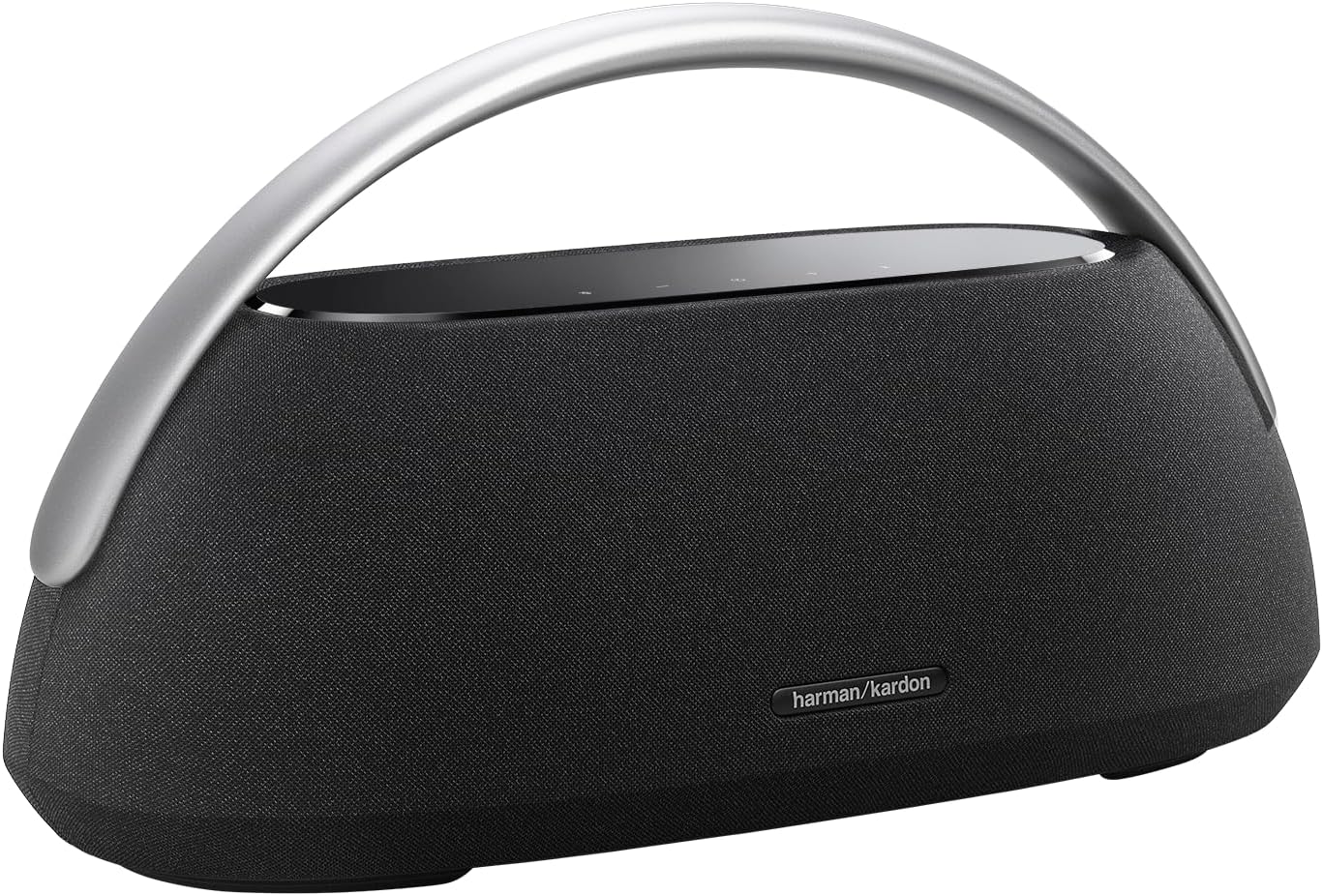
The unit arrives as a cohesive, self-contained tabletop audio system designed for immediate desktop deployment, packaged with essential operational hardware and constructed from structural acoustic components that emphasize both tactile feedback and mechanical stability.
- A complete three-way stereo driver array featuring a dedicated down-firing five-inch subwoofer, dual mid-range transducers, dual 1.57-inch tweeters, and an integrated front-facing passive radiator.
- An ergonomically curved, solid aluminum carry handle bolted directly across the top chassis for domestic transport between workstations.
- A responsive tempered glass top deck integrating capacitive touch controls for intuitive tactile system adjustments.
- A built-in rechargeable internal battery cell providing up to eight hours of cordless playback per operating cycle.
- An integrated USB power delivery port configured to charge external smartphones, tablets, or audio recorders directly from the internal powerbank.
- A dual far-field microphone array built into the front panel to capture vocal input for conferencing and room calibration.
- An automated environmental calibration system designed to recalibrate sound equalization automatically upon relocation.
- Dual-device Bluetooth transmission firmware supporting simultaneous multi-source pairing across mobile devices and computers.
- Wireless stereo pairing software enabling two matching units to form a broader dual-channel acoustic soundstage.
Key Specifications
| Attribute | Detail |
|---|---|
| Audio Output Mode | Stereo |
| Speaker Configuration | Three-Way Multi-Driver System |
| Subwoofer Diameter | 5 Inches (Down-Firing) |
| Tweeter Diameter | 1.57 Inches (Dual Transducers) |
| Chassis Materials | Crystal Enclosure, Aluminum Handle, Recycled Materials |
| Battery Average Life | Up to 8 Hours |
| Wireless Range | 50 Meters |
| Control Method | Tempered Glass Capacitive Touch |
| Microphone Array | Built-In Dual Far-Field Microphones |
| Water Resistance | Not Water Resistant |
Acoustic Architecture and Desk Monitoring Fidelity
Evaluating the harman kardon go play for studio tasks requires understanding how a three-way speaker configuration differs from typical consumer Bluetooth boxes. Most standard wireless speakers utilize full-range drivers forced to reproduce the entire audible spectrum simultaneously, which invariably leads to mid-frequency distortion whenever heavy bass notes trigger driver excursion. This hardware circumvents that limitation by dividing the frequency spectrum across dedicated mechanical drivers: two high-frequency 1.57-inch tweeters manage transient treble detail, discrete mid-range drivers isolate spoken dialogue and instruments, and a robust five-inch down-firing woofer handles low-frequency resonance independently. The addition of a front-mounted passive radiator further reinforces bass extension without generating mechanical turbulence inside the acoustic cabinet.
For video editors and audio producers, this physical separation yields an unusually clean vocal register. When editing narrative voiceovers or dialogue stems, speech remains articulate and distinct even if background music or ambient sound effects contain substantial low-end energy. The five-inch subwoofer pushes acoustic energy directly against the supporting tabletop surface, producing tactile bass response that fills medium to large work rooms effortlessly. Because the woofer faces downward, placing the speaker on a dense wooden desk or reinforced monitor bridge yields tight, authoritative sub-bass, though placing it on hollow or resonant furniture may require physical decoupling pads to avoid unwanted vibration.
While the speaker produces a detailed, clear stereo soundstage, it remains an active consumer-tuned acoustic platform rather than a completely flat, neutral studio monitor. The tuning emphasizes musicality, warmth, and dynamic impact, which makes it enjoyable for long editing sessions, rough client mix passes, and background listening. Those desiring sculptured glass enclosures and diffuse, ambient acoustic distribution might also compare desktop alternatives like the harman kardon aura studio 5, but this unit provides direct forward-projecting stereo dispersion that works far more predictably when seated directly in front of an editing timeline.
Portability Form Factor and Daily Creator Workflow
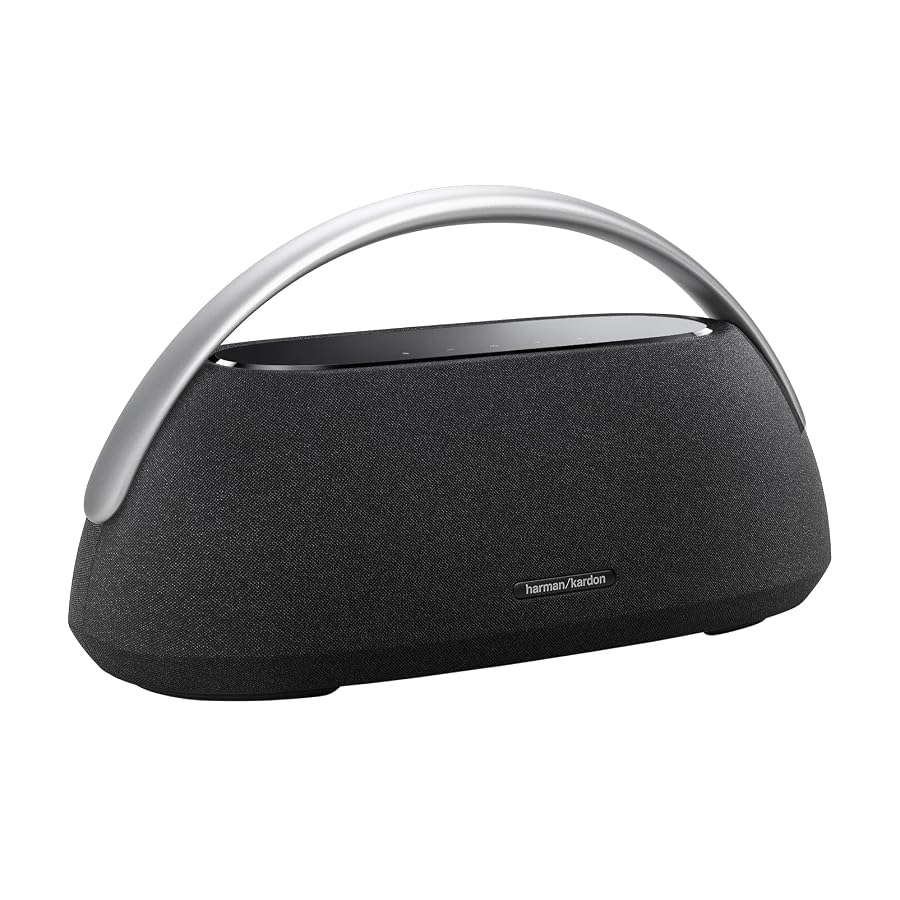
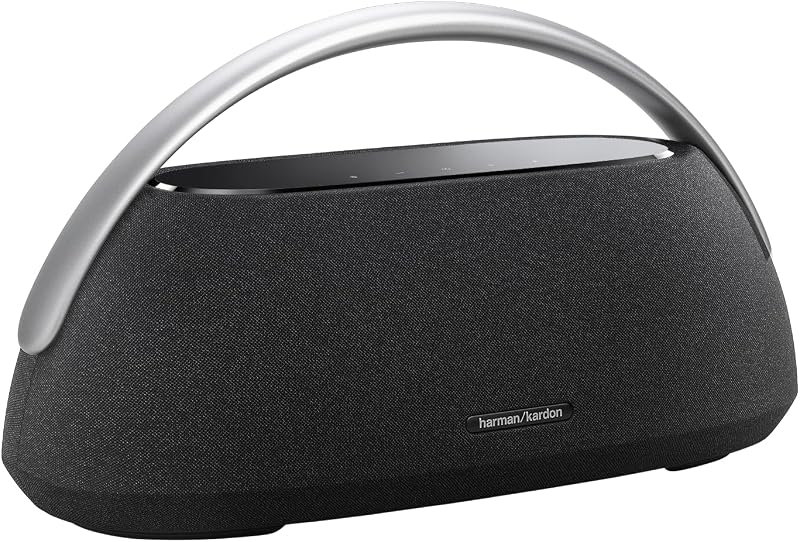
The physical footprint of this harman kardon portable bluetooth speaker establishes it primarily as a semi-portable tabletop centerpiece rather than an ultra-mobile outdoor sound accessory. Built around a substantial crystal enclosure wrapped in subtly textured acoustic fabric, the unit features a high-grade aluminum handle that spans the upper perimeter. This handle provides a secure, rigid grip for hoisting the speaker from an office desk and carrying it into a living room, podcast booth, or kitchen. It balances well during transit, but its tabletop mounting orientation and substantial mechanical weight signal clearly that it is intended to live on stable flat surfaces.
Cordless flexibility is supported by an internal rechargeable battery rated for up to eight hours of continuous audio reproduction. The harman kardon go play 3 battery life is sufficient to cover an entire workday away from an electrical outlet, allowing creators to stage production shoots or review edits without cable clutter. Additionally, the integrated rear USB port operates as an active power bank, supplying power to depleted smartphones, field recorders, or tablets during prolonged mobile sessions. Utilizing the USB port to recharge mobile devices does draw directly from the speaker internal reserve, which naturally reduces the total audio runtime accordingly.
Workspace durability requires cautious handling, as the manufacturer listing explicitly states that the speaker is not water resistant. The tempered glass touch interface and exposed fabric grille are vulnerable to liquid spills, making the speaker ill-suited for outdoor field production in rainy conditions or deployment near open beverage stations. Those who prioritize domestic portability with alternative form factors frequently cross-shop options like the hk onyx studio 8, but for creators dedicated to indoor tabletop production, the robust aluminum structural frame and touch-sensitive glass deck provide an executive workspace appearance.
Calibration and Room Acoustic Adaptation
One of the most persistent hurdles for creators working in unoptimized home studios is uneven bass buildup caused by boundary reflections, room modes, and reflective wall surfaces. The harman kardon go play auto self tuning feature addresses this challenge by incorporating onboard acoustic sensing directly into the startup sequence. Every time the speaker is moved to a new operating position or powered on in a different room, the integrated dual far-field microphone array analyzes ambient audio feedback and wall reflections, automatically adjusting the internal equalization profiles to harmonize the output with surrounding physical boundaries.
This automated recalibration is particularly beneficial for creators who do not maintain a permanent, acoustically treated mixing room. Moving the unit from a centered desk position to a corner bookshelf typically results in boomy, overbearing low frequencies due to corner acoustic loading. The auto-tuning software compensates for these boundary anomalies by attenuating problematic resonant peaks, preserving speech intelligibility and preventing muddy mid-bass from swamping narrative dialogue. The adjustments happen automatically in the background, eliminating the requirement for third-party calibration apps or external measuring microphones.
Beyond room equalization, the dual far-field microphone system functions as an integrated communications interface for remote work. The wide-aperture pickup pattern captures vocal input cleanly from across a standard conference table or editing desk, allowing video producers to conduct client review calls and production meetings without wearing bulky headsets. While professional voice tracking still demands a dedicated studio microphone, having an integrated microphone array that handles acoustic room compensation alongside casual communication streamlines the modern hybrid desk workflow.
Connectivity and Multi-Device Integration
Reliable wireless connectivity is fundamental when toggling between editing machines, tablets, and personal smartphones. The speaker features an extended wireless range specified up to 50 meters, maintaining a stable audio transmission even when the source computer or phone is carried into an adjacent room. The Bluetooth architecture supports simultaneous dual-device pairing, enabling two separate source devices to stay linked concurrently. This capability allows a creator to keep an editing laptop connected for video playback while maintaining an active link to a smartphone for incoming notifications and playlist sharing without cumbersome manual reconnecting.
Physical navigation is managed through the tempered glass top panel, which utilizes responsive capacitive touch controls for volume adjustments, power states, and Bluetooth initialization. The capacitive surface eliminates mechanical switch gaps where studio dust and debris could otherwise collect, maintaining an uncluttered, modern aesthetic. The touch controls react instantly to light finger taps, allowing quick volume adjustments during calls or playback without jarring the speaker chassis.
For large production spaces, photo studios, or collaborative creative workshops, the wireless stereo pairing functionality allows users to link two Go + Play 3 units together wirelessly. Once paired, the two hardware units divide into discrete left and right stereo channels, generating an expansive acoustic field with genuine spatial separation. This dual-unit deployment dramatically broadens the sweet spot across wider rooms, offering a modular acoustic solution for creators who host studio open houses or require heightened physical soundstage separation during playback reviews.
Check Harman Kardon Go + Play 3 on Amazon
Is the Harman Kardon Go + Play 3 Worth It
Deciding whether this tabletop system fits your production space ultimately comes down to your operational environment and expectations around acoustic performance. When performing an objective harman kardon go play 3 review, the hardware clearly excels as an upscale, high-output desktop monitor that bridges the divide between consumer lifestyle audio and serious creator media consumption. The inclusion of a dedicated three-way driver design, automated room self-tuning, and responsive glass touch controls yields acoustic clarity and tactile refinement that budget Bluetooth speakers simply cannot emulate.
For independent content creators, remote video editors, and home office professionals, the question of is harman kardon go play worth it can be answered affirmatively. It provides sufficient low-end authority through its five-inch down-firing woofer to deliver satisfying, immersive media consumption while retaining the critical mid-range separation required to assess spoken audio clearly. The eight hours of battery autonomy and integrated powerbank port grant practical domestic mobility, letting you move high-fidelity audio from an editing workstation to a kitchen counter or living space without pausing playback.
However, the unit is not universally suited for every use case. Audio purists requiring professional balanced XLR or TRS analog inputs will find the wireless-first architecture limiting, as the listing emphasizes Bluetooth transmission over professional studio patching. Furthermore, outdoor enthusiasts needing rugged weather protection must look elsewhere, as the chassis is not water resistant. But for the creator wanting an elegant, room-calibrating desktop powerhouse today without gambling on the uncertain future of a harman kardon go play 4, the current model stands as a deeply capable, aesthetically refined workstation audio centerpiece.
FAQ
Is there an official Harman Kardon Go + Play 4 release date?
The manufacturer has not announced an official release date, technical specifications, or production schedule for a fourth-generation model. The current Go + Play 3 remains the active, actively supported flagship within this specific product lineup.
Can the Harman Kardon Go + Play 3 be used as a primary studio monitor?
While the speaker features an advanced three-way driver array and excellent vocal clarity suitable for media editing, dialogue review, and reference listening, it is tuned for dynamic consumer sound rather than completely flat studio reference monitoring. It works best as a secondary reference speaker or an upscale desk audio system.
How long does the Harman Kardon Go + Play 3 battery last during active use?
The internal rechargeable battery provides an average runtime of up to eight hours on a full charge. Total operational time may decrease if you simultaneously use the rear USB port to charge external mobile devices from the internal power bank.
Is the Harman Kardon Go + Play 3 waterproof for outdoor use?
No, the product listing explicitly indicates that the unit is not water resistant. Due to its tempered glass touch panel, open fabric grille, and unsealed ports, it should be kept indoors and protected from rain, moisture, and liquid spills.
How does the auto self tuning feature calibrate room acoustics?
Every time the speaker powers on or relocates to a new setting, its integrated dual far-field microphones capture environmental acoustic reflections. Internal processing algorithms then automatically adjust equalization parameters to compensate for room boundaries and reduce muddy acoustic resonance.