As Amazon Associates, we earn from qualifying purchases. This means we may receive a small commission at no extra cost to you if you click through and make a purchase.
When outfitting an editing suite, content workstation, or casual media room, selecting audio monitors often comes down to choosing between self-powered units and traditional passive monitors. The Polk Audio T15 represents a classic passive option designed to handle everything from dialogue editing to multichannel audio mixing. For creators looking at the polk t15 speakers as a potential sound solution, understanding their power requirements and signal path is vital. Because these units do not feature internal amplification, they must be paired with an outboard stereo amplifier or an audio-video receiver before producing any sound.
This guide analyzes how the polk audio t15 bookshelf speakers behave in creator workspaces and compact entertainment environments. We explore driver architecture, amplifier matching requirements, mounting configurations, and real-world audio fidelity based strictly on the manufacturer specifications and audio engineering fundamentals. Whether you are assembling a straightforward editing workspace, integrating a secondary listening station, or mapping out a complete multi-speaker array, this overview provides the practical details needed to determine if these passive monitors fit your daily production workflow.

What You Get With the Polk Audio T15
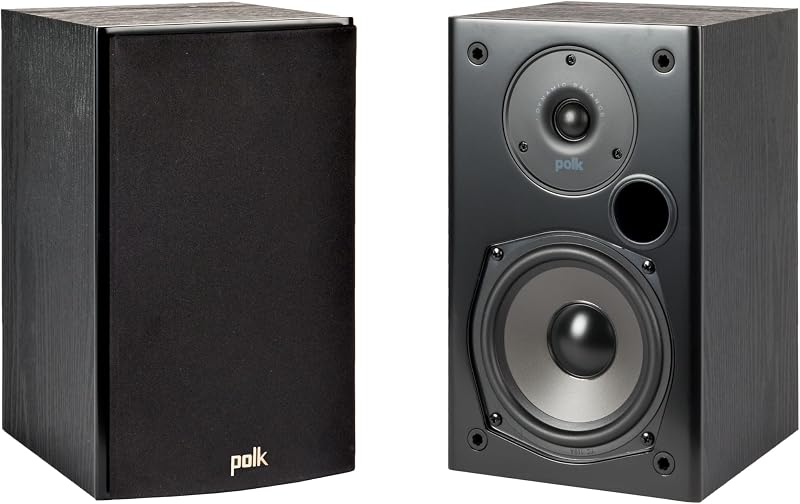
The Polk Audio T15 is sold as a pair of passive bookshelf monitors engineered for versatility across stereo listening and multichannel home entertainment environments. Designed to fit onto standard studio desks, dedicated speaker stands, or directly onto flat wall surfaces, each enclosure houses dedicated high and mid-frequency drivers designed to handle dynamic audio content.
- One pair of Polk Audio T15 passive bookshelf speakers in a black cabinet finish
- One 0.75-inch tweeter per cabinet dedicated to high-frequency audio playback
- One 5.25-inch Dynamic Balance driver per cabinet engineered for balanced midrange and low-end response
- Integrated keyhole mounting slots on the rear panel for straightforward wall mounting
- Rear-mounted binding posts configured for standard wired speaker connections
- Compatibility with wider multi-channel system components including T50 tower speakers, T30 center channels, and subwoofers
Key Specifications
Reviewing the formal polk t15 specs reveals the core physical and electrical parameters that govern how these speakers operate within an audio chain.
| Attribute | Detail |
|---|---|
| Brand | Polk Audio |
| Speaker Maximum Output Power | 100 watts |
| High-Frequency Driver | 0.75-inch tweeter |
| Mid/Bass Driver | 5.25-inch Dynamic Balance driver |
| Frequency Response Ceiling | 24,000 Hz (lower frequency threshold is not specified in listing) |
| Connectivity Technology | Wired (passive speaker terminals) |
| Audio Output Mode | Surround and stereo compatible |
| Form Factor | Bookshelf with integrated keyhole wall mount |
| Package Configuration | 1 Pair (left and right channels) |
Amplifier Pairing and Power Delivery
A crucial consideration when evaluating the Polk Audio T15 is that these are entirely passive monitors. Unlike powered computer speakers or active studio monitors that draw power directly from a wall outlet and accept direct auxiliary or USB feeds, these speakers require an external source of amplification. Achieving proper polk t15 amp pairing means matching them with a dedicated stereo integrated amplifier, a desktop class-D power amp, or an AV receiver capable of supplying clean power. The manufacturer specifies a maximum output handling of 100 watts, providing adequate headroom for typical nearfield listening and small-room playback.
For video editors and music hobbyists working at a production desk, space is often at a premium. Running bulky commercial receivers may not be practical in compact creator suites, making small-footprint desktop amplifiers an appealing pairing. Because connectivity is strictly wired, you must run standard two-conductor speaker wire from the amplifier outputs to the spring clips or binding posts on the back of each speaker. Ensuring your audio interface feeds clean line-level audio into your chosen amplifier is the foundational step toward achieving stable, distortion-free playback.
Creators comparing these entry-level passive units with higher-tier studio solutions often evaluate build differences across product lines. While advanced passive designs like the polk r200 bookshelf speakers feature heavier bracing, complex crossovers, and distinct driver materials aimed at audiophile accuracy, the T15 focuses on delivering accessible, functional power handling within standard 100-watt consumer amplifier limits.
Desktop Placement and Acoustic Optimization
Using the polk t15 for desktop mixing or content creation introduces specific acoustic dynamics that require deliberate physical setup. Because each cabinet houses a 5.25-inch Dynamic Balance woofer and a 0.75-inch tweeter, positioning these drivers at ear level is critical for preserving tonal balance. If the speakers sit flat on a desk surface, high frequencies from the 0.75-inch tweeter may fire directly into the user’s chest, while desk surface reflections can introduce acoustic smear across lower vocal frequencies.
To optimize nearfield monitoring, creators should position the speakers on small isolation stands or angled foam wedges. Angling the drivers upward toward the ears ensures that dialogue edits, background music adjustments, and sound effects are perceived accurately. Furthermore, maintaining equal distance between the left and right speakers relative to the listening position creates a cohesive stereo soundstage, allowing creators to pan instruments and voice tracks with confidence.
For those considering similar compact form factors, the polk monitor xt15 presents another compact option within the brand’s lineup. When positioning any bookshelf speaker of this scale on a workspace, leaving adequate clearance around the cabinet perimeter prevents unwanted acoustic boundary loading and ensures that the physical enclosure does not vibrate against desk accessories or secondary display monitors.
Wall Mounting and Studio Space Management
When desk real estate is consumed by video switchers, audio interfaces, and multiple computer monitors, taking advantage of the polk t15 wall mount capability offers a practical solution. The rear panel includes built-in keyhole slots, allowing users to secure the cabinets directly against a wall without purchasing bulky third-party mounting arms. This feature is particularly valuable for creators building clean, minimalist recording backgrounds or secondary listening zones where floor and desk space must remain open.
Mounting speakers flush to a drywall surface alters acoustic behavior. When a bookshelf speaker is mounted against a boundary, the low-frequency output is naturally amplified by boundary reinforcement. Because the manufacturer designed the T15 with front-facing or sealed port configurations suitable for wall placement, creators can use this boundary effect to their advantage to fill small studios without causing severe mechanical vibration or port choking.
If you prefer an architectural solution that hides the enclosure altogether, products like the polk audio ls 265 provide a flush-to-stud alternative. However, for rented creator spaces or temporary home studios where cutting drywall is not permissible, the integrated keyhole mount on the T15 provides an effective, reversible method to elevate speakers off work surfaces.
Sound Profile and Driver Performance
A primary factor in any monitoring decision is overall polk t15 sound quality. The acoustic foundation relies on a two-way driver configuration featuring a 0.75-inch tweeter paired with a 5.25-inch Dynamic Balance driver. Polk’s Dynamic Balance technology is engineered to identify and eliminate unwanted driver resonances, resulting in a cleaner midrange response that is particularly beneficial for spoken-word editing, podcast production, and vocal monitoring.
When assessing the polk t15 frequency response, the manufacturer listing documents an upper extension reaching up to 24,000 Hz. This extended treble response allows high-frequency air, transient details, and sibilance in voice recordings to remain clearly audible during playback. However, the listing does not specify the lower boundary of the frequency range. Based on the 5.25-inch physical driver size, creators should recognize that sub-bass frequencies below typical bookshelf limits will roll off naturally, meaning deep bass synthesis and low-frequency sub-bass monitoring will require the addition of a dedicated powered subwoofer.
For YouTube vloggers and casual audio editors, the vocal clarity offered by the Dynamic Balance driver is well-suited for checking dialogue intelligibility. The listing emphasizes clear sound even at low volume levels, which helps creators who edit late at night or work in non-soundproof residential rooms where high listening levels could cause neighborhood disturbances.
Home Theater Expansion and Multichannel Setups
Beyond individual creator desks, the polk t15 home theater setup workflow is a prominent application outlined in the product specifications. The listing explicitly states that these speakers can function as front left-and-right main channels or as surround satellite speakers in a multi-speaker environment. This versatility makes them an adaptable asset for creators who use the same physical space for daytime video production and evening entertainment.
Polk designed the T-series ecosystem for modular expansion. Creators starting with a modest 2.0 stereo arrangement can gradually expand into a comprehensive 5.1 surround sound layout. According to the manufacturer documentation, the T15 integrates seamlessly with T50 floor-standing tower speakers for the front channels, a T30 center channel for anchored vocal dialogue, and an external powered subwoofer to cover deep cinematic low-frequency effects.
Because the T15 shares tonal voicing and design heritage across the T-series family, using them as rear or side surrounds ensures seamless panning across multichannel sound fields. For video editors mixing projects destined for surround delivery or streaming platforms that support spatial audio, having matched surround channels provides an accurate representation of how the mix translates across consumer home theater systems.
Check Polk Audio T15 on Amazon
Is the Polk Audio T15 Worth It
Answering whether is polk t15 worth it depends heavily on your existing hardware inventory and production goals. If you already possess an AV receiver or an outboard desktop stereo amplifier, these speakers offer a durable, full-range stereo pair capable of handling dialogue editing, music playback, and video monitoring. The inclusion of a 5.25-inch driver and a 0.75-inch tweeter inside a wall-mountable cabinet gives creators substantial layout flexibility without demanding significant desktop real estate.
Conversely, creators seeking an all-in-one plug-and-play desktop monitor with built-in USB, optical, or Bluetooth inputs may find the passive nature of the T15 cumbersome. Adding an external amplifier and routing physical speaker wire introduces additional hardware and cabling to your workspace. Furthermore, audio engineers who require surgical monitoring down into deep sub-bass frequencies will notice the physical limits of the 5.25-inch driver, necessitating a secondary subwoofer to monitor full-spectrum sound.
Ultimately, the Polk Audio T15 serves creators and hobbyists who want a modular, reliable passive foundation. They operate smoothly as nearfield desk monitors when elevated on stands, function cleanly as wall-hung background monitors, and easily transition into surround satellites if your studio transforms into a multi-channel home theater.
FAQ
Are the Polk Audio T15 speakers passive or powered?
The Polk Audio T15 speakers are entirely passive. They do not have built-in amplifiers, power cords, or digital inputs. To produce sound, they must be connected via traditional two-conductor speaker wire to an external power source such as an audio-video receiver, integrated amplifier, or desktop mini-amplifier.
Can I use the Polk Audio T15 directly with a computer or laptop?
You cannot plug the Polk Audio T15 directly into a computer’s 3.5mm headphone jack or USB port. To use them in a desktop computer setup, you must run an audio cable from your computer or audio interface into an external amplifier, and then run speaker wire from that amplifier to the T15 binding posts.
What is the maximum power handling of the Polk Audio T15?
The manufacturer listing specifies a maximum output power handling of 100 watts. Pairing the speakers with an amplifier that delivers clean, rated power within this specification ensures stable performance without risking thermal overload or distortion.
How do I mount the Polk Audio T15 onto a wall?
Each Polk Audio T15 cabinet includes an integrated keyhole slot built directly into the rear panel. This allows the speaker to be hung securely on a standard wall-mounted screw anchored into a wall stud or appropriate drywall anchor, eliminating the need for bulky aftermarket clamping brackets.
Can the Polk Audio T15 be integrated into a 5.1 surround sound system?
Yes. The manufacturer documentation specifies that the T15 can serve as front left-right channels or as surround channels. They are designed to match acoustically with other Polk T-series components, including the T50 floor-standing towers, the T30 center channel speaker, and a dedicated standalone subwoofer.