As Amazon Associates, we earn from qualifying purchases. This means we may receive a small commission at no extra cost to you if you click through and make a purchase.
When outfitting an audio workstation, choosing the right monitor requires balancing driver separation, distortion control, and spatial dispersion. The KEF R3 Meta solves this equation by packing flagship three-way acoustic engineering into a stand-mount profile tailored for discerning creators and audiophiles. Arriving as a stereo pair designed for shelf or stand placement, this monitor targets sound designers, music producers, and media professionals who need reference-grade fidelity without surrendering their room to massive floorstanding speakers. If you need low-end extension combined with clinical spatial imaging in spaces where full-sized tower speakers cannot fit, this system delivers an uncompromising monitoring experience.
Throughout this guide, we analyze the core performance attributes of this speaker pair to determine how its hardware translates to creative production environments. We explore the acoustic advantages of deploying the kef r3 meta for music production, evaluate driver mechanics, inspect kef r3 meta specs from the manufacturer, and examine setup integration considerations. Whether you are assembling a mastering suite or outfitting a dedicated home editing desk, this breakdown outlines what to expect before adding this pair to your signal chain.
What You Get With the KEF R3 Meta

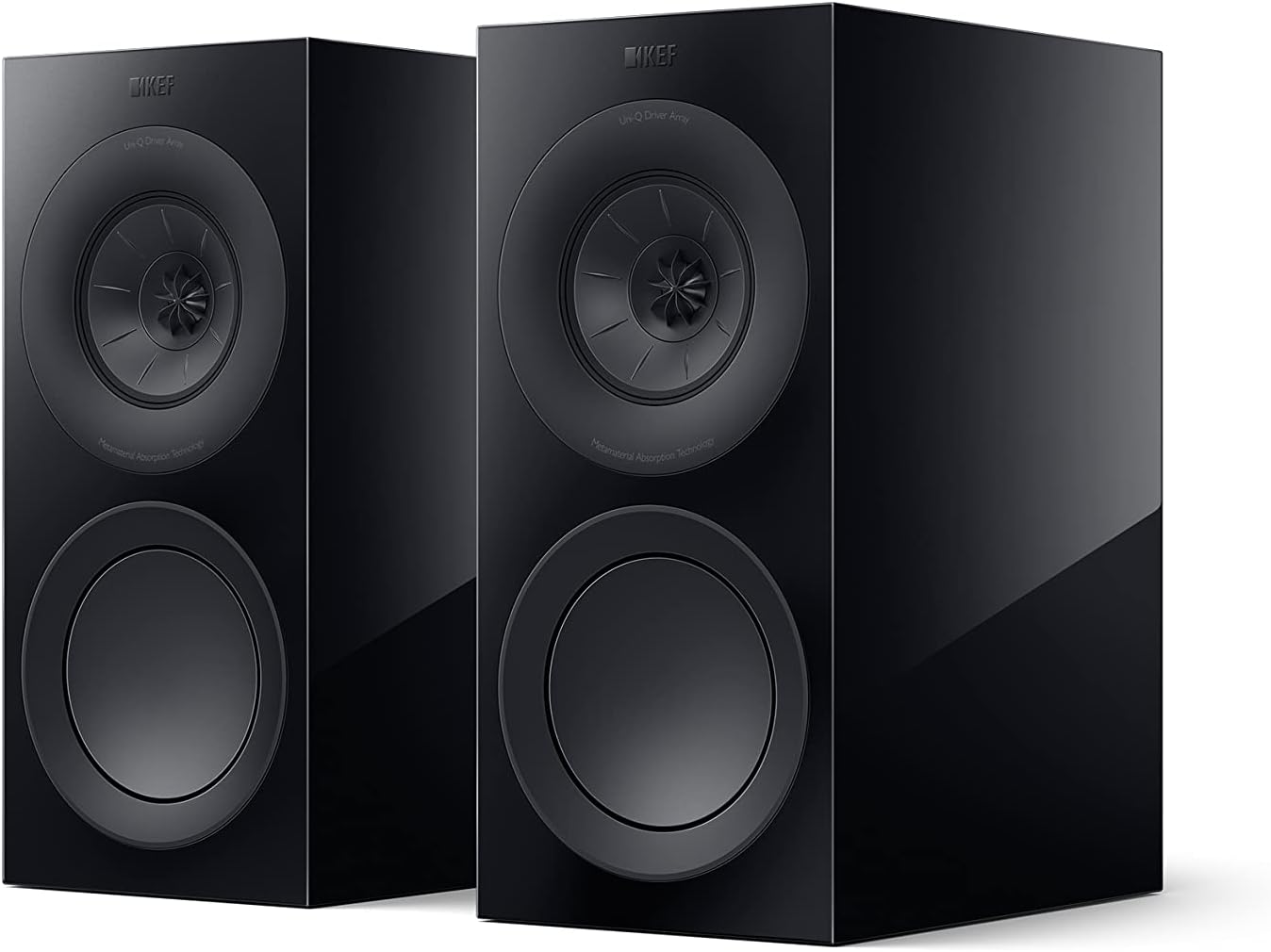
Unboxing this system reveals a stereo pair of bookshelf speakers built with an aluminum enclosure and engineered with driver hardware shared with the brand’s flagship R11 Meta floorstander. The package supplies a complete stereo setup designed for shelf placement, while floor mounting requires optional stand hardware.
- One matched pair of KEF R3 Meta bookshelf speakers in premium acoustic enclosure finishing.
- Twelfth-generation Uni-Q driver array combining a 25.4-millimeter vented aluminum dome tweeter with Metamaterial Absorption Technology.
- Dedicated 6.5-inch hybrid aluminum bass driver engineered for extended low-frequency authority.
- Shelf-mount cabinet construction supporting corded electric power architecture and remote control operation.
- High-resolution audio certification compatible with televisions, gaming consoles, DVD players, and dedicated music players.
- Manufacturer warranty coverage lasting 5 years to protect long-term studio integration.
Key Specifications
| Hardware Category | Manufacturer Specification |
|---|---|
| Speaker Configuration | Three-way bookshelf design |
| High-Frequency Transducer | 25.4 mm vented aluminum dome with MAT |
| Bass Transducer | 6.5 in hybrid aluminum cone woofer |
| Frequency Response (±3dB) | 58Hz – 28kHz |
| Enclosure Material | Aluminum |
| Audio Output Mode | Stereo |
| Control Method & Wireless | Remote control with 10-meter Bluetooth range |
| Mounting Format | Shelf mount (S2 floor stands sold separately) |
| Environmental Resistance | Not water resistant |
| Manufacturer Warranty | 5 year warranty |
Acoustic Accuracy for Critical Production Workflows
Evaluating overall kef r3 meta sound quality reveals an acoustic profile oriented toward transparency, tonal neutrality, and analytical precision. At the heart of this output is the twelfth-generation kef r3 meta uni-q driver array, which mounts the 25.4-millimeter tweeter directly inside the acoustic center of the midrange cone. This coaxial configuration acts as a single point source, dispersing frequencies evenly across both horizontal and vertical planes. For sound editors who shift between multiple screens at an editing desk, this uniform radiation pattern ensures the acoustic sweet spot remains consistent without shifting tonal balance off-axis.
Rearward high-frequency energy inside traditional speaker cabinets can reflect back through the dome, creating smearing and sibilance across the upper registers. To eliminate these internal reflections, KEF implemented Metamaterial Absorption Technology, which consists of a synthetic disc behind the tweeter dome containing an intricate network of channels. According to official data, this MAT structure absorbs 99% of unwanted sound waves radiating from the back of the tweeter. When cutting vocal tracks or balancing delicate reverb tails, this damping enables pristine clarity free from metallic ringing. Editors testing smaller monitors such as the kef q1 meta will immediately recognize how this three-way architecture clarifies congested acoustic mixes.
Low-end reproduction benefits significantly from the dedicated 6.5-inch hybrid aluminum bass driver, giving the speaker independent low-frequency authority. The official kef r3 meta frequency response extends from 58Hz to 28kHz (±3dB), providing a reliable acoustic window into low-end percussion and upper harmonic details. By delegating low bass reproduction to the 6.5-inch woofer, the central Uni-Q cone moves minimally, avoiding mechanical modulation. The listing confirms Hi Res Audio certification, ensuring that the driver array cleanly handles wide dynamic sweeps without compressing complex audio passages.
Amplification Demands and Source Matching
Operating a high-end monitor pair requires an understanding of amplification requirements, as passive three-way speakers depend on clean, stable current to achieve their dynamic ceiling. While the listing includes mentions of corded electric operation, remote control, and a 10-meter Bluetooth range for media playback, finding the proper kef r3 meta amp pairing is vital for professional monitoring. Driving three independent driver sections demands an external amplifier or receiver with adequate headroom to control the 6.5-inch woofer during fast transient peaks.
Supplying inadequate amplification can lead to sluggish bass response, diminished dynamic contrast, and distortion at higher listening volumes. Connecting these speakers to an amplifier with a high damping factor allows the hybrid aluminum cone to stop and start instantaneously, preserving punch in kick drums and basslines. The intricate crossover network distributes signals across three separate driver bands, making clean current delivery essential across the entire 58Hz to 28kHz range. While buyers seeking simpler setups might look at the kef q3 meta, the R-series system rewards high-performance amplification chains with remarkable control and micro-detail retrieval.
Beyond studio desks, the listing notes compatibility across gaming consoles, DVD players, televisions, and surround sound systems. Feeding the speakers high-quality signals via low-noise interconnects prevents interference from degrading audio fidelity in complex creator spaces with multiple computers and displays. The included 5-year manufacturer warranty gives creators confidence that the internal passive crossovers and precision drivers are constructed to withstand rigorous studio use over years of continuous playback.
Workspace Footprint and Room Placement Dynamics
Placing these monitors into a studio workspace requires planning around cabinet depth, structural stability, and room boundary interactions. Designed for shelf mounting with rigid aluminum construction, the speakers require a solid surface that will not resonate under bass excursions. Placing them directly on a standard office desk without isolation can cause low-frequency buildup through the desktop surface. The manufacturer listing highlights that matching S2 speaker stands are sold separately, providing an ideal decoupling solution if you choose to elevate the speakers behind a console.
Room boundary placement strongly impacts how the 58Hz bass extension behaves in smaller editing bays. Positioning the rear-ported cabinets directly against drywall or in tight room corners naturally accentuates bass frequencies, potentially skewing your perception of the low end. Allowing space between the cabinet rear and the back wall preserves linear bass response, allowing the Uni-Q driver to present an honest stereo image. For creators working in untreated rooms, incorporating basic acoustic treatment at early reflection points will maximize the spatial separation generated by the point-source driver.
Environmental conditions must also be considered before permanent installation. The technical specifications verify that this model is not water resistant and carries no waterproofing rating, restricting operation to indoor, climate-controlled environments. Available in Black Gloss, White Gloss, Walnut, and Indigo Gloss Special Edition, the cabinets integrate seamlessly into professional visual studios and video backgrounds, though the high-gloss finishes benefit from regular microfiber wiping to remove dust and studio handling marks.
Three-Way Architecture Compared to Traditional Two-Way Monitors
Comparing the kef r3 meta vs ls50 meta or typical two-way studio monitors highlights the mechanical advantages of a dedicated three-way layout. In a standard two-way speaker, a single driver handles both midrange vocals and low-frequency bass duties, forcing the cone to execute large physical excursions while simultaneously articulating fine vocal textures. The KEF R3 Meta eliminates this acoustic compromise by delegating low frequencies exclusively to the 6.5-inch hybrid aluminum woofer, leaving the Uni-Q array free to focus on midrange and treble.
Because the midrange cone is freed from heavy bass excursion, acoustic smearing and intermodulation distortion are virtually eliminated. In a dedicated kef r3 meta home studio, this acoustic separation translates into an articulate soundstage where background vocal harmonies, rhythm sections, and synthesizer layers remain distinct during dense mixing sections. Sound designers working on complex film audio tracks can isolate micro-details and panning automation without bass transients masking the dialogue channel.
Traditional multi-driver monitors also separate the tweeter and woofer vertically along the front baffle, creating phase cancellations and vertical lobing whenever the listener stands or leans back. The coaxial layout of the kef r3 meta three-way speaker places the tweeter at the exact center of the midrange driver, ensuring smooth dispersion across all listening angles. This cohesive phase response reduces ear fatigue during marathon editing sessions and delivers dependable acoustic feedback whether you are seated in the center sweet spot or moving across the room.
Is the KEF R3 Meta Worth It
Determining whether this speaker pair fits your setup depends on your performance requirements, available space, and monitoring chain. For content creators, mixing engineers, and audiophiles seeking reference-level midrange accuracy, deep low-end extension, and expansive stereo imaging, these monitors provide exceptional acoustic fidelity. Sharing the driver architecture of the top-tier R11 Meta, they offer flagship acoustic engineering in a bookshelf profile that fits professional mixing desks and high-end living spaces.
However, this speaker pair is not an all-in-one desktop solution for shoppers seeking self-powered simplicity. Because they are passive monitors requiring dedicated amplification and external interface hardware, integrating them into your workspace requires an additional investment in power gear and cables. Creators with compact desk setups may also find the cabinet dimensions and the need for separate S2 stands or isolation pads demanding compared to small active studio monitors.
If you have the amplification hardware and physical space to support them, the acoustic performance of this pair is difficult to surpass in the passive stand-mount category. The combination of Metamaterial Absorption Technology, a 6.5-inch hybrid aluminum bass woofer, and an aluminum enclosure delivers an honest, non-fatiguing presentation. For serious listeners and creators building an uncompromising acoustic setup, these monitors stand as a premier hardware investment.
FAQ
Does the KEF R3 Meta require an external amplifier to work?
Yes, the KEF R3 Meta is a passive speaker system that requires an external stereo amplifier or AV receiver to deliver power to the drivers. The listing specifies corded electric control architecture, remote operation, and Hi Res Audio support, but you will need dedicated external amplification and speaker wire to connect your audio interface, music player, or television.
How does Metamaterial Absorption Technology improve sound quality?
Metamaterial Absorption Technology, or MAT, uses a specialized disc behind the 25.4-millimeter tweeter dome containing an intricate network of channels. According to manufacturer specifications, this maze-like structure absorbs 99% of unwanted acoustic reflections radiating from the rear of the tweeter, preventing cabinet distortion from coloring the high frequencies and ensuring natural treble reproduction.
Can the KEF R3 Meta be mounted on floor stands?
Yes, while the primary mounting type is listed as shelf mount, the manufacturer data specifies that matching S2 speaker stands are available and sold separately. Placing the speakers on rigid floor stands decouples them from your editing desk, isolates low-end vibrations, and allows precise ear-level positioning in dedicated studio rooms.
What color finishes are available for this speaker model?
The product data lists four available finishes: Black Gloss, White Gloss, Walnut, and an Indigo Gloss Special Edition. These options allow creators to match their monitors with existing studio furniture, home theater decor, or camera backdrops.
Are these speakers suitable for outdoor or humid environments?
No, the product specifications explicitly state that the speaker is not waterproof and has a water resistance level rated as not water resistant. The speakers must be used indoors in climate-controlled spaces away from moisture, rain, or high humidity to preserve the aluminum enclosure and internal crossover electronics.