
As Amazon Associates, we earn from qualifying purchases. This means we may receive a small commission at no extra cost to you if you click through and make a purchase.
Choosing a pocket-friendly camera for casual vlogging often means balancing portability against excessive complexity. If you are looking at the Kodak PIXPRO C1, you are considering an ultra-compact digital camera designed with a front-facing display specifically for content creators, social media video clips, and travel documentation. Rather than overcomplicating your creative process with interchangeable lenses, complex exposure triangles, or nested digital menus, this compact vlogging camera flip screen model offers an approachable point-and-shoot design that prioritizes rapid operation and physical ergonomics.
While modern smartphones carry impressive image processing, a dedicated handheld device with tactile buttons, integrated optical stabilization, and a dedicated flip-up monitor brings a completely different rhythm to personal recording. This comprehensive evaluation covers the real-world utility of the camera, detailing how its retro-inspired shell handles everyday shooting, what you can realistically expect from its fixed optical design, and how its imaging pipeline fits into an active online workflow. Whether you want an everyday travel diary camera or an uncomplicated tool for social clips, understanding these trade-offs ensures you make the right choice.
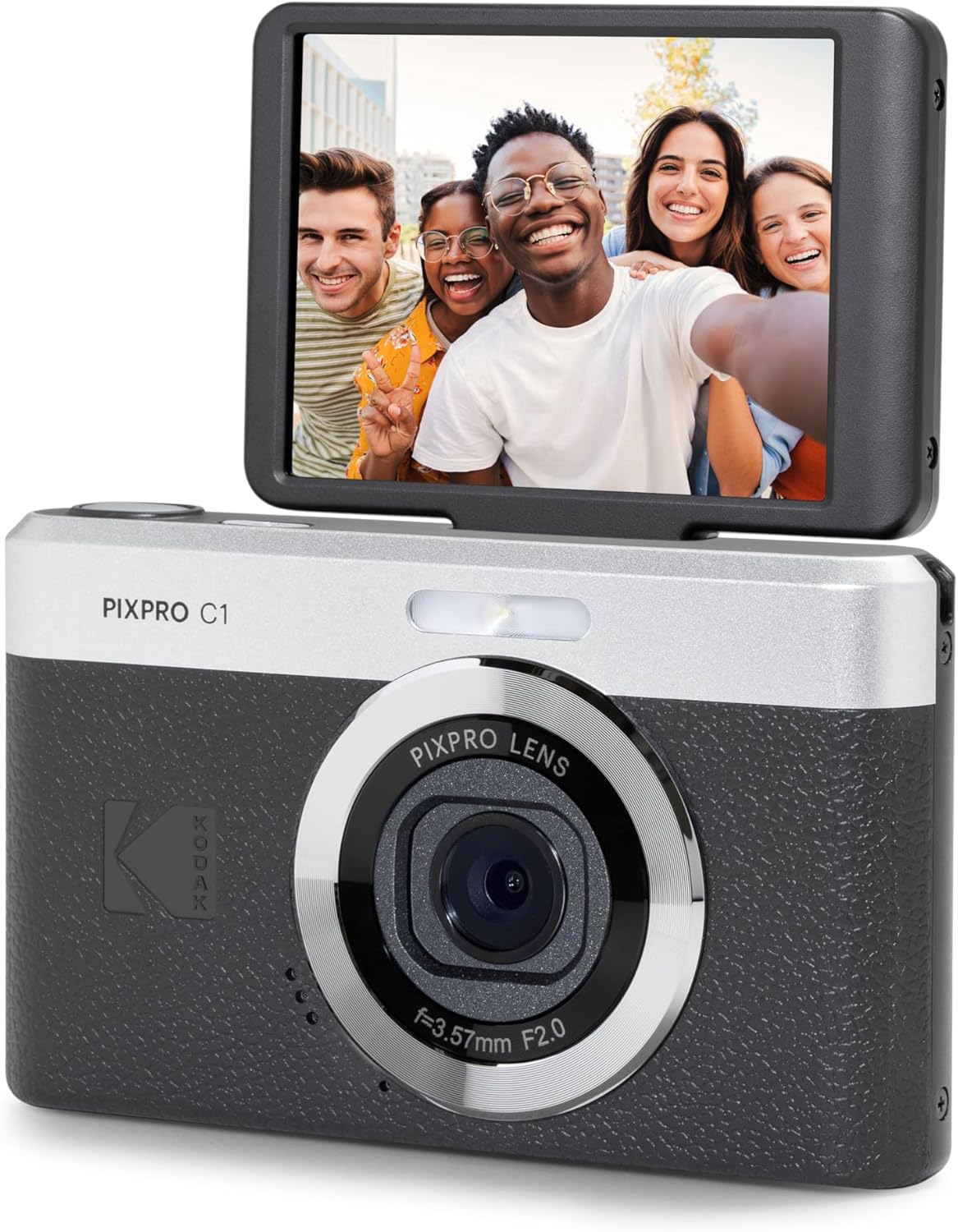
What You Get With the Kodak PIXPRO C1

The Kodak PIXPRO C1 is configured straight out of the box as a self-contained recording tool designed for minimal preparation and immediate shooting. Its core components center around automated functionality and physical framing flexibility:
- 13-megapixel back-illuminated BSI CMOS image sensor
- 26mm wide-angle fixed-focus optical lens with a bright f/2.0 maximum aperture
- 2.8-inch color LCD display that tilts upward 180 degrees for forward-facing preview
- Full HD 1080p video recording mode for clips and creator projects
- Built-in rechargeable lithium-ion battery powered via a standard USB-C interface
- Built-in 4X digital zoom functionality for quick focal adjustments
- Standard tripod mounting socket located on the base of the chassis
- MicroSD and microSDHC memory card slot supporting capacities up to 32GB
- Preset automated shooting profiles including Night Landscape, Backlight Portrait, Beach, and Children
Key Specifications
| Specification Attribute | Manufacturer Detail |
|---|---|
| Image Sensor Type | 1/3-inch BSI CMOS |
| Effective Still Resolution | 13.0 Megapixels (13.12 MP total) |
| Focal Length | 26mm Equivalent Wide Angle |
| Focus System | Fixed Focus (No manual or continuous AF adjustment) |
| Maximum Lens Aperture | f/2.0 |
| Video Resolution | 1080p Full HD |
| Display Monitor | 2.8-inch LCD with 180-degree upward tilt |
| Image Stabilization | Optical Image Stabilization |
| Supported Aspect Ratios | 16:9, 3:2, 4:3 |
| Storage Media Compatibility | MicroSD / MicroSDHC cards up to 32GB |
| Power & Charging | Integrated Lithium-Ion Battery with USB-C Charging Port |
Vlogging Workflow and the 180-Degree Flip Screen
The primary attraction of the kodak c1 camera flip screen is how quickly it transforms from a standard street camera into a dedicated piece of creator gear. The 2.8-inch LCD panel is hinged at the top of the body, allowing it to flip upward a full 180 degrees until it faces forward toward your subject. When recording yourself, this orientation gives you immediate visual confirmation of your framing, head positioning, and exposure balance without needing an external wireless monitor or a reflective mirror accessory. For solo vloggers walking through busy spaces, having the screen positioned directly above the lens barrel keeps your eye-line relatively close to the glass, producing a more direct and natural connection with your viewers.
Mounting the camera onto mini tripods, handheld extension grips, or desktop stands is straightforward thanks to the standard threaded tripod socket situated on the bottom plate. Because the display flips upward rather than swinging to the side, it remains unobstructed even when you hold the camera by its sides or set it down flat on a level tabletop. Content creators producing quick talking-head updates, aesthetic room diaries, or social clips will appreciate that the monitor does not force a wide, cumbersome rig setup. Unlike larger digital systems that require separate shoe adapters or custom cages just to see your own frame, this unit is ready for forward-facing capture the moment the display is flipped upward.
However, running a flip-screen setup like this does require managing physical boundaries. The 2.8-inch LCD provides adequate brightness for typical indoor rooms, overcast streets, and shaded parks, but intense direct sunlight can make precise exposure evaluation trickier since the listing does not specify anti-glare panel coatings. If you are comparing this layout with other compact models in the broader lineup, such as the zoom-oriented kodak pix pro fz45, the defining mechanical advantage of the C1 remains this effortless vertical tilt mechanism built specifically for front-facing work.
Optical Behavior of the 26mm Fixed Focus Lens
Understanding the optics of the kodak pixpro c1 fixed lens is essential to getting predictable results. The camera features a 26mm wide-angle lens with an f/2.0 maximum aperture. This focal length provides a broad field of view that is well-suited for arm’s-length video logs, group selfies, wide environmental scenery, and travel street scenes. You can hold the camera comfortably in front of you while still capturing your head, shoulders, and a generous slice of the surrounding architecture or landscape without forcing an uncomfortable stretch in your arm.
The defining technical characteristic here is the fixed-focus design. Unlike cameras with dynamic autofocus systems that continuously calculate distances and adjust internal glass elements, this model fixes focus across a set optical field. The practical benefit for video creators is the complete elimination of autofocus hunting. In dynamic environments, automated autofocus motors can pulse or drift between the presenter and background objects, introducing distracting visual jitters. The C1 completely avoids this issue, ensuring steady focus whenever the subject remains within its intended depth of field.
The trade-off to a fixed-focus system is the loss of close-up capability. If you are a creator who regularly holds small products, cosmetic containers, or detailed art pieces close to the lens for macro inspection, the fixed lens cannot adjust its focal plane to resolve objects only a few inches away. Everything from roughly arm’s length to infinity remains in acceptable focus, but macro-style tabletop product reviews will appear soft. The camera does feature a 4X digital zoom mode for cropping closer to distant subjects, though because digital zooming crops directly into the sensor array rather than utilizing optical movement, it should be used judiciously to preserve crisp edges.
Sensor Output and Full HD Video Quality
At the heart of the imaging architecture is a 1/3-inch back-illuminated BSI CMOS sensor producing 13.12 megapixels of resolution. For still photography, this produces standard JPEG files with selectable aspect ratios of 16:9, 3:2, or 4:3, giving users native flexibility depending on whether images are destined for desktop wallpapers, print albums, or vertical mobile feeds. Back-illuminated architecture allows the sensor photodiodes to collect incoming light more efficiently than older conventional CMOS designs, pairing well with the bright f/2.0 aperture to provide respectable performance in moderate indoor lighting and twilight environments.
When switching modes, the kodak pixpro c1 video quality delivers 1080p Full HD footage suitable for everyday travel montages, YouTube video journals, and social clips. While high-end commercial bodies target 4K workflows, standard 1080p files offer significant practical benefits for casual creators: they generate lighter storage overhead, require less computer processing power during video editing, and upload rapidly over mobile networks. The inclusion of optical image stabilization is an important feature here, as physical stabilization helps absorb micro-tremors from walking steps and handheld motions far better than basic software cropping alone.
For users who prefer automated settings rather than manual adjustments, the exposure system relies on Program auto exposure supplemented by dedicated scene modes. Modes such as Night Landscape, Backlight Portrait, Beach, and Children configure the internal shutter speeds—which range dynamically from 1/10000 second to standard speeds—and ISO levels down to ISO 100 to suit distinct lighting conditions. While professional creators seeking flat color profiles or log recording will find the processing straightforward and locked down, users who want clean, natural, ready-to-share video without grading will find the output convenient.
Portability, Battery Life, and Everyday Usability
Portability is one of the most compelling reasons to choose the kodak c1 digital camera. Featuring a distinctive retro vintage aesthetic finished in black, the camera slips easily into jacket pockets, sling bags, or glove compartments without adding noticeable bulk. For photographers and travelers who find heavy camera bags restrictive or who prefer to leave their fragile smartphones safely tucked away, this pocketable form factor encourages spontaneous, uninhibited documentation of daily life.
Power management is handled by an integrated rechargeable lithium-ion battery. The kodak pixpro c1 battery life supports standard day-to-day shooting intervals, and the inclusion of a modern USB-C charging port significantly elevates its convenience on the road. Instead of carrying proprietary battery cradles or separate wall adapters, you can recharge the camera using the exact same USB-C cable and portable power bank that powers your mobile phone or laptop. This makes topping up the charge during transit, between shooting locations, or in a vehicle completely frictionless.
Storage management is similarly straightforward, utilizing standard microSD and microSDHC memory cards up to 32GB. While high-capacity 128GB or 256GB cards are common in professional rigs, the 32GB ceiling on this camera is ample for 13MP JPEG stills and standard 1080p clips. For users who also enjoy preserving memories in physical formats, images captured on the C1 can easily be exported to small mobile print hubs, such as the kodak dock plus, for rapid printing. Alternatively, travelers needing an element-sealed companion for water activities might weigh this street model against a hardened option like the pix pro wpz2, though the C1 remains the dedicated choice when front-facing video framing is the absolute priority.
Check Kodak PIXPRO C1 on Amazon
Is the Kodak PIXPRO C1 Worth It
Deciding if the Kodak PIXPRO C1 is worth it comes down to matching your creative expectations with its streamlined, minimalist design. If your goal is to find a pocketable, attractive point-and-shoot camera with a built-in flip-up display that makes framing casual vlogs, family milestones, and travel adventures effortless, this model fulfills that role admirably. The combination of an f/2.0 wide lens, optical image stabilization, and simple automated shooting profiles eliminates technical stress, allowing beginners, teenagers, and everyday hobbyists to focus entirely on capturing moments.
On the other hand, if your production work demands advanced creative features such as interchangeable lenses, close-up macro focusing, dedicated external microphone jacks, or 4K resolution capture, the C1 will feel intentionally limited. Its fixed-focus 26mm lens and 1080p output are built for speed and simplicity rather than commercial video production. It thrives as an accessible, take-anywhere imaging companion that avoids the distractions and notifications of a smartphone while keeping physical operation delightfully basic.
For creators seeking an inexpensive secondary angle for desk recordings, travelers wanting a dedicated retro pocket camera, or casual vloggers who want to step into front-facing video without mastering technical photography jargon, the Kodak PIXPRO C1 delivers practical, functional value in a stylish package.
FAQ
Does the Kodak PIXPRO C1 have optical zoom?
No, the Kodak PIXPRO C1 does not feature optical zoom. It uses a fixed-focal-length 26mm wide-angle lens with an f/2.0 maximum aperture. It does, however, offer a built-in 4X digital zoom option for framing adjustments directly from the sensor.
Can you attach an external microphone to the Kodak C1?
The listing does not specify an external microphone input. The camera is designed around an all-in-one compact chassis that captures video and audio internally without requiring auxiliary recording attachments.
What type of memory card does the Kodak PIXPRO C1 accept?
The camera supports microSD and microSDHC memory cards with storage capacities up to 32GB. High-capacity microSDXC cards beyond 32GB are not listed as compatible.
How does the 180-degree flip screen work on this camera?
The 2.8-inch LCD display is mounted on an upward-tilting top hinge. You simply lift the panel upward until it points fully forward over the top plate of the camera, allowing you to clearly preview your framing while recording video or taking photos of yourself.
How do you recharge the Kodak PIXPRO C1 battery?
The camera features a built-in rechargeable lithium-ion battery that charges directly inside the camera body using an included or standard USB-C cable connected to a power outlet, computer, or portable power bank.
What shooting modes are available on the camera?
The camera includes several automated scene and exposure modes, including Auto, Program (P), Night Landscape, Movie, Landscape, Backlight Portrait, Beach, and Children.


