As Amazon Associates, we earn from qualifying purchases. This means we may receive a small commission at no extra cost to you if you click through and make a purchase.
If you are seeking a reliable, crash-tolerant flying device that operates comfortably within tight living spaces without scuffing drywall or nicking fingers, the Force1 Scoot delivers an accessible, fully enclosed solution. As a self-contained hover craft engineered for hand-driven navigation, this model bypasses the steep learning curve, physical joysticks, and smartphone pairing routines associated with typical beginner aircraft. Whether you want a low-stress novelty flight tool for indoor spaces, a casual diversion in your home studio, or an engaging gadget for younger family members, the drone offers immediate pick-up-and-play operation straight out of the box.
Navigating indoor airspace presents distinct hazards, from furniture legs and computer displays to household pets and delicate fixtures. Unlike open-propeller quads like the drone dji mini 3 that require cautious clearance and GPS acquisition, this compact orb relies entirely on local physical shielding and proximity detection. In this detailed breakdown, we assess what comes packaged with the unit, review the verified technical specifications, and examine how the sensor array, webbed protective perimeter, and battery pacing behave during everyday domestic flights.
What You Get With the Force1 Scoot

The packaging for the Force1 Scoot focuses strictly on essential flying hardware, arriving ready for quick deployment once the onboard cell receives its initial power charge.
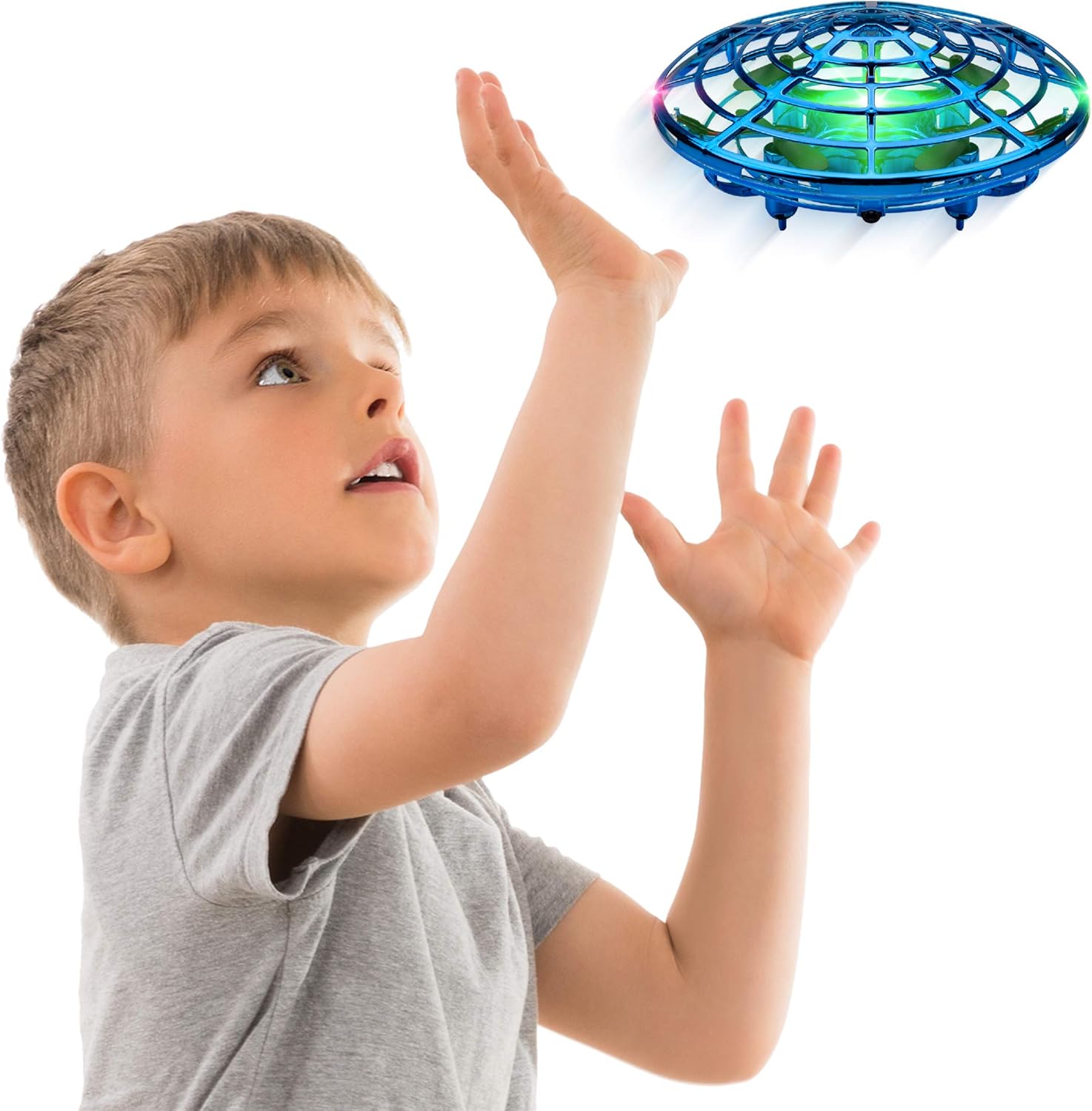
- Force1 Scoot Drone (Blue): The primary 4.7-inch circular flying craft featuring an internal multi-rotor drive assembly shielded completely behind an impact-resistant plastic webbed shell.
- USB Charging Cable: A dedicated charging lead tailored for the internal lithium-ion cell, compatible with standard USB power bricks, power banks, and computer ports.
- Comprehensive Product Manual: A clearly illustrated guide outlining basic launch routines, proximity steering interactions, safe hamburger-style catching methods, and battery maintenance.
- Integrated 360-Degree Obstacle Detection Array: Onboard motion sensors embedded along the perimeter designed to continuously monitor proximity and redirect flight paths.
- Onboard Vibrant LED System: Multi-color internal lighting that illuminates the interior framework during active rotation and low-light operation.
- Factory-Calibrated Internal Flight Controller: An automated stabilization system that handles altitude hold, takeoff detection upon release, and gentle hover positioning without external trimming.
Key Specifications
| Specification Category | Listing Detail |
|---|---|
| Product Model | Scoot Blue |
| Physical Dimensions | 4.7 inches L x 4.7 inches W x 2.0 inches H |
| Total Unit Weight | 1.12 ounces |
| Control Architecture | Hand-operated motion sensor guidance |
| Obstacle Sensing | 360-degree infrared proximity avoidance |
| Chassis Construction | Flexible plastic webbed 360-degree shell |
| Battery Chemistry | Lithium-ion rechargeable internal cell |
| Estimated Flight Duration | Up to 8 minutes per charge |
| Recharge Window | Approximately 50 minutes via USB |
| Wireless and Media Features | No wireless communication; no camera or media capture |
Indoor Safety and the Webbed Shell Enclosure
Deploying a traditional quadcopter inside a home or studio environment frequently introduces real anxiety regarding property damage and physical injury. High-speed spinning blades easily slash curtains, scratch wooden surfaces, or injure curious hands. When operating a dedicated force1 scoot drone for indoor use, physical safety stems directly from the structural cage surrounding the internal mechanical rotors. The Scoot utilizes a resilient, flexible plastic lattice that fully encompasses the top, bottom, and lateral perimeter of the rotating components, creating a continuous protective buffer between the propulsion system and your surroundings.
This enclosed layout allows the drone to bounce harmlessly off bookcases, computer displays, and drywall without leaving structural abrasions or stalling the internal motors. In contrast to hobby-grade cinema platforms like a dji mini 4 pro fly more combo which demand wide outdoor margins and rigorous pilot concentration, this mini craft invites tactile interaction. When a flight session concludes or the unit drifts near a spectator, you simply collect it out of the air by pinching the upper and lower rims of the webbed shell—an approach the manufacturer designates as catching it hamburger-style.
Beyond safeguarding personal property, the cage geometry provides essential longevity for the aircraft itself. During test descents and incidental collisions, the pliable polymer absorbs impact energy before distributing shock away from the delicate internal motor shafts. Beginners, young family members, and casual hobbyists can experiment freely without the lingering fear that a single miscalculated trajectory will shatter a rotor arm or snap an exposed propeller blade.
Motion Sensor Navigation and Hands-Free Flight Handling
Controlling an unmanned aerial craft typically demands muscle memory, stick calibration, and constant spatial awareness. The force1 scoot hands free drone eliminates conventional dual-stick transmitters entirely in favor of an autonomous hover profile guided by gesture recognition. Upon tossing the lightweight 1.12-ounce orb into still air, internal gyroscopic sensors immediately trigger the propulsion motors, catching the craft mid-fall and establishing a stable hover height without any user-inputted trim commands.
Directional steering relies upon the force1 scoot obstacle avoidance system, which uses perimeter-mounted proximity sensors scanning 360 degrees of horizontal space. When you raise an open palm toward one flank of the aircraft, the corresponding sensor registers the incoming obstacle and pulses the opposing brushless motors to push the craft away in the opposite direction. By angling your hands around the perimeter or grouping multiple players into a circle, you can direct the force1 scoot ufo flying toy across a room like an aerial game of catch without ever making physical contact during flight.
While the responsive motion detection provides smooth, intuitive interactions in controlled spaces, pilots should account for the physical dynamics of infrared sensing. Highly reflective surfaces, deep glossy furniture finishes, or intense direct sunlight beaming through open windows can occasionally scatter sensor pulses, causing momentary latency in avoidance maneuvers. In stable domestic lighting, however, the force1 scoot motion sensor mini drone reads proximate hand movements predictably, delivering an engaging, interactive flight loop that feels markedly distinct from screen-tethered remote operation.
Battery Endurance and Recharging Dynamics
Small-scale flight hardware is always constrained by the immutable physics of power-to-weight ratios. The force1 scoot battery life delivers a continuous flight window of up to 8 minutes under normal operating conditions. While an eight-minute operating span might initially appear brief to those accustomed to long-range outdoor craft like a dji mavic 4, eight minutes represents solid operational stamina for a palm-sized indoor drone carrying a comprehensive physical enclosure and active sensor arrays.
Replenishing the internal lithium-ion power pack requires an average force1 scoot drone charging time of approximately 50 minutes. The included USB charging lead connects directly into the craft’s recessed charging port, allowing you to replenish power using standard low-voltage USB adapters, desktop workstations, or portable field banks. Because the battery is integrated directly inside the protective cage to maintain balance and protect the cell from collision forces, hot-swapping spare batteries on the fly is not possible, meaning flight sessions must be spaced around the recharge cycle.
Managing the force1 scoot drone flight time efficiently involves pacing your domestic sessions and recognizing low-voltage warnings. When the internal cell nears depletion, the vibrant internal LED illumination alters its pattern, and the altitude-hold system gently lowers the craft toward the ground to prevent catastrophic drops. Allowing the battery a few minutes to cool down before plugging in the charging cable helps preserve long-term cell chemistry, ensuring consistent hover stability across months of casual usage.
Flight Environment and Workspace Compatibility
Determining whether a room is suited for the Force1 Scoot largely comes down to room dimensions, thermal air currents, and surrounding clutter. The unit measures a compact 4.7 inches in diameter and 2 inches in vertical height, enabling it to operate comfortably in modest living rooms, bedrooms, or creative studios. Because the propulsion wake generated by the small rotors is minimal, the drone does not scatter loose desk papers or trigger overwhelming downdrafts, making it remarkably unobtrusive around home office workstations.
However, indoor aerodynamics do play an active role in how smoothly the craft hovers. Overhead ceiling fans, air conditioning vents, or heavy drafts from open hallways will create air turbulences that push against the ultra-light 1.12-ounce chassis. When encountering strong drafts, the internal flight computer works harder to balance its position, which can consume extra battery power and result in mild drift toward adjacent walls. Flying in calm, enclosed rooms ensures the most stable hover behavior.
For individuals comparing different models in this specialized category, such as the target-shooting variant known as the force1 scoot skeet drone, the standard Scoot model prioritizes pure social interaction and spatial obstacle negotiation. Its vibrant LED light indicators illuminate the inner framework, making evening flights in dimmed rooms particularly striking. The luminous glow not only adds aesthetic appeal for casual observers but also provides sharp visual orientation so you can instantly track the drone’s position against dark backgrounds.
Is the Force1 Scoot Worth It
Evaluating whether this hand-operated flyer belongs in your gear collection hinges entirely on what you expect from an indoor aircraft. If you are searching for a camera platform, manual aerial acrobatics, or outdoor long-distance exploration, the complete absence of optical lenses, radio transmitters, and heavy wind resistance will leave your creative workflow unserved. For creators needing video capture or mapping tools, serious remote-controlled platforms remain essential.
Conversely, for creators and hobbyists who want a zero-maintenance indoor stress-reliever, a desk-side novelty, or an exceptionally safe flying toy for kids aged eight and up, the value proposition is unmistakable. The combination of complete propeller shielding, automated toss-to-launch mechanics, and responsive proximity avoidance eliminates the steep frustration curve that typically plagues miniature indoor quadcopters. It performs its intended function reliably without damaging your living environment or demanding pilot certification.
Ultimately, the Force1 Scoot succeeds by narrowing its focus to safe, interactive physical play. It bridges the gap between complex robotics and accessible recreation, offering dependable hover control and forgiving impact durability within a self-contained, lightweight profile.
FAQ
How do you launch and land the Force1 Scoot?
Launching the craft is entirely manual and requires no remote controller: gently toss the drone upward into the air, and its internal flight sensors will detect the motion, start the propellers, and stabilize the craft into an automated hover. To land the drone, approach it from the side and catch the top and bottom of the webbed shell hamburger-style, then turn it upside down to power down the motors.
Can the Force1 Scoot be flown outdoors?
The Force1 Scoot is engineered specifically as an indoor hover drone. Because it weighs only 1.12 ounces and relies on infrared proximity sensors for obstacle avoidance, ambient outdoor sunlight can interfere with the sensors, and even minor natural wind gusts will easily overpower the lightweight frame and carry it away.
What are the exact Force1 Scoot drone specs for size and weight?
The drone features physical dimensions of 4.7 inches in length, 4.7 inches in width, and 2.0 inches in height, forming a circular spherical profile. The entire assembly weighs 1.12 ounces, keeping it exceptionally lightweight and compliant with indoor safety needs.
How long does the battery last and how do you recharge it?
The integrated lithium-ion battery provides up to 8 minutes of continuous flying time on a complete charge. Recharging is handled via the included USB cable, which connects to standard USB power ports and takes roughly 50 minutes to restore full battery capacity.
Does the Force1 Scoot have a camera or remote control?
No, the listing confirms that the Force1 Scoot does not feature wireless communication, a camera, or media recording capabilities. It operates purely as a hand-guided motion sensor drone without any external handheld transmitter or smartphone software connection.