As Amazon Associates, we earn from qualifying purchases. This means we may receive a small commission at no extra cost to you if you click through and make a purchase.
Evaluating the Force1 Scoot Skeet requires understanding its role as a standalone, hand operated indoor drone. This specific package delivers only the drone unit, meaning it arrives without the compatible LED blaster gun. Shoppers frequently wonder if an autonomous target drone can provide dependable flight and long-term engagement on its own. The short answer is yes: the craft operates independently via internal infrared sensors, using responsive gesture navigation to hover, dodge domestic obstacles, and execute mid-air stunts without requiring secondary accessories.
For hobbyists, parents, and creators seeking a safe environment to introduce multi-rotor flight concepts indoors, this platform provides risk-free handling. In this force1 scoot skeet drone review, we analyze how its sensor-driven mechanics behave in confined rooms, examine its battery endurance and recharge cycles, explore the standalone value of its target shooting technology, and establish clear expectations for who will benefit most from adding this hands-free aircraft to their indoor recreation setup.

What You Get With the Force1 Scoot Skeet
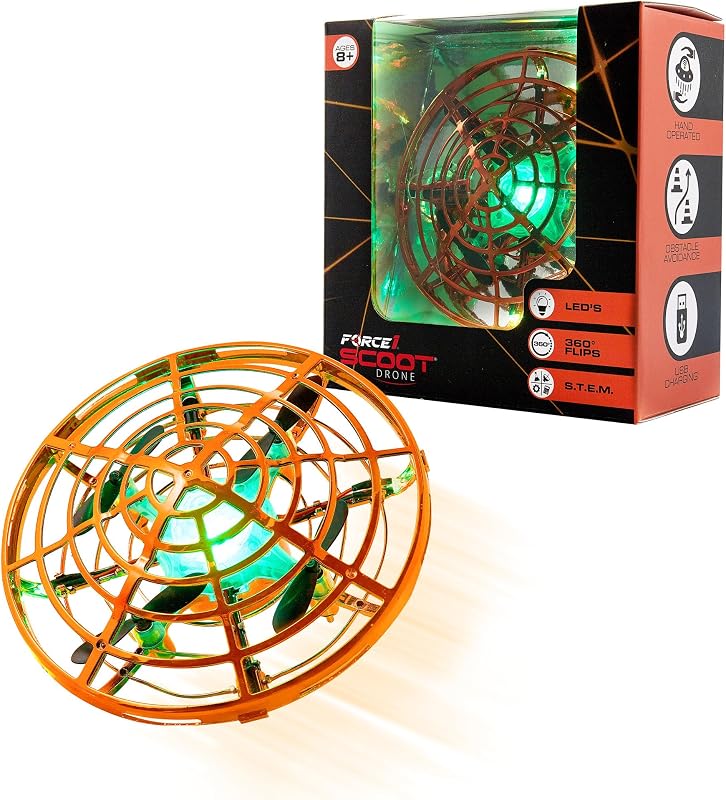
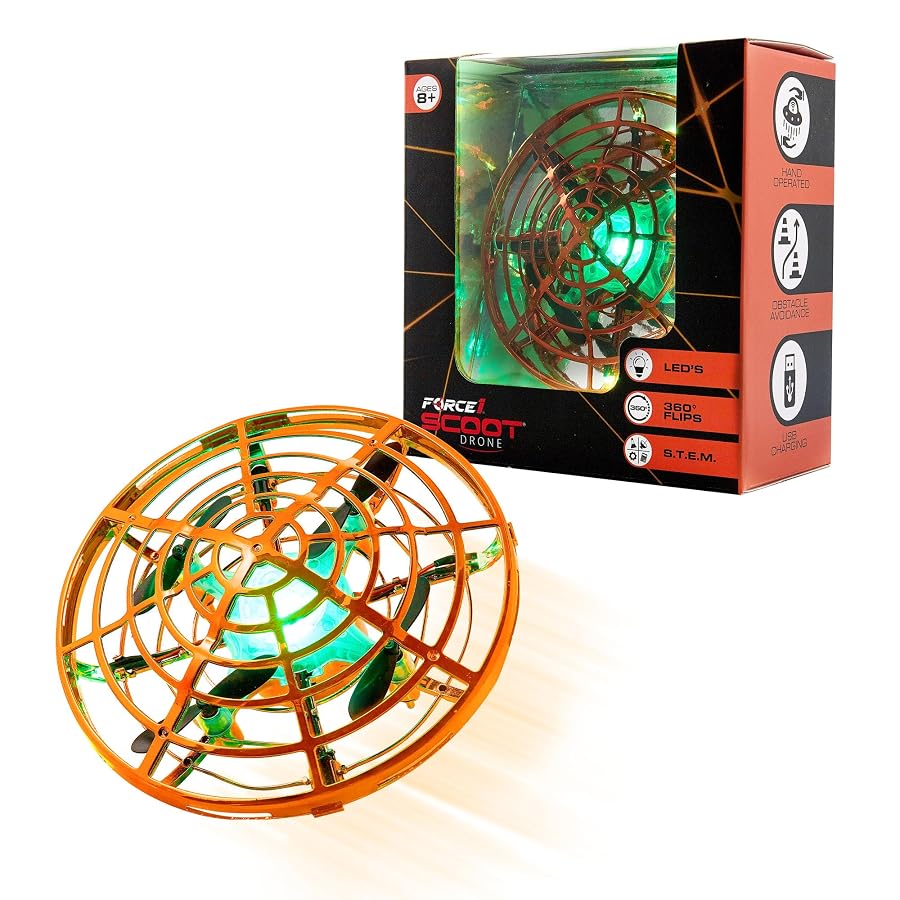
The product package contains the core hardware necessary to begin flying immediately out of the box. Because this listing represents the drone-only configuration, the interactive target blaster gun is sold separately and is not supplied in this retail package.
- Orange Scoot Skeet drone with an integrated rechargeable lithium polymer battery
- Dedicated USB charging cable for replenishment via standard USB power ports
- Pre-installed internal propeller system completely shielded within the chassis
- Protective 360-degree webbed outer cage built from durable, nontoxic plastic
- Special integrated motion LED sensors engineered for Scoot Skeet blaster compatibility
Key Specifications
The published force1 scoot skeet drone specs define a compact, lightweight indoor platform built strictly for short-range recreational hovering and gesture navigation.
| Specification Attribute | Manufacturer Detail |
|---|---|
| Dimensions | 4.75″L x 4.75″W x 1.97″H |
| Control System | Infrared gesture control |
| Maximum Operational Range | 8 feet |
| Flight Duration | Approximately 7 minutes |
| Recharge Period | 50 minutes via USB cable |
| Battery Chemistry | Internal Lithium Polymer cell |
| Intended Age Group | Beginner pilots ages 8 and up |
| Construction Material | Nontoxic, durable plastic webbed shell |
| Acrobatic Capabilities | 360-degree flips and auto-hover altitude hold |
Flight Mechanics and Hands-Free Gesture Navigation
The operational appeal of the aircraft centers on its fully automated stabilization and tactile force1 scoot skeet gesture control. Bypassing standard radio transmitters and smartphone interfaces, the device utilizes the patented motion sensor architecture found on the original force1 scoot drone. Getting airborne requires no trim tuning or compass calibration. Once powered on, a gentle toss into the air triggers the internal altitude hold system, prompting the quadcopter to establish an autonomous hover at roughly eye level while actively scanning for physical interaction.
Guiding the craft across a room relies entirely on hand proximity. Approaching the outer rim with an open palm prompts the infrared sensors to push the aircraft away in the opposite direction. This enables smooth passing games between two people without any physical contact. Beyond standard directional drifting, the internal flight controller includes programmed stunt routines. Positioning hands around specific sensor zones signals the drone to execute automated 360-degree aerial flips before instantly regaining its level hover, providing engaging visual feedback that appeals to beginner pilots.
Pilots must note the functional boundaries of this infrared guidance system. The manufacturer rates the maximum operational range at 8 feet, meaning the craft must remain in close quarters with its human guides. Unlike conventional remote-controlled aircraft like the drone dji mini 3 that accommodate wide-area piloting across hundreds of feet, this platform is tailored specifically for tight, close-up interactions where participants physically follow the drone through domestic rooms.
Indoor Safety and Obstacle Detection in Confined Spaces
Flying any aircraft inside a home raises immediate concerns regarding delicate furniture, television screens, and personal safety. The Force1 Scoot Skeet for indoor flight addresses these issues through an entirely enclosed chassis. Instead of leaving high-speed rotor blades exposed, the craft embeds its propellers within a flexible, nontoxic webbed plastic cage. This barrier prevents spinning blades from making direct contact with fingertips, walls, or household decor, eliminating the scuffs and painful finger nips often associated with miniature quadcopters.
Complementing the physical cage is the integrated force1 scoot skeet obstacle avoidance system. Miniature infrared sensors stationed around the perimeter continuously gauge distances to surrounding boundaries. When the drone drifts toward a doorway, cabinet, or wall, the system detects the obstruction and reverses propeller thrust to back away automatically. Should the craft drift into an irregular object like hanging drapery that bypasses optical sensors, the pliable shell absorbs the impact and rebounds without shattering the frame or motor mountings.
Even with functional obstacle detection, indoor environments introduce physical limitations. Strong HVAC currents, overhead ceiling fans, or drafts from exterior doors can push the ultra-lightweight frame off course faster than the automated correction system can react. Hobbyists familiar with heavier outdoor equipment like a drone mini pro neo should recognize that this micro flyer lacks mechanical trim or wind-resistance algorithms, requiring calm indoor air to maintain reliable spatial tracking.
Battery Endurance and Turnaround Cycles
Battery capability represents a major practical consideration for miniature aircraft, and this model adheres to typical micro-drone power limitations. The official force1 scoot skeet flight time delivers approximately 7 minutes of sustained airborne operation on a full charge. Powering four lift motors, processing continuous infrared obstacle detection, and driving the integrated LED sensors simultaneously places high demands on the internal lithium polymer battery, making 7 minutes standard for this compact weight class.
The primary constraint during play sessions is the substantial charging period. Replenishing the internal cell takes approximately 50 minutes through the supplied USB charging cable. Because the lithium polymer battery is sealed permanently inside the central chassis rather than mounted in a modular, swappable compartment, you cannot rotate fresh spare batteries into the airframe. When the charge depletes, the entire aircraft must remain grounded and plugged into a powered USB source before flying again.
Managing this force1 scoot skeet battery life requires sensible session planning. For casual recreational breaks or brief STEM demonstrations, a 7-minute flight window offers ample opportunity for interactive games. However, larger group activities or back-to-back flight experiments will experience substantial downtime. Knowing that each flight session requires nearly an hour of recovery prevents frustration and keeps expectations grounded regarding the operational rhythm of the aircraft.
Target Shooting Functionality and Standalone Value
What separates this model from standard hover balls is its integrated target sensor array. The fuselage features specialized optical LED receptors specifically designed for scoot skeet drone target shooting activities. In a complete hardware configuration, these sensors communicate with an infrared Scoot Skeet light blaster gun, registering direct hits and causing the hovering drone to perform evasive maneuvers or sink toward the floor, turning the autonomous drone into an airborne shooting gallery.
Prospective buyers must note that this listing is the drone-only edition, meaning the interactive LED blaster gun is not included in the package. The manufacturer data does not specify whether alternative infrared transmitters or generic laser tag blasters will trigger these proprietary LED target sensors. If your primary goal is running competitive shooting games, you will need to source the compatible Scoot Skeet blaster separately to access those interactive hit-detection mechanics.
Fortunately, the lack of a blaster does not cripple the flight performance of the machine. The drone functions fully on its own as an autonomous, obstacle-dodging hover toy. Users can launch it, direct its movement with hand gestures, and trigger 360-degree flips without touching a blaster or remote control. For households simply seeking an engaging, safe indoor flyer, the aircraft delivers complete standalone entertainment value while leaving the target shooting feature open as a future upgrade.
Check Force1 Scoot Skeet on Amazon
Is the Force1 Scoot Skeet Worth It
Deciding whether this aircraft fits your recreation needs comes down to who will pilot it and the kind of control experience you want. Addressing whether the force1 scoot skeet is worth it requires recognizing its role as a dedicated indoor entertainment tool. For parents, educators, and beginner flyers ages 8 and up, the drone provides dependable value. Its resilient webbed casing protects household property, the toss-to-launch mechanics remove intimidating configuration hurdles, and the hands-free gesture navigation delivers instant engagement without complex controller training.
Conversely, experienced drone pilots and content creators seeking rigorous manual piloting practice will find the platform heavily constrained. Without physical control sticks, camera hardware, or manual throttle modulation, the drone cannot teach stick muscle memory or cinematography techniques. If you are shopping for a training platform to prepare for sophisticated camera quadcopters like a dji mavic 4, this autonomous craft will feel too automated and restrictive due to its programmed hover routines and 8-foot range limit.
Ultimately, the Force1 Scoot Skeet succeeds by delivering a safe, durable, and crash-resilient aerial experience for indoor environments. As long as buyers keep in mind that the blaster gun requires a separate purchase and accept the 50-minute recharge cycle, this hands-free flyer provides reliable, safe domestic flight that avoids walls and keeps spinning rotors away from fingers.
FAQ
Does the Force1 Scoot Skeet include the blaster gun in the box?
No, this package contains the drone only. The compatible Scoot Skeet LED blaster gun is sold separately, though the drone operates completely independently using hands-free gesture control without the blaster.
How long does the Force1 Scoot Skeet take to charge?
The built-in lithium polymer battery takes approximately 50 minutes to fully recharge using the included USB cable, providing roughly 7 minutes of continuous flight time.
Can the Force1 Scoot Skeet be used outdoors?
The drone is designed specifically for indoor use. Outdoor breezes easily overcome the lightweight frame, and direct sunlight can interfere with the infrared sensors that manage obstacle detection and gesture tracking.
How do you steer the Force1 Scoot Skeet without a remote?
The drone uses built-in infrared sensors to track hand proximity. Placing your hand near the side of the shell pushes the craft in the opposite direction, allowing you to guide its flight path hands-free.
Can you replace the battery when it runs out of power?
No, the drone houses an internal, non-removable lithium polymer battery. You cannot swap battery packs; the entire unit must be plugged into a USB port to recharge between flights.
Indoor flight sessions often stir up dust bunnies and light debris from shelves or corners that rarely see action. Keeping your play space clear ensures obstacle-free flight paths for future launches, making a lightweight cleanup tool essential. Exploring the latest Cordless Vac Verdict gives you practical options for swiftly clearing away fallen dust after an afternoon of target practice.


