As Amazon Associates, we earn from qualifying purchases. This means we may receive a small commission at no extra cost to you if you click through and make a purchase.
For solo creators, remote field broadcasters, and mobile videographers, carrying a heavy laptop and external capture cards everywhere creates significant setup friction. The Magewell Director Mini addresses this challenge directly by consolidating switching, multi-destination encoding, recording, and monitoring into a single handheld chassis. If you are deciding whether this unit is the right buy for your setup, it is designed specifically for creators who need a self-contained, portable video switcher that eliminates the computer entirely while maintaining broadcast-grade feed switching. Rather than wrestling with software crashes or multiple dongles, this device gives you a dedicated hardware environment capable of handling multiple inputs anywhere you have network access.
In this detailed Magewell Director Mini review, we examine how the device performs across various production environments, outline the complete Magewell Director Mini specs, explore battery runtime and connectivity options, and evaluate whether the standalone streaming encoder workflow suits your production needs. We also break down its scene creation tools, network streaming capabilities, and overall value to help you decide if it fits into your mobile gear bag.
What You Get With the Magewell Director Mini

The listing outlines a fully integrated hardware package engineered to function as an all-in-one broadcast studio without requiring an external computer or secondary preview monitor.
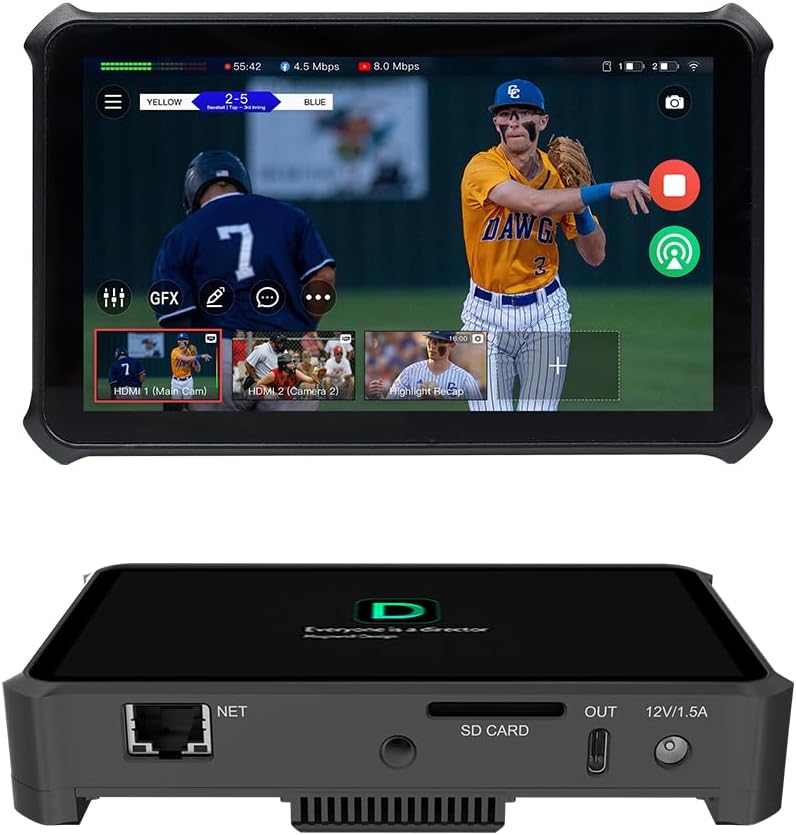
- Hardware switching and encoding hub powered by a built-in 5.44-inch capacitive AMOLED touchscreen for live preview and scene management
- Dual HDMI input ports alongside two USB-A ports supporting webcams, UVC devices, and peripheral expansion
- Support for up to three simultaneous IP video inputs, including NDI HX, SRT, RTMP, and RTSP streams, plus mobile camera feeds and media playback
- Simultaneous H.264 and H.265 hardware encoding up to 1080p at 60 frames per second with user-adjustable bitrates
- Dual hot-swappable NP-F battery mounting slots and a dedicated DC power port for uninterrupted field operation
- Simultaneous recording and streaming to internal storage and external SD cards
- Integrated production toolset featuring chroma keying, custom graphics, overlays, scoreboards, lower thirds, timers, and live webpage rendering
- Network connectivity suite featuring gigabit Ethernet, dual-band Wi-Fi, and cellular support via external USB modems
- Cross-platform remote management compatibility through dedicated mobile applications for Android and iPhone
Key Specifications
| Specification Attribute | Technical Detail |
|---|---|
| Display Screen | 5.44-inch capacitive AMOLED touchscreen |
| Physical Video Inputs | 2x HDMI, 2x USB-A |
| Network IP Video Sources | Up to 3 simultaneous (NDI HX, SRT, RTMP, RTSP) |
| Video Encoding Formats | H.264, H.265 (HEVC) up to 1080p60 |
| Audio Channels and Processing | Stereo (2 channels), HD audio codecs, HDMI and USB output |
| Recording Storage Media | SD card slot and internal storage |
| Power Architecture | Dual hot-swappable NP-F battery slots and DC power input |
| Power Consumption | 15 Watts |
| Network Connectivity | Dual-band Wi-Fi, Ethernet, optional cellular via USB modem |
| Supported Streaming Targets | YouTube, Twitch, Facebook, RTMP, SRT |
| Control Options | Capacitive touchscreen, Android and iPhone mobile apps |
Input Flexibility and Multi-Source Switching
Managing multi-camera shoots in mobile settings traditionally required an array of capture cards, splitters, and desktop software. As a compact live production switcher, this unit bypasses those headaches by pairing two full-sized HDMI inputs with two versatile USB-A ports. This physical arrangement allows creators to connect mirrorless cameras directly through HDMI while simultaneously routing plug-and-play webcams, capture dongles, or digital media feeds into the USB ports. Having both connection types on a handheld chassis ensures you can mix standard production cameras with modern digital capture devices without carrying signal converters.
For creators who usually lug a high-performance gaming rig like the msi titan 18 hx dragon edition norse myth just to run desktop OBS for multi-camera feeds, moving to a dedicated compact switcher substantially cuts down setup footprint and cable mess. In addition to physical ports, the hardware handles up to three concurrent IP sources, giving you the freedom to incorporate network camera streams, remote RTMP inputs, or wireless smartphone video directly into your active scenes. Switching between physical HDMI angles, incoming network streams, and stored media clips happens seamlessly through the hardware video signal processor.
Audio routing is equally straightforward thanks to integrated HD audio codec support and stereo output handling. The system processes stereo sound across two discrete channels, routing clean audio alongside video streams through HDMI and USB outputs. Field audio setups can easily plug in external wireless receiver kits such as the dji mic mini transmitter to capture crisp dialogue directly into the primary camera feed or digital input, keeping the entire broadcast in sync without needing a separate analogue audio mixer on your mobile desk.
Real-World Portability and Battery Management
True mobile broadcasting demands continuous power independent of AC wall outlets. The device tackles this requirement through dual hot-swappable NP-F battery mounts built directly into the rear housing. Drawing just 15 watts during active production, the Magewell Director Mini battery power architecture allows creators to swap depleted battery packs sequentially without ever cutting off the live broadcast or corrupting an ongoing local recording. This uninterrupted power handoff is crucial for sideline sports coverage, convention walk-throughs, and remote outdoor events where AC drops simply do not exist.
When operating inside a fixed studio or temporary control room, the unit shifts easily to mains power using its dedicated DC input jack. This dual-power strategy ensures you do not waste battery cycles while staging scenes, setting up graphics, or conducting pre-show sound checks at a desk. Switching between DC power and battery power happens transparently, so accidental power cord disconnects during busy live events will not terminate your transmission as long as backup NP-F batteries are seated in the mounts.
This power flexibility elevates the director mini mobile workflow above conventional field encoder rigs. Because the entire switching, monitoring, and power system occupies a single form factor roughly the size of a field monitor, solo operators can mount the unit directly on a tripod arm, fluid head, or lighting stand. Eliminating loose power bricks, external monitor batteries, and tangled DC splitters drastically accelerates deployment times when moving between shooting locations.
Network Streaming and NDI Integration
Evaluating the Magewell Director Mini for live streaming highlights its robust connectivity suite, tailored specifically for unpredictable network environments. The unit features integrated dual-band Wi-Fi for wireless local network access alongside a standard gigabit Ethernet port for secure wired connections. For outdoor creators streaming far beyond Wi-Fi access points, the listing highlights cellular connectivity support via external USB modems, though you must supply your own compatible cellular modem to access mobile carrier data.
One of the most powerful protocol capabilities on this device is Magewell Director Mini NDI support. With NDI HX implementation alongside SRT, RTMP, and RTSP protocols, you can incorporate low-latency networked video sources across a local area network without stringing lengthy HDMI cables through crowded event halls. A remote camera situated across a venue can transmit high-definition video over standard network switches directly into your scene layout, significantly expanding your production coverage without extra physical cabling.
The internal hardware encoder handles both H.264 and modern H.265 compression, delivering crisp 1080p output at up to 60 frames per second. Users can fine-tune streaming bitrates to match available network bandwidth, preventing frame drops during peak congestion. Furthermore, the system supports multi-destination outputs, allowing simultaneous transmission directly to platforms like YouTube, Twitch, and Facebook, or custom RTMP and SRT servers without needing an external cloud restreaming service.
Onboard Monitoring and Scene Control Usability
Monitoring incoming video feeds directly on the unit is made effortless by the integrated 5.44-inch capacitive AMOLED touchscreen display. The panel delivers deep contrast and vivid colors, making it easy to confirm camera focus, color balance, and exposure even when working in ambient lighting conditions. Direct touch interaction lets you tap between camera angles, fire lower thirds, and trigger scene transitions instantly without needing physical switch buttons or a tethered computer mouse.
Beyond simple input switching, the device includes a comprehensive suite of digital production tools built right into the firmware. Operators can construct complex broadcast scenes complete with chroma key green-screen removal, graphic overlays, lower thirds, countdown timers, scoreboards, and live webpage elements. This depth of visual customization means sports streamers, church production teams, and corporate webinar hosts can deliver polished, television-style broadcasts straight from the device without post-production software.
For scenarios where the operator must step away from the switcher, wireless control options through dedicated mobile apps for Android and iPhone provide total operational freedom. You can trigger scene cuts, adjust audio levels, and monitor stream health directly from a smartphone screen. While the 5.44-inch AMOLED provides excellent local monitoring, studio setups can route program outputs via HDMI to large reference screens like a sony bravia 7 55 for client previewing in a green room or control tent.
Check Magewell Director Mini on Amazon
Is the Magewell Director Mini Worth It
Determining whether the device fits your kit comes down to your production style and mobility requirements. For solo creators, mobile journalists, traveling sports broadcasters, and houses of worship looking to streamline live productions, this hardware switcher solves nearly every workflow pain point. By combining an AMOLED field monitor, hardware video switcher, multi-protocol streamer, and dual-battery power hub into one chassis, it eliminates the bulk, complexity, and failure points of multi-component laptop rigs.
However, larger production teams with extensive multi-camera requirements should note its hardware limitations. The system provides two physical HDMI ports, so broadcasts requiring four or more direct HDMI camera feeds will have to rely on IP streams, NDI sources, or USB capture devices to fill additional angles. Furthermore, the video encoding is capped at 1080p at 60 frames per second, meaning operations strictly requiring full 4K delivery will need higher-tier hardware pipelines.
When evaluated strictly on its intended purpose—a dependable, PC-free, standalone mobile broadcast hub—the Magewell Director Mini delivers outstanding utility. If your goal is to produce multi-source live streams on location with minimal setup time and rock-solid hardware stability, this compact production powerhouse easily justifies its place in a creator gear bag.
FAQ
Can the Magewell Director Mini record and stream at the same time?
Yes, the device supports simultaneous streaming and recording workflows. It can record your program output as well as individual sources directly to an external SD card or internal memory while simultaneously encoding and streaming live to web destinations.
What types of batteries does the device accept for mobile operation?
The unit features dual hot-swappable NP-F battery slots on the back panel. This design allows you to remove and replace an exhausted battery while the device continues running on the second battery, providing uninterrupted mobile power in the field.
Does the unit support cellular data streaming directly out of the box?
The device supports cellular connectivity, but it does not contain a built-in cellular modem or SIM card slot. To stream over a cellular network, you must plug a compatible external USB cellular modem into one of the available USB ports.
Can you control the switcher remotely without touching the screen?
Yes, remote control is fully supported through official companion apps available for Android and iPhone smartphones. This allows solo operators to switch scenes, monitor status, and manage feeds wirelessly from their mobile phone.
What is the maximum video streaming resolution supported by the hardware?
The internal hardware encoder supports H.264 and H.265 compression up to a maximum resolution of 1080p at 60 frames per second, with customizable bitrates for various streaming platforms.