
As Amazon Associates, we earn from qualifying purchases. This means we may receive a small commission at no extra cost to you if you click through and make a purchase.
Evaluating a dedicated graphics card for content creation requires balancing rendering throughput, acoustic behavior, and physical compatibility. The MSI GTX 1650 Super Gaming X stands out as a compact dual-fan desktop component engineered to handle standard high-definition production tasks without generating distracting acoustic noise. Content creators, vloggers, and hobbyist video editors looking to accelerate rendering times and maintain fluid timeline playback will find that this dedicated GPU targets entry-level desktop workstations with a practical set of hardware capabilities. Built around NVIDIA’s Turing architecture, this model brings dedicated video encoding hardware into a power-efficient profile that fits cleanly into smaller desktop builds.
For creators working primarily with 1080p video footage, standard graphic design suites, and multi-monitor productivity setups, understanding how this specific card performs under sustained render loads is essential. While flagship graphics processing units target extreme resolutions and massive memory footprints, this card focuses on providing reliable daily operation, low operational volume, and robust video decoding. In this review, we examine thermal dissipation, timeline responsiveness, hardware-accelerated video rendering, memory limitations, display connectivity, and overall workflow suitability to help you decide whether this graphics card matches your production requirements.
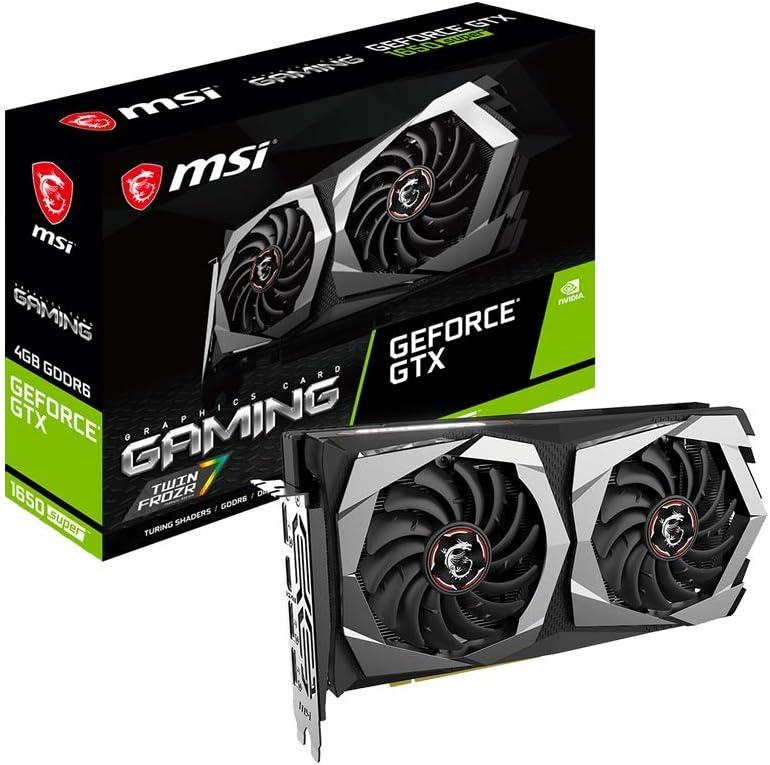
What You Get With the MSI GTX 1650 Super Gaming X

The retail package provides the essential core hardware and documentation needed to integrate the card into a compatible desktop workstation.
- MSI GeForce GTX 1650 Super Gaming X graphics card
- Included cables and connectors specified in the product packaging
- Quick setup guide for physical desktop hardware installation
- 7th generation Twin Frozr thermal design featuring dual Torx Fan 3.0 units
- Brushed metal backplate providing structural rigidity across the circuit board
- Exterior shroud design with integrated RGB lighting elements
Key Specifications
| Attribute | Detail |
|---|---|
| Graphics Processor | NVIDIA GeForce GTX 1650 Super |
| Boost Clock | 1755 MHz |
| Video Memory | 4 GB GDDR6 |
| Memory Interface | 128-bit |
| Memory Clock Speed | 12 GHz |
| Video Outputs | DisplayPort 1.4 (x3), HDMI 2.0b (x1) |
| Maximum Digital Resolution | 7680×4320 |
| Dimensions | 9.8 inches (L) x 1.7 inches (W) |
| Interface | PCI-Express x16 |
| Cooling Hardware | Dual Fan System (Twin Frozr 7) |
Thermal Dissipation and Studio Acoustic Control
In any creative studio environment, background noise is a serious concern, especially for vloggers and voiceover artists recording audio in the same room as their editing workstation. The gtx 1650 super gaming x twin frozr cooling assembly utilizes MSI’s 7th generation thermal design, pairing two specialized Torx Fan 3.0 units with custom aerodynamics to dissipate heat steadily. The fan blades combine steep curved edges to accelerate airflow alongside traditional dispersion blades that force air through the heatsink beneath. This physical arrangement keeps temperatures stable during extended timeline export sequences without subjecting the workspace to sudden, high-frequency fan whine.
For studio audio fidelity, the msi gtx 1650 super noise level remains unobtrusive during passive editing sessions and light graphic work. When reviewing timeline sequences, trimming audio tracks, or grading stills, the thermal system manages heat efficiently so that fan activity stays smooth rather than pulsing unpredictably. Creators who have previously worked on louder, single-blower graphics cards or smaller single-fan desktop boards will notice a distinctly controlled acoustic profile during everyday use. Those comparing cooling setups across the manufacturer’s lineup might also look at higher-tier cards like the msi twin frozr rtx 2060 super, which demonstrates how this dual-fan architecture scales across different power categories.
Build quality also plays a meaningful role in long-term chassis resonance and thermal control. The brushed metal backplate not only provides visual polish inside a workstation window but also reinforces the physical printed circuit board against flex over time. The 9.8-inch length and 1.7-inch thickness allow the card to fit standard ATX and Micro-ATX desktop cases comfortably without blocking adjacent expansion slots or obstructing airflow channels. By maintaining lower component temperatures, the card avoids thermal throttling, ensuring that export tasks complete predictably without mid-render performance drops.
Hardware-Accelerated Video Encoding and Editing Workflows
Content creators working in modern Non-Linear Editors (NLEs) like Adobe Premiere Pro, DaVinci Resolve, or open-source suites rely heavily on dedicated hardware encoding blocks. The msi 1650 super nvenc encoder provides dedicated silicon designed to compress and process digital video frames independently of your host central processor. Because the GTX 1650 Super features the Turing-generation NVENC block, it encodes H.264 and HEVC video streams with high visual fidelity and rapid export speeds. This architecture relieves CPU utilization during final exports, allowing vloggers to render standard 1080p web uploads quickly while keeping background productivity tasks fully responsive.
In practice, msi gtx 1650 super gaming x video editing capabilities show their greatest utility in 1080p timeline workflows involving multi-track audio, basic text overlays, color balancing, and standard transitions. Scrubbing through high-definition camera footage feels noticeably smoother than relying solely on software CPU decoding. Upgrading from older entry-level graphics adapters like the gtx 1060 msi 3gb reveals noticeable improvements in hardware decoding support for modern streaming codecs and lower power consumption during live rendering.
The overall gtx 1650 super creator workflow benefits significantly when video captures are encoded in real time. Streamers and tutorial producers who record their screens with software like OBS Studio can offload stream processing to the dedicated NVENC engine without dropping render frames in their creative applications. The boost clock speed of 1755 MHz ensures that GPU-accelerated effects—such as basic color adjustments, sharpening filters, and scaling operations—render consistently. While extreme visual effects pipelines and heavy 3D rendering will eventually saturate this GPU, standard 1080p video production operates within its sweet spot.
Memory Capacity and Timeline Resolution Boundaries
A defining aspect of this graphics card is its memory subsystem, consisting of gtx 1650 super 4gb gddr6 video memory linked across a 128-bit memory interface. Operating at a memory clock speed of 12 GHz, this configuration provides substantially higher bandwidth than older GDDR5 entry cards, helping to feed texture assets and frame buffers rapidly to the core processor. In daily production tasks, this bandwidth allows standard high-definition video timelines to maintain steady playback frames even when several video tracks and graphic overlays are stacked together.
However, creators must understand the physical ceiling imposed by a 4 GB memory limit. Modern 4K timelines, multi-camera raw video editing, and complex motion graphics compositions in software like Adobe After Effects quickly demand more than 4 GB of VRAM. Attempting to render multi-layered 4K projects can lead to memory saturation, which forces the operating system to swap assets into system RAM and causes noticeable timeline stuttering or out-of-memory warnings. Creators prioritizing mobile editing or demanding modern workloads might contrast this hardware with portable creator machines like the msi thin 15 rtx 4060, which feature expanded memory capacities and contemporary generation architectures.
For 1080p workflows, proxy-based 4K editing pipelines, and photo editing in Adobe Lightroom or Photoshop, the 4 GB GDDR6 capacity remains completely manageable. Managing timeline resolution sensibly and utilizing optimized media proxies allows editors to bypass VRAM bottlenecks cleanly. Understanding these memory parameters ensures you align your software settings with the physical capabilities of the hardware, preventing performance hiccups during critical editing sessions.
Workspace Productivity and Multi-Display Configuration
Creative productivity hinges on screen real estate, and the msi gtx 1650 super displayport setup delivers an exceptionally versatile array of physical display outputs for a card in this class. Featuring three DisplayPort 1.4 connections alongside a single HDMI 2.0b port, this GPU allows editors to configure a four-display workstation setup directly from the card. Having multiple monitors lets you assign dedicated screens for timeline playback, raw asset bins, script notes, and color correction scopes without continually switching between minimized windows.
The hardware supports a maximum digital display resolution of 7680×4320, meaning that running single or dual high-resolution displays is fully supported within the physical specification. For vloggers and graphic artists using calibrated color monitors alongside secondary text screens, the triple DisplayPort 1.4 outputs provide secure locking connections and high refresh rate compatibility. The HDMI 2.0b connection accommodates consumer 4K televisions or standard external reference displays for client playback review.
Physical installation into desktop chassis environments is straightforward thanks to standard PCI-Express x16 interface compatibility. The card dimensions of 9.8 inches by 1.7 inches ensure that it fits inside most compact micro-ATX editing towers, leaving adequate clearance for front intake case fans. For creators building or upgrading a dedicated home office editing station, having four modern digital video outputs on an energy-conscious card provides significant flexibility when organizing an ergonomic multi-screen workspace.
Check MSI GTX 1650 Super Gaming X on Amazon
Is the MSI GTX 1650 Super Gaming X Worth It
Determining if the card represents the right investment comes down to your primary production media and workstation goals. When evaluating whether is msi gtx 1650 super gaming x worth it, hobbyists, vloggers, and independent digital creators editing primarily in 1080p resolution will discover a balanced hardware option. The combination of the Turing NVENC encoding engine, efficient dual-fan cooling, and low operational acoustics makes it well-suited for home studios where silent operation and quick export times take precedence over massive raw computing horsepower.
On the other hand, commercial filmmakers, 3D animators, and creators who routinely process multi-stream 4K RAW or 6K cinema footage should recognize the inherent constraints of a 4 GB GDDR6 memory buffer. Heavy color grading nodes, optical flow frame interpolation, and complex compositor trees will quickly push past the memory ceiling of this card, leading to sluggish timeline performance. For those heavier workloads, investing in a workstation GPU with at least 8 GB or 12 GB of VRAM is a more pragmatic long-term strategy.
Reviewing the msi gtx 1650 super gaming x specs shows that for its intended bracket—focused 1080p video editing, screen recording, podcast video production, and multi-monitor office productivity—the card delivers solid, dependable engineering. Its robust Twin Frozr thermal solution ensures consistent clock speeds, while the low noise profile keeps audio recording zones clean. For creators seeking a capable desktop GPU that accelerates day-to-day video exports without complicating system thermal management, this model remains a sensible, purpose-built choice.
FAQ
Does the MSI GTX 1650 Super Gaming X support 4K video editing?
While the card can output video to displays up to 7680×4320 resolution, editing complex multi-track 4K video timelines is constrained by its 4 GB GDDR6 memory buffer. For light 4K cutting or workflows utilizing 1080p editing proxies, the card operates reliably, but dense 4K timelines with heavy visual effects may experience memory bottlenecks.
What video outputs are available on the MSI GTX 1650 Super Gaming X?
The card features four digital outputs: three DisplayPort 1.4 connectors and one HDMI 2.0b port. This layout allows creators to connect up to four displays simultaneously for expanded timeline viewing and asset management.
How quiet is the cooling system during video rendering?
Equipped with MSI’s 7th generation Twin Frozr thermal design and dual Torx Fan 3.0 units, the card maintains controlled temperatures with minimal acoustic noise. Under rendering workloads, the fan profile remains steady, making it suitable for desktop setups situated in audio recording or voiceover spaces.
What items are included in the retail box with the graphics card?
According to the manufacturer listing, the packaging includes the MSI GeForce GTX 1650 Super Gaming X graphics card, cables and connectors, and a quick setup guide to assist with installation into your desktop system.
What interface and physical space does the card require inside a desktop?
The card connects via a standard PCI-Express x16 slot on a desktop motherboard. Its physical dimensions measure 9.8 inches in length and 1.7 inches in width, fitting standard dual-slot spacing across most ATX and Micro-ATX desktop cases.


