As Amazon Associates, we earn from qualifying purchases. This means we may receive a small commission at no extra cost to you if you click through and make a purchase.
Running modern generative pipelines, local large language models, and high-resolution diffusion checkpoints on standard desktop hardware has historically meant dealing with thermal limits, loud fan noise, and severe memory bottlenecks. The NVIDIA DGX Spark arrives as a dedicated personal supercomputer engineered to eliminate those roadblocks, providing technical creators, visual artists, and AI engineers with enterprise-grade compute directly on their desks. If you are questioning whether this compact system is the right investment for your studio, the answer depends heavily on your workflow needs: it is built specifically for users who need to fine-tune massive architectures and execute low-latency local inference without paying continuous cloud rental fees or risking client data privacy.
In this review, we examine how the hardware specifications translate to real studio productivity, covering the Desktop GB10 Grace Blackwell Chip, the extensive unified memory footprint, and how it compares in daily practice to traditional multi-GPU setups like an nvidia geforce rtx 4090 desktop rig. We will also explore the operating system environment, physical connectivity, thermal and spatial footprint, and whether this specialized machine delivers enough value to justify adding it to your production pipeline.
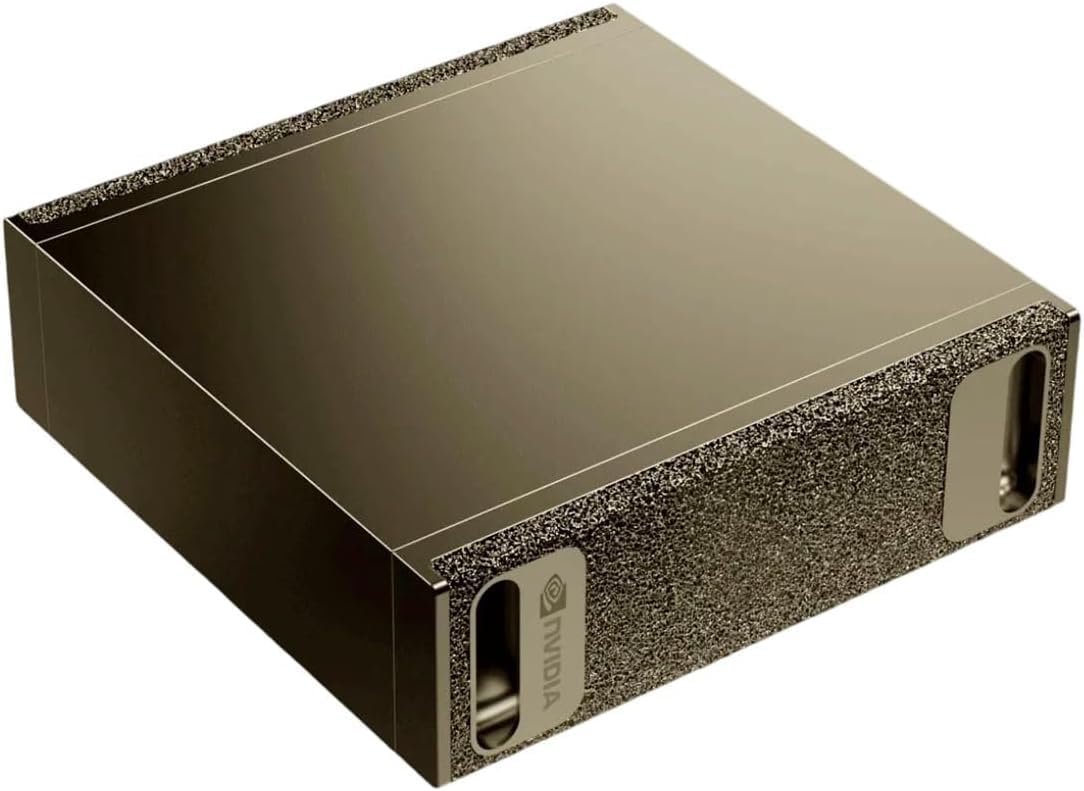
What You Get With the NVIDIA DGX Spark

The NVIDIA DGX Spark packages data-center-class machine learning architecture into an ultra-compact desktop footprint, designed to arrive ready for immediate deployment in studio, education, and business environments.
- Desktop GB10 Grace Blackwell Chip delivering up to 1 petaFLOP of AI compute performance.
- 128GB of high-speed unified DDR5 system memory to accommodate immense model architectures.
- 4 TB solid state drive for local storage of datasets, model weights, and media assets.
- NVIDIA DGX OS pre-installed with the complete NVIDIA AI software stack.
- Compact gold-toned mini PC chassis featuring a minimalist desktop aesthetic.
- Versatile physical interface array including HDMI video output, USB ports, Ethernet, and Bluetooth connectivity.
- Lightweight 1.2 kg physical build measuring 9.5 x 9.5 x 6 inches.
Key Specifications
| Specification Attribute | Hardware Detail |
|---|---|
| Processor Architecture | Desktop GB10 Grace Blackwell Chip |
| AI Compute Throughput | Up to 1 petaFLOP |
| System & Video Memory | 128 GB DDR5 Unified Memory |
| Maximum Supported RAM | 128 GB |
| Internal Storage Capacity | 4 TB Solid State Drive (SSD) |
| Form Factor Category | Mini PC |
| Chassis Dimensions | 9.5 x 9.5 x 6 inches |
| System Total Weight | 1.2 kg |
| Operating System | NVIDIA DGX OS |
| Display and I/O Connectivity | HDMI, USB, Ethernet, Bluetooth |
Local Model Fine-Tuning and Parameter Scaling
The primary attraction of this workstation is its ability to run massive generative models locally without splitting model layers across awkward consumer hardware configurations. Thanks to the nvidia spark 128gb unified memory architecture, creators and developers are no longer restricted by standard consumer video memory limits that typically top out at 24 gigabytes. By integrating system and graphics memory into a single 128GB pool, the machine allows researchers and production artists to load and run full parameter models directly on the desktop.
According to the official specifications, this hardware enables experimentation with models scaling up to 200 billion parameters at FP4 precision. For video creators and technical hobbyists running high-resolution image synthesis pipelines, complex ComfyUI workflows, or multi-modal vision-language assistants, this vast capacity means zero layer offloading latency. Achieving this level of capacity on a traditional workstation typically requires enterprise accelerator boards like the nvidia rtx pro 6000, making the unified architecture of this system uniquely accessible for rapid local prototyping.
Beyond raw parameter capacity, having up to 1 petaFLOP of AI performance via the Grace Blackwell architecture accelerates model fine-tuning cycles significantly. Creators building custom LoRA weights for character consistency, style preservation, or studio-specific language models can complete training passes locally. This capability drastically reduces iteration times, letting you adjust parameters, inspect results, and re-train in minutes without waiting in cloud compute queues or worrying about metered API billing.
Studio Integration and Mini PC Form Factor
Professional production spaces are often tightly packed with audio monitors, reference displays, camera switchers, and editing consoles. The physical design of this system directly addresses space limitations by housing its supercomputing architecture inside a mini PC chassis measuring just 9.5 x 9.5 x 6 inches and weighing 1.2 kg. The minimalist gold chassis sits easily alongside creative gear without requiring dedicated rack cabinets or industrial floor stands.
Storage management is another major factor for generative workflows where checkpoint weights, training datasets, and cache files consume gigabytes of room within days. The integrated 4 TB solid state drive offers ample capacity right out of the box to store complex model repositories, base checkpoints, and source media files. Having high-speed internal solid-state storage minimizes checkpoint loading delays, ensuring that large model files stream rapidly into system memory when switching tasks.
Physical I/O options provide straightforward desk integration. The inclusion of an HDMI video output interface allows direct hookup to standard production monitors, while integrated USB ports accommodate external storage arrays and wired accessories. For fast data transmission across studio infrastructure, the system includes Ethernet connectivity, alongside Bluetooth for wireless peripherals. This makes it effortless to integrate the hardware into an existing local area network as a dedicated compute node or desk workstation.
Operating System and NVIDIA Software Stack Usability
A critical consideration for any potential buyer is the software ecosystem. The system runs NVIDIA DGX OS, an enterprise-grade Linux distribution engineered from the ground up for high-performance computing, deep learning frameworks, and automated container management. For technical creators and machine learning practitioners, this pre-configured operating environment is a massive advantage because it guarantees full compatibility with the official NVIDIA AI software stack right out of the box.
Deploying tools such as PyTorch, TensorRT, vLLM, and Triton Inference Server requires minimal manual driver configuration compared to standard desktop operating systems. The seamless integration ensures that any pipeline, script, or automated generative workflow developed locally on your desk can be exported and deployed straight to cloud instances or data centers without encountering software version conflicts or missing runtime libraries.
However, creators accustomed to running standard desktop software suites like Adobe Creative Cloud or DaVinci Resolve should recognize the operational trade-off. Because this machine operates on DGX OS rather than Windows or macOS, it functions primarily as a dedicated AI acceleration micro-server or developer workstation. Users looking for a single box to handle timeline editing, gaming, and general productivity might prefer a hybrid setup featuring an rtx pro 4000 blackwell, while utilizing the DGX Spark as a headless background node serving generative generation requests across the studio network.
Desktop AI Supercomputing Versus Cloud Infrastructure
For independent studios, video editors, and agency creative teams, the recurring expense of cloud computing has become a major monthly overhead. Renting high-VRAM cloud instances for hours of model fine-tuning and batch rendering can lead to volatile operational expenses. Having a dedicated personal AI supercomputer on your desk turns that recurring cost into a fixed, predictable capital investment that operates around the clock without metered surcharges.
Data privacy and client confidentiality provide an even stronger justification for local compute. Studios handling sensitive unreleased commercial footage, private voice recordings, or proprietary training datasets frequently face client non-disclosure agreements that prohibit uploading assets to third-party cloud servers. Operating on-premises hardware ensures total control over intellectual property and client media, allowing production houses to offer secure, enterprise-grade AI generation without external compliance risks.
Finally, local execution eliminates the network latency inherent in cloud-based generation. Pushing gigabytes of raw 4K video clips or multi-track audio to an external cloud GPU farm creates a noticeable bottleneck. With local compute connected over wired Gigabit studio Ethernet, pipeline inputs and output renders transfer instantly, maintaining momentum across fast-paced production deadlines.
Check NVIDIA DGX Spark on Amazon
Is the NVIDIA DGX Spark Worth It
Determining whether this system is worth the investment comes down to how heavily your creative or technical pipeline relies on local machine learning execution. For AI researchers, creative technologists, independent game developers, and commercial production studios that need to fine-tune custom generative models, the machine offers remarkable value. The combination of 128GB unified memory and Grace Blackwell computing in a silent, compact form factor provides capabilities previously restricted to enterprise server rooms.
Conversely, for creators whose workflows consist purely of traditional video editing, color grading, and standard 3D rendering without custom local AI models, this machine is not the right fit. Its specialized Linux-based DGX OS environment is tailored exclusively for deep learning execution, rather than serving as an all-purpose consumer desktop for creative software suites.
For users who bridge the gap between creative production and machine learning engineering, this personal desktop supercomputer delivers an extraordinary return on investment. It liberates your workflow from recurring cloud fees, removes memory limitations, and protects sensitive media assets, making it one of the most capable dedicated studio AI accelerators available today.
FAQ
Can the NVIDIA DGX Spark run models up to 200 billion parameters?
Yes, the hardware specifications confirm that its 128GB unified memory architecture supports running and experimenting with large models up to 200 billion parameters when utilizing FP4 precision.
What operating system comes pre-installed on the NVIDIA DGX Spark?
The system comes with NVIDIA DGX OS, an enterprise Linux distribution optimized specifically for high-performance computing and the complete NVIDIA AI software stack.
Can I use the NVIDIA DGX Spark as a standard video editing PC?
The unit runs NVIDIA DGX OS, which is built for AI development, fine-tuning, and inference rather than consumer creative applications like Adobe Premiere or DaVinci Resolve. It works best as a dedicated AI compute node alongside your main editing rig.
What type of storage is included with the system?
The listing specifies an internal 4 TB solid state drive (SSD), offering generous high-speed storage for large model weights, datasets, and development environments.
What physical ports and connectivity are available on the chassis?
The system features an HDMI video output interface, multiple USB ports, wired Ethernet networking, and integrated Bluetooth connectivity for external hardware and peripherals.