As Amazon Associates, we earn from qualifying purchases. This means we may receive a small commission at no extra cost to you if you click through and make a purchase.
The Orange Pi RV2 represents a significant milestone in open-architecture computing, bringing an eight-core RISC-V configuration into the mainstream single board computer landscape. As developers, makers, and homelab hobbyists seek alternatives to established ARM platforms, this board provides an accessible entry point into an instruction set architecture known for transparency and modularity. Powered by the Ky X1 octa-core 64-bit processor with integrated neural compute acceleration, the device delivers a compelling hardware mix featuring dual M.2 NVMe slots, dual Gigabit Ethernet ports, and multiple display and camera pipelines. For builders planning custom edge appliances, low-power microservers, or embedded artificial intelligence nodes, this board offers substantial physical capability in a compact form factor.
Choosing an emerging processor architecture requires understanding both its physical performance advantages and the nuances of its operating system support. In this detailed Orange Pi RV2 review, we evaluate the system architecture, real-world throughput, expansion headers, and software availability to help you determine if this hardware fits your workshop or server rack. We analyze how the Ky X1 processor handles computational loads, explore the benefits of having dual solid-state drive interfaces directly on the board, and assess whether the platform is ready for everyday creator and development tasks.
What You Get With the Orange Pi RV2

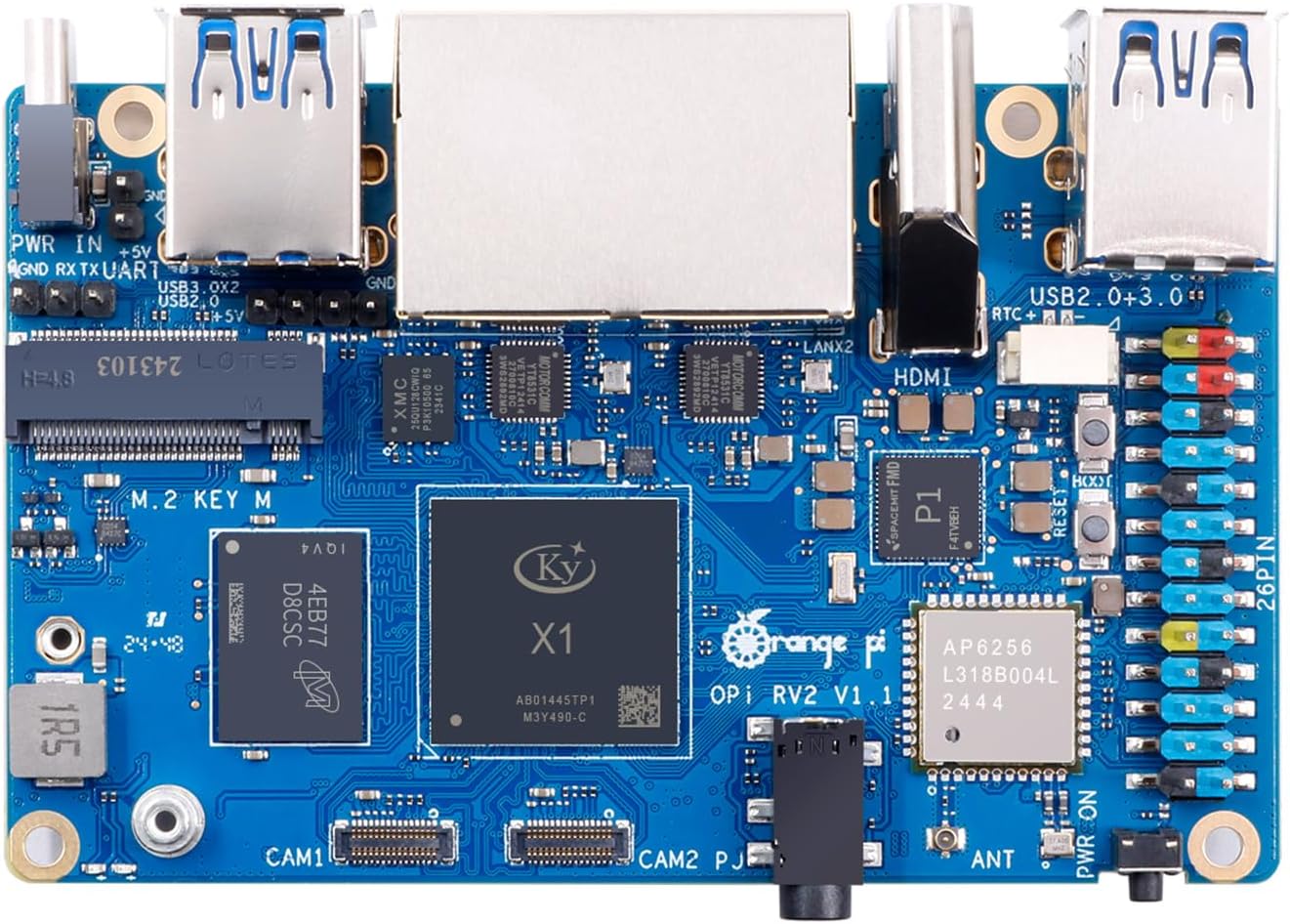
The Orange Pi RV2 combines high-density processing silicon with an extensive array of input, output, and storage interfaces engineered directly onto its 3.5-inch square circuit board.
- Ky X1 8-core 64-bit RISC-V processor featuring integrated AI compute delivering 2.0 TOPS of neural acceleration.
- LPDDR4X system memory options available in 2GB, 4GB, or 8GB configurations to match various multitasking demands.
- Two dedicated M.2 M-Key slots running on PCIe 2.0 2-Lane buses for direct NVMe solid-state storage expansion.
- Storage versatility including an onboard capacity listing of 128MB alongside support for optional plug-in eMMC modules in 32GB, 64GB, and 256GB capacities.
- Dual Gigabit Ethernet ports driven by onboard YT8531C-CA physical transceiver chips for advanced networking setups.
- Integrated wireless connectivity handled by an AP6256 module providing dual-band Wi-Fi 5.0 and Bluetooth 5.0 with Low Energy support.
- Dual display connectivity featuring one HDMI 2.0 port and one 4-lane MIPI DSI connector supporting heterodyne outputs up to 1920×1440 resolution at 60Hz.
- Two independent 4-lane MIPI CSI camera interfaces for multi-angle computer vision capture and stereo imaging.
- Peripheral USB connectivity including three USB 3.0 Host ports, one flexible USB 2.0 Host/Device port, and an onboard 4-pin USB 2.0 pin header.
- Dedicated hardware controls consisting of physical buttons for Boot selection, System Reset, and Power On, accompanied by a 3-pin serial debug header.
- Standard 26-pin general-purpose expansion interface multiplexing GPIO, UART, I2C, SPI, and PWM peripheral signal lines.
- Onboard power management featuring a Type-C 5V 5A main input, a 2-pin auxiliary 5V 1A cooling fan power connector, and a 2-pin real-time clock battery connector.
- Manufacturer hardware protection backed by a 12-month limited warranty.
Key Specifications
| Hardware Component | Manufacturer Specification |
|---|---|
| Central Processing Unit | Ky X1 8-Core 64-Bit RISC-V AI CPU |
| Neural Processing Unit | Integrated 2.0 TOPS AI acceleration engine |
| System Memory | 2GB, 4GB, or 8GB LPDDR4X RAM |
| PCIe Storage Expansion | 2x M.2 M-Key slots (PCIe 2.0 2-Lane, NVMe SSD support) |
| Modular Storage Support | Optional eMMC modules (32GB / 64GB / 256GB), 128MB onboard storage |
| Wired Networking | 2x 10/100/1000M Gigabit Ethernet (YT8531C-CA PHY) |
| Wireless Interfaces | Wi-Fi 5.0 (802.11ac) and Bluetooth 5.0 BLE (AP6256 module) |
| Video Output Interfaces | 1x HDMI 2.0, 1x 4-lane MIPI DSI (Dual-screen heterodyne up to 1920×1440@60fps) |
| Camera Interfaces | 2x 4-lane MIPI CSI camera connectors |
| USB Connectivity | 3x USB 3.0 Host, 1x USB 2.0 Host/Device, 1x 4-pin USB 2.0 header |
| Expansion Headers | 26-Pin expansion header (GPIO, UART, I2C, SPI, PWM), 3-Pin debug serial port |
| Board Dimensions | 3.5 inches length by 3.5 inches width by 0.06 inches height |
| Power Requirements | Type-C 5V 5A DC input, 2-pin auxiliary 5V 1A fan output |
| Supported Operating Systems | Ubuntu 24.04, Debian, Linux, Android 12, OpenHarmony |
Processing Power and RISC-V Architecture Performance
At the center of the Orange Pi RV2 specs is the Ky X1 octa-core 64-bit processor, an architecture engineered to bring multi-threaded throughput to the open silicon movement. According to manufacturer hardware documentation, the Ky X1 delivers a single-core computational uplift surpassing standard ARM Cortex-A55 cores by more than thirty percent. This architectural gain gives the board a distinct advantage when executing compiled system binaries, handling background background daemon tasks, and managing active developer environments. Having eight physical cores provides ample thread concurrency, enabling developers to run localized compilation jobs or host containerized services without saturating the processor.
Complementing its standard computing cores, the board features integrated neural processing hardware capable of 2.0 TOPS of artificial intelligence compute. Rather than offloading machine learning tasks to an external accelerator or bulky discrete add-in card, the board leverages core-level integration to streamline neural model deployment. This architecture supports various edge AI large models, computer vision filtering, and natural language processing tasks directly on the device. For automated maker installations operating from portable power stations or compact field batteries such as a ugreen nexode power bank, having efficient onboard compute reduces the total footprint required for remote data collection.
Thermal management is an essential operational consideration when pushing the Orange Pi RV2 RISC-V performance under sustained compilation or inference workloads. To maintain peak clock frequencies without encountering thermal throttling, the board incorporates an onboard 2-pin auxiliary power header capable of supplying 5V at up to 1A specifically for active cooling fans. Combining an active cooling heatsink with the onboard physical buttons for Boot, Reset, and Power On ensures that benchtop developers have full hardware-level control during kernel testing, benchmark execution, and automated recovery cycles.
Storage Flexibility and Dual M.2 NVMe Expansion
One of the most notable design choices on this board is the inclusion of Orange Pi RV2 dual M.2 slots, an uncommon feature in the single board computer sector. Both slots utilize an M-Key physical interface wired to dedicated PCIe 2.0 2-Lane connections, allowing direct installation of high-speed NVMe solid-state drives without requiring clumsy expansion daughterboards or ribbon cables. Providing twin high-speed storage buses unlocks balanced input and output bandwidth, allowing users to configure dedicated operating system drives alongside separate high-capacity data volumes.
In addition to the dual NVMe interfaces, the board features an onboard storage capacity listing of 128MB and provides an expansion socket for optional eMMC storage modules available in 32GB, 64GB, and 256GB capacities. This multi-tiered storage architecture allows system designers to decouple the primary operating system boot environment from high-wear scratch disks or heavy media libraries. While high-end consumer entertainment platforms like a ps5 console modern warfare 3 bundle feature fixed internal solid-state layouts engineered purely for proprietary gaming stacks, this board gives builders complete control over drive partitioning, file system selection, and localized RAID arrays.
Having two independent PCIe storage buses makes the Orange Pi RV2 SBC uniquely capable when running data-intensive local workflows. Developers can establish software-mirrored storage arrays, configure separate caching layers, or run local database engines that demand predictable random access speeds. Because PCIe NVMe communication completely bypasses the throughput bottlenecks inherent to traditional microSD cards, the board delivers significantly improved boot times, swift container spin-up cycles, and sustained file read and write operations.
Dual Gigabit Networking and Home Server Deployment
Network connectivity is anchored by two independent Gigabit Ethernet ports powered by individual YT8531C-CA physical layer transceiver chips. Having twin physical Ethernet interfaces makes the Orange Pi RV2 for home server setups remarkably flexible, enabling configurations such as software routing, network address translation, physical hardware firewalls, and isolated network bridges. Users can assign one physical port to an external wide-area network or upstream router while utilizing the second interface to manage a dedicated local subnet for local network appliances.
Beyond its wired interfaces, the board integrates an onboard AP6256 module that delivers dual-band Wi-Fi 5.0 and Bluetooth 5.0 with Low Energy functionality. This hybrid networking profile ensures that the board can communicate across wireless sensor networks while maintaining hardwired data links to central network storage. Whether managing a local DNS filter, hosting private media shares, or running lightweight microservices, the board provides the balanced network bandwidth necessary to prevent communication bottlenecks.
The combination of dual Gigabit Ethernet and dual M.2 NVMe storage positions the device as an exceptional foundation for compact network attached storage builds. In a DIY NAS configuration, the eight-core processor easily coordinates network file sharing protocols like NFS and SMB across the local network, while the dual solid-state drives provide resilient read and write caching. The board functions effectively as a low-noise, energy-efficient server appliance that operates quietly in a home office or workshop cabinet.
Edge Computing and Camera Vision Workflows
For creators and automation engineers exploring computer vision, the board is equipped with two discrete 4-lane MIPI CSI camera interfaces. This dual-input camera pipeline allows the device to capture synchronized high-bandwidth video streams from multiple angles, facilitating stereo vision, depth mapping, and automated visual quality inspection. In outdoor wildlife monitoring or experimental field setups where researchers pair digital capture boards with high-magnification optical gear like a vortex diamondback spotting scope, having local image ingestion coupled with high-speed processing simplifies automated species tracking and photographic logging.
The board translates camera input into actionable automation through its Orange Pi RV2 AI capabilities, which leverage the 2.0 TOPS neural processing engine to run image classification, object detection, and spatial tracking algorithms. By processing image matrices locally on the Ky X1 processor, the system minimizes network transmission latency and keeps sensitive visual data confined to local hardware. The board listing specifies compatibility across major edge AI frameworks, allowing developers to convert and execute trained models without requiring constant cloud connectivity.
Display output capabilities complement the camera ingestion pipelines through an HDMI 2.0 port and an auxiliary 4-lane MIPI DSI connector. The system supports dual-screen heterodyne display configurations at resolutions up to 1920×1440 at 60 frames per second, allowing developers to present real-time telemetry, visual monitoring dashboards, or dual-monitor diagnostic interfaces directly from the board. Combined with three high-speed USB 3.0 ports, a multi-mode USB 2.0 port, and a 26-pin expansion header, the board effortlessly interfaces with industrial sensors, microcontrollers, and custom control panels.
Operating System Compatibility and Linux Support
A capable processor requires robust system software, and the Orange Pi RV2 Linux support landscape encompasses several major distributions tailored for the 64-bit RISC-V instruction set. The official listing specifies compatibility with Ubuntu 24.04, Debian, general Linux kernel builds, Android 12, and OpenHarmony. Providing Ubuntu 24.04 support is particularly advantageous, as it grants developers access to modern package archives, updated system libraries, and standard container tools engineered for enterprise and edge deployments.
Working with an emerging instruction set like RISC-V naturally differs from developing on mature x86 or ARM architectures. While primary system utilities, standard Python libraries, and core Linux server packages compile cleanly, certain proprietary binaries or architecture-specific third-party software may require manual compilation from source code. Developers should anticipate spending time configuring toolchains and testing software dependencies, making the platform particularly well-suited for builders who enjoy low-level operating system configuration and kernel optimization.
Hardware diagnostics and initial board setup are streamlined by the inclusion of a dedicated 3-pin debug serial port operating at 3.3V logic levels. By connecting a serial-to-USB converter to these pins, developers can monitor low-level bootloader messages, diagnose early kernel panics, and access the system shell before graphical drivers or network interfaces initialize. This dedicated console access is invaluable when experimenting with custom kernel configurations, embedded Linux builds, or novel operating system ports.
Is the Orange Pi RV2 Worth It
Determining whether the Orange Pi RV2 is worth it comes down to your technical background, project requirements, and architectural interests. For makers, embedded software engineers, and homelab enthusiasts eager to build on the open RISC-V instruction set, the board delivers outstanding hardware value. The convergence of an eight-core processor, onboard neural processing, dual M.2 NVMe slots, and dual Gigabit Ethernet on a single compact board creates a versatile testing ground that bridges academic exploration and practical edge computing.
Conversely, users looking for an effortless desktop replacement, a plug-and-play retro gaming console, or a beginner-level single board computer should approach with realistic expectations. The RISC-V software ecosystem, though advancing rapidly through active open-source contributions, still requires a degree of familiarity with terminal navigation, software compilation, and kernel troubleshooting. If your intended software stack relies on pre-compiled proprietary ARM or x86 binaries, verifying software package availability on RISC-V before purchasing is essential.
For forward-looking homelab builders seeking an independent network appliance, an edge AI prototyping hub, or a dedicated dual-NVMe microserver, the Orange Pi RV2 stands as a capable and forward-thinking investment. Its dense feature set and open architectural foundation give builders the tools needed to develop, test, and deploy modern applications without being tethered to traditional silicon monopolies.
FAQ
What power supply is required to operate the Orange Pi RV2?
The Orange Pi RV2 requires a 5V 5A DC power supply delivered via its onboard USB Type-C port. Because the board supports power-hungry components such as dual M.2 NVMe solid-state drives, multiple USB 3.0 peripherals, and active cooling fans, utilizing a stable 25W power adapter is critical to prevent system instability, drive dropouts, or brownout resets under heavy processing loads.
Can the Orange Pi RV2 run standard NVMe solid-state drives?
Yes, the board features two onboard M.2 M-Key slots wired to PCIe 2.0 2-Lane interfaces designed specifically for NVMe solid-state drives. These interfaces allow you to mount fast M.2 storage drives directly onto the board for high-throughput operating system installations, database storage, or localized file caching without relying on external USB drive enclosures.
Which operating systems are compatible with the Orange Pi RV2?
According to the official product specifications, the board supports Ubuntu 24.04, Debian, general Linux distributions, Android 12, and OpenHarmony. Operating system images configured for the 64-bit RISC-V architecture provide access to standard Linux command-line tools, container platforms, and embedded software environments.
How does the Ky X1 RISC-V processor perform compared to standard ARM processors?
The Ky X1 is an octa-core 64-bit processor that incorporates integrated AI acceleration. Hardware specifications state that its single-core CPU performance surpasses the widely used ARM Cortex-A55 core by over thirty percent, offering snappy multi-threaded execution for server daemons, compilation tasks, and edge computing workloads.
Does the Orange Pi RV2 support dual monitors?
Yes, the board provides dual-screen heterodyne display capabilities through its combination of a full-sized HDMI 2.0 port and a 4-lane MIPI DSI interface. It can drive dual independent displays simultaneously at resolutions reaching up to 1920×1440 at 60 frames per second.
What interfaces are available for connecting cameras and sensors?
The board includes two 4-lane MIPI CSI camera interfaces for video capture, along with a standard 26-pin expansion header that provides multiplexed access to GPIO, UART, I2C, SPI, and PWM signal lines. It also features a dedicated 3-pin serial debug port for low-level console diagnostics.