As Amazon Associates, we earn from qualifying purchases. This means we may receive a small commission at no extra cost to you if you click through and make a purchase.
Finding a compact desktop that can manage heavy local machine learning models alongside multi-stream video production is a persistent challenge for modern digital creators. The BOSGAME M5 directly targets this demand by pairing AMD’s high-tier Ryzen AI Max+ 395 processor with an expansive 128GB pool of unified LPDDR5X memory, creating a micro workstation capable of handling workloads that traditionally demanded a massive full-tower PC. If your daily production involves spinning up local large language models, compiling dense software stacks, or scrubbing through complex 4K timelines without offloading tasks to remote cloud servers, this specific hardware configuration offers an uncompromising balance between physical footprint and sustained computational throughput.
While compact computers frequently make severe compromises in thermal endurance, memory capacity, or input versatility, this unit presents an ambitious mobile workstation architecture adapted for the desktop. In this detailed review, we examine how the hardware handles demanding creative applications, explore the advantages of its shared memory subsystem for local inference, evaluate the physical cooling and expansion capabilities, and determine whether this small system represents the ideal workstation replacement for your creative studio or software lab.

What You Get With the BOSGAME M5

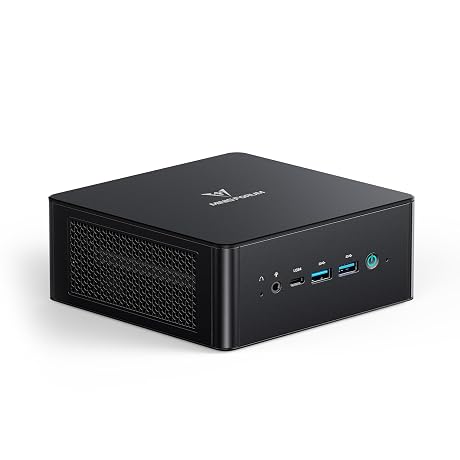
The BOSGAME M5 arrives in a dense, silver desktop chassis configured straight out of the box with high-end processing hardware and a fully installed operating environment, giving creators immediate access to production-grade compute resources without requiring manual internal configuration.
- AMD Ryzen AI Max+ 395 processor with 16 Zen 5 cores, 32 threads, and boost frequencies up to 5.1GHz
- 128GB LPDDR5X-8000 unified memory shared across computing and graphic cores
- Integrated AMD Radeon 8060S graphics featuring 40 RDNA 3.5 compute units
- Integrated AMD XDNA 2 neural processing unit delivering 50 TOPS NPU output and up to 126 TOPS total AI performance
- Pre-installed 2TB NVMe PCIe 4.0 solid-state drive
- Secondary M.2 2280 PCIe 4.0 slot for internal storage expansion
- High-speed front-facing SD 4.0 flash card reader
- Multi-display interface supporting up to four monitors via dual USB4, HDMI 2.1, and DisplayPort 1.4
- Comprehensive wireless and wired networking via WiFi 7, Bluetooth 5.4, and 2.5GbE Ethernet
- Windows 11 Pro operating system pre-installed
Key Specifications
| Component | Specification Detail |
|---|---|
| Processor | AMD Ryzen AI Max+ 395 (16 Cores, 32 Threads, up to 5.1GHz) |
| Graphics Processing | Integrated AMD Radeon 8060S (40 RDNA 3.5 Compute Units) |
| System Memory | 128GB LPDDR5X-8000 Unified Memory |
| Primary Storage | 2TB NVMe PCIe 4.0 SSD |
| Storage Expansion | 1x Open M.2 2280 PCIe 4.0 Slot |
| NPU & Total AI Output | 50 TOPS NPU (AMD XDNA 2), up to 126 TOPS Total System AI |
| Display Outputs | Dual USB4, HDMI 2.1, DisplayPort 1.4 (Quad Display up to 8K@60Hz) |
| Networking | WiFi 7, Bluetooth 5.4, 2.5 Gigabit Ethernet |
| Operating System | Windows 11 Pro |
| Dimensions & Weight | 7.48 x 2.05 x 8.66 inches, 3.8 kg |
Local AI Performance and Memory Bandwidth
Local artificial intelligence inference has rapidly transitioned from an experimental novelty into a foundational productivity requirement for developers, researchers, and content creators. Most desktop systems struggle with local models because standard consumer graphics cards feature modest video memory pools, forcing practitioners to either purchase expensive multi-GPU arrays or tolerate slow CPU inference. The BOSGAME M5 solves this structural bottleneck by implementing 128GB of unified LPDDR5X-8000 memory. Because this vast shared memory pool is dynamically accessible by the 16-core Zen 5 processor, the 40-compute-unit Radeon 8060S graphics, and the integrated XDNA 2 NPU, you can load large quantized parameter models directly into high-bandwidth memory without suffering out-of-memory crashes.
Under sustained artificial intelligence workloads, the platform leverages its 50 TOPS dedicated NPU alongside graphics compute to reach up to 126 TOPS of combined system AI processing. This hardware profile makes the computer an exceptional local sandbox for running private offline digital assistants, natural language code completion engines, and continuous data analysis pipelines. In comparison to standard compact computers like the beelink ser5 max mini pc, which rely on conventional dual-channel SODIMM architectures with strict capacity ceilings, the unified LPDDR5X memory bus on this system provides the operational headroom required to host multiple concurrent local services without system degradation.
Furthermore, running generative visual tasks locally eliminates recurring subscription fees and guarantees data confidentiality for sensitive commercial projects. The high-speed memory ensures stable prompt evaluations and consistent token generation rates during intensive inference sessions. For researchers building specialized agents or creators generating complex visual assets directly on their desks, having an integrated architecture with 128GB of addressable space removes the traditional boundaries imposed by discrete consumer graphics cards.
Creative Workflows and Video Editing Capabilities
For video producers and multimedia artists, raw rendering power must be backed by seamless timeline interactivity and broad codec support. The integrated AMD Radeon 8060S graphics engine, equipped with 40 RDNA 3.5 compute units, operates as the visual cornerstone of the machine. This graphics configuration eliminates the necessity of a discrete graphics card while delivering the mathematical and visual rendering capabilities necessary for complex 4K video editing, color grading pipelines, and three-dimensional CAD rendering. Multi-track video projects populated with graphics overlays, motion blur effects, and high-bitrate media files scrub fluidly across the editing timeline because the system can allocate massive portions of its 128GB shared pool directly to graphic assets.
Media ingest is streamlined through the integrated SD 4.0 card reader mounted on the chassis, allowing videographers and photographers to dump gigabytes of raw camera footage onto the fast internal NVMe storage without relying on external dongles. Once the assets are imported, the dual USB4 ports, HDMI 2.1 port, and DisplayPort 1.4 connection allow you to configure up to four displays simultaneously, with maximum display capabilities scaling up to 8K resolution at 60Hz. This comprehensive display support allows editors to maintain a dedicated timeline monitor, full-screen color reference display, browser research pane, and audio mixer simultaneously on a single workstation.
Beyond traditional timeline cutting, the 16 Zen 5 processor cores and 32 threads excel at processor-bound creative operations including background video transcoding, complex audio mastering with dozens of real-time plugins, and multi-layered image composite processing. Digital creators who frequently juggle demanding export renders while simultaneously prepping subsequent assets will appreciate the processor’s ability to maintain high clock speeds across its full core array without stalling ongoing background processes.
Expansion Options and Connectivity for Creator Desktops
Storage management is a vital factor when evaluating any creative workstation, as high-resolution video caches, local neural network weights, and comprehensive sample libraries quickly consume drive capacity. The BOSGAME M5 addresses this storage pressure by pairing an internal 2TB NVMe PCIe 4.0 SSD with a dedicated secondary M.2 2280 PCIe 4.0 expansion slot. Users can install a second high-speed solid-state drive internally to partition their operating environment from raw media assets or project files, preserving peak bus speeds and preventing drive-filling errors during extended rendering sessions.
Connectivity standards represent another significant strength of the system. While entry-level desktop solutions like the kamrui pinova p1 mini pc computer, amd ryzen 4300u processor, 16gb ddr4 ram 256gb m.2 ssd, mini desk offer basic connectivity suitable for standard office browsing, this workstation integrates modern WiFi 7 wireless alongside a 2.5GbE Ethernet port. The high-speed wired network port is ideal for creative studios connected to local network-attached storage (NAS) servers, providing rapid continuous file backups and collaborative team editing without local transfer bottlenecks. Bluetooth 5.4 ensures stable, low-latency peripheral connections for wireless keyboards, mice, and studio audio monitors.
The dual USB4 ports provide immense versatility for hardware enthusiasts looking to construct a high-performance modular desk environment. These ports supply ultra-fast data transfer protocols capable of driving external high-speed RAID arrays, professional audio interfaces, and external hardware hubs. The rear input panel also hosts standard USB interfaces, giving you abundant physical ports to connect dedicated human interface devices, external capture cards, and hardware control surfaces without constant cable swapping.
Form Factor, Weight, and Power Considerations
Engineered into a silver metallic enclosure measuring 7.48 by 2.05 by 8.66 inches, the unit occupies an exceptionally compact horizontal footprint on a desk. However, prospective buyers should note that at 3.8 kilograms, this is a remarkably dense and substantial piece of equipment compared to standard plastic miniature PCs. The weight reflects the heavy internal copper heat sinks and structural metal chassis required to stabilize and cool components running under sustained electrical draw. While far more mobile than a traditional mid-tower desktop, its physical density makes it a workstation intended primarily for static desk installations rather than frequent travel inside a casual commuter backpack.
Thermal management relies on a high-capacity air and heat sink cooling assembly designed to dissipate the heat produced by the processor and integrated graphics under load. Drawing up to 240 watts of power via its North American Type A 2-pin power connection, the hardware demands adequate continuous airflow to maintain peak performance during multi-hour render jobs or continuous local AI batch generation. Unlike thin mobile notebooks such as the hp 15.6 inch fhd ips touch windows 11 laptop amd ryzen 7 7730u 16gb ram 512gb ssd natural silver, which are forced to aggressively throttle clock speeds to manage tight thermal ceilings and conserve battery life, the dedicated cooling chamber inside this chassis allows the 16-core Zen 5 chip to stretch its legs and sustain high computational output over long creative sessions.
The compact desktop form factor also translates into a cleaner, more organized studio aesthetic. Because all primary peripheral connections, multi-monitor feeds, and network cables route directly into the back and front of the chassis, users can position the computer discreetly beside a display monitor or tuck it neatly beneath a desk shelf, recapturing valuable physical surface space for drawing tablets, mixing consoles, or studio monitors.
Is the BOSGAME M5 Worth It
Determining whether this micro workstation represents the right investment comes down to your specific computing requirements and software workflows. If you are an artificial intelligence practitioner, software engineer, or high-end video creator who requires immense memory capacity to run local models and edit complex timelines without maintaining a massive computer tower, this platform offers unmatched capability in its size class. The combination of 128GB of ultra-fast unified memory, 16 full-performance Zen 5 cores, and 40 RDNA 3.5 compute units effectively creates a unique workstation tier that standard mini PCs simply cannot rival.
On the other hand, users whose daily routines revolve around standard web browsing, office document processing, light photo touch-ups, or casual media streaming will find this machine completely overpowered for their needs. The specialized hardware, 240-watt power design, and comprehensive AI hardware engine deliver capabilities that remain largely dormant in basic office environments. Buyers seeking simple computing tools would be far better served by standard entry-level desktop units that focus on basic utility rather than workstation-grade parallel computing.
For professional creators, data specialists, and studio hobbyists committed to local AI workflows, the machine stands out as a focused, forward-looking computing tool. Its dual M.2 storage configuration, WiFi 7 wireless, 2.5GbE LAN, and four-display flexibility provide the essential expansion and communication features necessary to anchor a production studio for years to come.
FAQ
Can the BOSGAME M5 run large local AI models without dedicated GPU VRAM?
Yes. The system utilizes 128GB of LPDDR5X-8000 unified memory shared directly between the Zen 5 CPU, the 40-compute-unit Radeon 8060S graphics, and the 50 TOPS XDNA 2 NPU. This unified pool allows you to load and run large language models and generative visual pipelines that exceed the VRAM boundaries of standard consumer discrete graphics cards.
How many monitors can you connect to the BOSGAME M5 simultaneously?
The system supports up to four independent displays simultaneously through its dual USB4 ports, one HDMI 2.1 port, and one DisplayPort 1.4 interface, supporting high refresh rates and resolutions up to 8K at 60Hz.
Does the BOSGAME M5 support storage expansion beyond the included 2TB SSD?
Yes. In addition to the pre-installed 2TB NVMe PCIe 4.0 SSD, the internal motherboard features a second M.2 2280 PCIe 4.0 slot, enabling users to add an additional high-speed solid-state drive for project files and media libraries.
What operating system comes installed on the BOSGAME M5?
The computer comes pre-configured with Windows 11 Pro, offering built-in support for enterprise management, virtualization tools, and modern creative application suites.
How heavy is the BOSGAME M5 mini PC?
The unit weighs approximately 3.8 kilograms (8.38 pounds) with dimensions of 7.48 by 2.05 by 8.66 inches, featuring a substantial metal chassis and dedicated thermal cooling system designed to manage up to 240 watts of power consumption.