
As Amazon Associates, we earn from qualifying purchases. This means we may receive a small commission at no extra cost to you if you click through and make a purchase.
Searching for the sony ax 6400 frequently leads buyers to the Sony a6400, an interchangeable-lens camera that remains one of the most popular tools for solo shooters, online video creators, and hybrid photographers. The central decision for any prospective buyer comes down to balancing its remarkable strengths against a few specific design omissions. Powered by a 24.2-megapixel APS-C CMOS sensor and an acclaimed autofocus engine that locks onto subjects in 0.02 seconds, this camera produces crisp imagery and high-resolution footage. However, because it lacks internal mechanical stabilization, anyone planning to shoot primarily handheld footage must understand how to stabilize their capture through external tools or optical lens systems.
This comprehensive breakdown evaluates whether the camera suits your production demands, especially when acquired as a multi-piece package. We examine how the camera operates in daily production compared to alternatives like the sony zv-e10 ii mirrorless camera, covering essential topics such as focus acquisition speeds, recording profile depth, thermal endurance, display ergonomics, and overall value. The following analysis examines what is included in the package, verified performance metrics, physical handling quirks, and real-world workflow advice to help you decide if this mirrorless workhorse belongs in your creative kit.
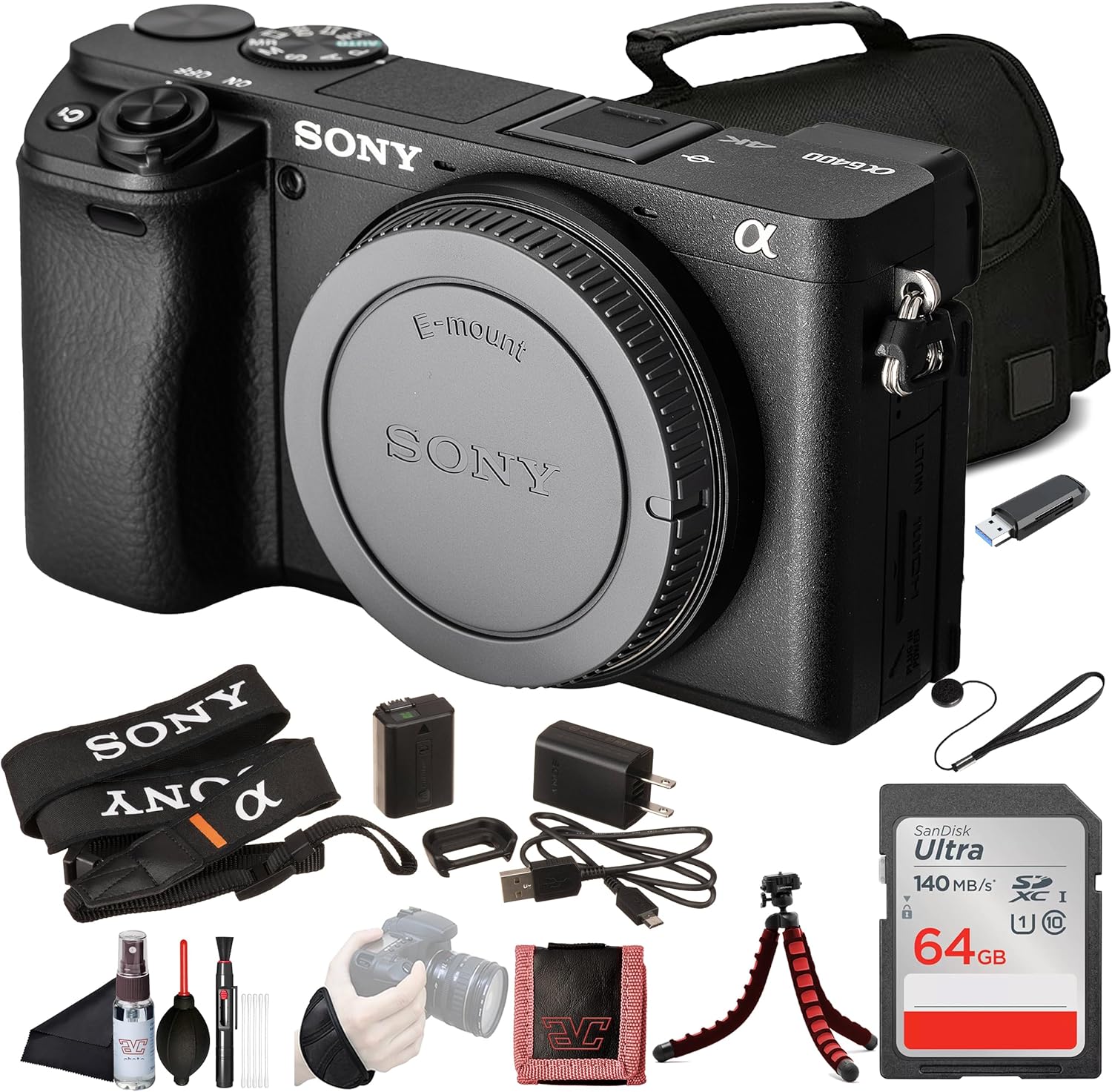
What You Get With the Sony a6400

The sony a6400 creator bundle packages the standard factory camera kit alongside essential field accessories designed to get a new content creator producing immediately without purchasing immediate add-ons.
- Sony a6400 Mirrorless Camera body (ILCE-6400/B)
- Sony NP-FW50 Rechargeable Battery (1020mAh capacity)
- Sony AC Adapter and Micro-USB charging cable
- Sony ALC-B1EM front body cap for E-mount camera bodies
- Shoulder strap, protective eyepiece cup, and accessory hot shoe cap
- SanDisk 64GB Ultra SDXC memory card
- High-speed memory card reader and protective memory card wallet
- 12-inch flexible wrap-around tripod for desktop or handheld mounting
- Reinforced hand wrist strap and padded soft carrying case
- Lens cap and camera maintenance cleaning kit
Key Specifications
The technical foundation of the camera dictates its shooting capabilities across both video production and high-speed still photography. Below are the core sony ax 6400 specs pulled directly from the manufacturer documentation.
| Feature | Specification Details |
|---|---|
| Sensor Format and Resolution | 24.2 MP APS-C CMOS Sensor |
| Autofocus Point Array | 425 phase-detection points with Real-Time Eye AF |
| Autofocus Response Time | 0.02-second subject acquisition |
| Continuous Burst Shooting | Up to 11 frames per second with mechanical shutter |
| Video Recording Formats | 2160p (4K UHD) with full pixel readout and no pixel binning |
| Color Profiles | S-Log3, S-Log2, and HLG (Hybrid Log-Gamma) |
| Display Monitor | 3.0-inch 180-degree tilt-up touchscreen |
| In-Body Image Stabilization | None (optical stabilization dependent on attached lens) |
| Lens Mount System | Sony E-mount |
| Chassis Construction | Magnesium alloy casing with environmental sealing |
Autofocus Tracking and Daily Reliability
The primary reason creators continue to choose this camera is its tracking performance. The camera relies on 425 phase-detection points covering nearly the entire sensor area, paired with Sony advanced artificial-intelligence algorithms. When operating in high-pressure shooting scenarios, the sony a6400 autofocus tracking system locks focus in roughly 0.02 seconds. It features Real-Time Eye AF for both human subjects and animals, continuously keeping the eye pin-sharp even when a subject turns their head, shifts behind foreground obstacles, or walks quickly toward the lens.
For independent creators filming themselves, this tracking reliability eliminates the anxiety of ruined takes. In studio presentations or tutorial recordings, the touch-tracking feature allows you to tap your face on the screen, step into position, and trust the camera to maintain focus without hunting or drifting. This level of responsiveness provides an enormous workflow advantage compared to fixed-lens tools like the sony rx10 camera, because it pairs high-speed phase detection with the creative flexibility of interchangeable E-mount glass.
Action photographers also benefit from the combination of dense focus point coverage and high-speed burst shooting. The mechanical shutter fires at up to 11 frames per second while maintaining continuous autofocus and exposure tracking. Whether you are capturing running pets, sporting events, or unpredictable wildlife, the camera calculates subject distance rapidly between frames. The tracking algorithm predicts subject motion across the 4:3 and 3:2 framing grids, yielding a remarkably high hit rate of sharp images throughout fast sequences.
Video Capture and Cinematic Color Profiles
Video output quality on this model remains exceptional because of how the sensor collects visual information. When recording sony a6400 4k video at 2160p resolution, the camera samples a 6K data readout across the entire sensor surface without pixel binning, then oversamples that data down into an ultra-sharp 4K master file. This oversampling process minimizes moire patterns, eliminates jagged edges along high-contrast lines, and preserves fine textile textures and facial features that often turn muddy on cameras using line skipping.
Filmmakers seeking elevated dynamic range can access professional color profiles directly from the internal menu. The inclusion of S-Log2 and S-Log3 allows users to capture flatter, wider dynamic range profiles that preserve detail across harsh window highlights and deep background shadows. For creators working on fast-turnaround projects or HDR workflows, the camera includes HLG (Hybrid Log-Gamma), allowing immediate playback on compatible HDR displays without intensive color transformation. These grading tools allow you to match footage cleanly alongside professional cinema bodies.
However, creators must remain aware of technical limits inherent to this processing pipeline. Because the sensor reads out substantial data during oversampled 4K recording, rapid camera pans can introduce rolling shutter artifacts, causing vertical lines to tilt slightly during aggressive whip pans. Additionally, internal capture is processed in standard 8-bit color space, meaning aggressive grade adjustments on S-Log footage must be handled carefully to avoid banding in clear skies or smooth gradients.
Handling and the Impact of Missing Sensor Stabilization
The most debated physical characteristic of this body is its stabilization system, or lack thereof. The listing confirms that hardware sony a6400 image stabilization is absent from the camera body itself. Without an in-body image stabilization (IBIS) sensor cradle, handheld camera movement directly transfers to your captured footage. If you walk while filming without mechanical or optical stabilization aids, your footage will show micro-jitters and abrupt footsteps that detract from viewer engagement.
To overcome this limitation, creators employ several practical workflow strategies. Many shooters choose Sony E-mount lenses equipped with built-in Optical SteadyShot (OSS), which compensates effectively for natural hand tremors during static handheld shots. For moving walk-and-talk vlogs, mounting the camera to an external motorized gimbal or setting it upon the included 12-inch flexible tripod creates a steady, fatigue-free shooting rig. Treating the camera as a modular rig rather than an all-in-one run-and-gun device ensures smooth footage in dynamic settings.
Display mechanics also require thoughtful planning when evaluating the sony a6400 flip screen. The 3.0-inch monitor tilts upward 180 degrees, perching directly above the top plate so you can monitor framing while standing in front of the lens. While this mechanism is practical, mounting a conventional shotgun microphone directly onto the camera hot shoe will partially obstruct your view of the monitor. Creators commonly resolve this layout conflict by utilizing a cold shoe relocation bracket or a compact camera cage to shift audio receivers off to the side.
Chassis Durability and Low Light Sensor Capabilities
Despite its compact dimensions and travel-friendly footprint, the camera features a rigid magnesium alloy chassis engineered for demanding field use. The body structure resists flex when paired with heavy telephoto lenses, and internal sealing shields critical buttons and seam joints against light dust and moisture. Paired with reliable Wi-Fi and Bluetooth connectivity, the camera allows rapid wireless image transfer and remote control via smartphone, which streamlines location scouting and field work.
Sensor architecture plays an equally critical role when lighting conditions deteriorate. The 24.2 MP APS-C sensor provides solid sony a6400 low light performance across varying illumination levels. Starting from an expanded minimum ISO of 100, the camera keeps shadow noise tightly controlled through moderate sensitivity levels. Clean signal processing ensures that evening street photography, dimly lit indoor receptions, and indoor studio setups preserve accurate color rendering without excessive grain muddling your subject.
When comparing this configuration against standard bare-body listings like the traditional sony alpha a6400 camera, the physical accessories included in this package enhance real-world durability. The padded carrying case shields the magnesium exterior during transport, while the bundled lens cap, wrist tether, and cleaning supplies maintain optical clarity and prevent dirt buildup on the exposed sensor glass when swapping lenses on outdoor shoots.
Is the Sony a6400 Worth It
Determining whether the sony a6400 aps-c mirrorless camera represents the right investment depends heavily on your production format and technical expectations. If your work involves talking-head YouTube content, live streaming, real estate capture on a tripod, product photography, or studio portraiture, this camera excels. Its lightning-fast autofocus acquisition, sharp oversampled 4K visual output, and rugged magnesium frame deliver professional results that outperform many newer consumer cameras.
On the other hand, creators who require an ultra-casual, walk-and-talk vlogging setup without extra accessories may find the absence of in-body image stabilization limiting. If you refuse to use optically stabilized lenses, gimbals, or tabletop tripods, smoothing out handheld camera shake will require software stabilization in post-production. Furthermore, creators who frequently mount top-mounted shotgun microphones must purchase an offset shoe bracket to keep the 180-degree flip screen unobstructed.
Ultimately, when asking is sony a6400 worth it, the answer is a definitive yes for creators who value autofocus precision, lens versatility, and rich image quality over automated internal stabilization. Packaged with a functional tabletop tripod, high-speed memory card, and carrying case, this camera kit delivers exceptional production power that will serve dedicated creators through years of continuous publishing.
FAQ
Does the Sony a6400 have in-body image stabilization?
No, the listing confirms that hardware image stabilization is not built into the camera body. To achieve stable footage while shooting handheld, you must use Sony lenses with built-in Optical SteadyShot (OSS), mount the camera on a motorized gimbal, or secure it to a static support like the included 12-inch flexible tripod.
Is the Sony a6400 suitable for vlogging?
Yes, the camera is widely utilized as a sony a6400 for vlogging option due to its 180-degree flip-up touchscreen and reliable Real-Time Eye AF. However, because mounting a shotgun microphone directly to the top accessory shoe will block the screen, you will need a cold shoe relocation bracket or camera cage to keep your display visible while recording audio.
What memory card comes included in this creator bundle?
The bundle includes a SanDisk 64GB Ultra SDXC memory card, along with a dedicated high-speed card reader and a protective memory card wallet to organize your storage media safely in the field.
Can the camera record full 4K video without cropping?
The camera captures 4K video at 2160p resolution using a full sensor pixel readout with no pixel binning, oversampling a 6K visual area down to standard 4K. This process ensures outstanding sharpness and dynamic range, though rapid camera pans can produce rolling shutter effects.
What is the continuous shooting speed of this camera?
The camera can capture action sequences at up to 11 frames per second using its mechanical shutter, maintaining continuous autofocus tracking across its 425 phase-detection focus points throughout the burst.


