As Amazon Associates, we earn from qualifying purchases. This means we may receive a small commission at no extra cost to you if you click through and make a purchase.
Finding a microcontroller that balances microscopic board dimensions with heavy processing power is a constant puzzle for DIY hardware builders. The AITRIP D1 Mini ESP32 addresses this exact trade-off by mounting an Espressif dual-core processor onto the familiar miniature footprint popularized by classic maker boards. Creators looking to deploy compact Internet of Things nodes, smart sensor hubs, or lightweight motor controllers will find that this board delivers a significant leap in computing headroom without demanding redesigns of miniature enclosures. For builders wanting an upgrade from earlier single-core hardware, it represents an accessible pathway toward dual-core multithreading and integrated Bluetooth without abandoning breadboard-friendly prototyping.
This technical breakdown reviews the complete feature set, physical layout, power specifications, and firmware ecosystem of the board. Readers will explore the architectural differences between vintage controller designs and this dual-core update, inspect the board pinout, and learn how to manage development environments across popular IDE platforms. The following sections detail everything from power consumption quirks to smart home connectivity, helping builders determine whether this hardware belongs in their next custom electronics build.

What You Get With the AITRIP D1 Mini ESP32
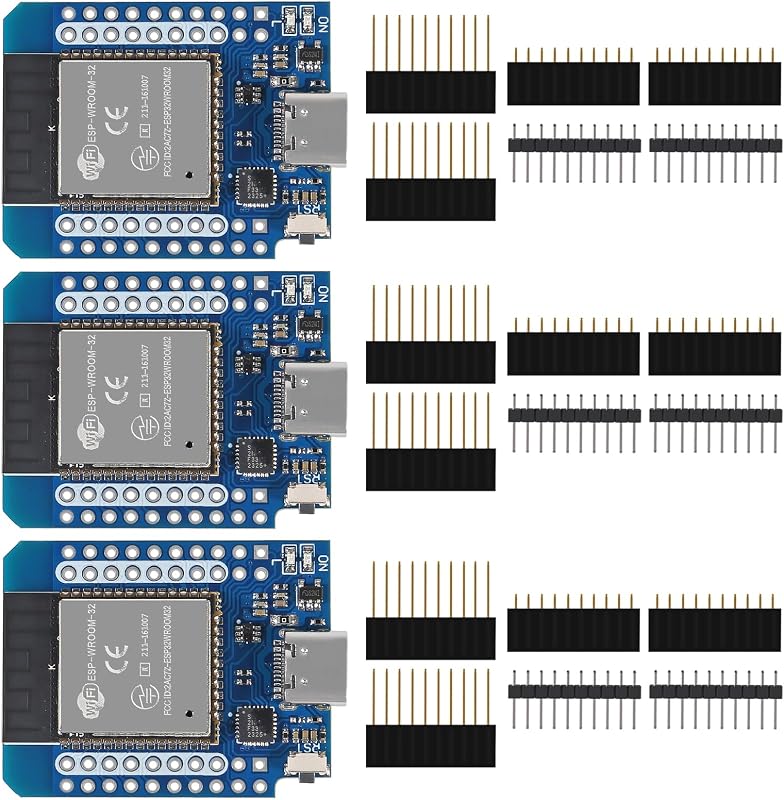
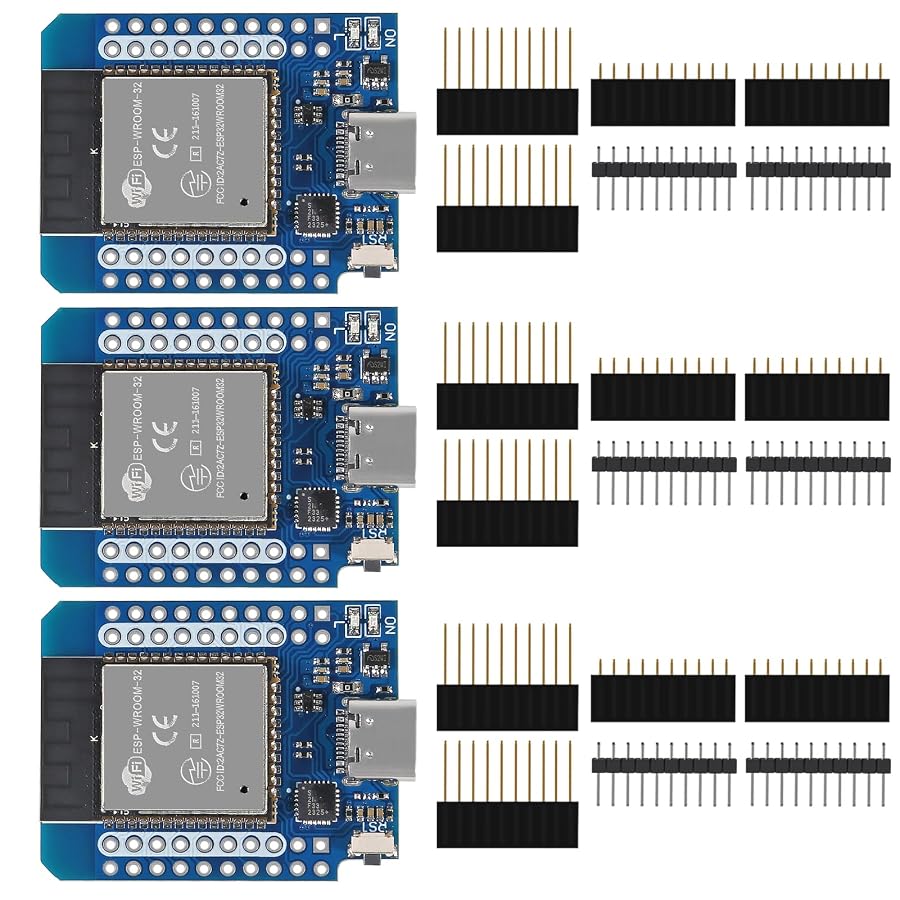
The AITRIP D1 Mini ESP32 arrives as a multi-piece development package designed for rapid deployment on breadboards or inside embedded enclosures. Built around the proven ESP-WROOM-32 module, the hardware integrates essential connectivity controllers directly on the printed circuit board so makers do not need external programmer modules or breakout bridges.
- Integrated Espressif dual-core processor architecture backed by 512 KB of internal RAM for demanding background tasks.
- On-board Silicon Labs CP2104 USB-to-UART bridge controller providing reliable serial data exchange.
- Reversible Type-C USB physical port for direct 5V DC power supply input and desktop serial flashing.
- Dual wireless radio providing 802.11 b/g/n Wi-Fi with transmission rates up to 150 Mbps alongside integrated Bluetooth support.
- On-board 5V to 3.3V switching power regulator engineered to supply up to 1A of steady current.
- Array of 34 accessible digital input and output lines supporting hardware interrupts, PWM, I2C, and one-wire interfaces.
- Dual 8-bit digital-to-analog converter channels and 18 channels of 12-bit analog-to-digital input resolution.
- Standard multi-board pack configuration containing standalone development units ready for male or female pin header soldering.
Key Specifications
Examining the exact technical parameters reveals how this board manages intensive peripheral communication alongside wireless transmission. The table below outlines the core hardware specifications published for this revision.
| Specification Attribute | Hardware Detail |
|---|---|
| Processor Type | Espressif Dual-Core 32-bit Tensilica architecture |
| Internal Memory | 512 KB RAM |
| Serial Programmer Bridge | Silicon Labs CP2104 USB-to-UART |
| USB Connector Standard | Type-C reversible connector |
| Wireless Radio Standard | Wi-Fi 802.11 b/g/n (up to 150 Mbps) and Bluetooth connectivity |
| Operating Logic Voltage | 3.3V DC (per I/O pin) |
| Input Voltage | 5V DC via USB or regulated pin input |
| Integrated Power Regulator | 5V 1A on-board switching power supply |
| Current Capacity | Minimum 500mA operating current; 40mA max per GPIO pin |
| Analog Peripheral Support | 18 ADC channels (12-bit) and 2 DAC channels (8-bit) |
| Bus Communication Protocols | SPI, I2C, CAN, UART, 1-Wire |
| Supported Environments | Arduino IDE, MicroPython, Lua, FreeRTOS |
Pinout Layout and Form Factor Versatility
Understanding the physical architecture of this board begins with its footprint, which closely mirrors the layout popularized by legacy miniature modules. While older single-core boards offered a very restricted set of exposed connections, this iteration exposes extensive functionality across its dual inline header rows. The wemos d1 mini esp32 pinout provides access to up to 34 input and output connections, which represent a massive jump in peripheral accommodation for such a tiny circuit board. Nearly every general-purpose pin supports pulse-width modulation, external hardware interrupts, I2C communication, and 1-wire protocol handshakes, with only pin D0 exhibiting standard hardware functional limitations.
A notable mechanical improvement is the adoption of modern port hardware. The wemos d1 mini esp32 type c connector eliminates the fragile mechanical retention clips and directional frustration of legacy micro-USB plugs. The modern connector sits flush on the board edge, allowing clean integration into custom 3D-printed project boxes and tight instrument clusters. For makers designing portable equipment alongside radio gear such as an ats mini v4 receiver station, the streamlined connector ensures consistent mechanical stability when external cables move or twist during fieldwork.
Builders transitioning existing hardware setups must remain vigilant about pin spacing and shield stacking. Although the board retains physical width compatibility with many legacy add-on shields, the underlying pin assignments on an ESP32 do not map one-to-one with older microcontrollers. Certain pins are tied to internal boot modes, flash memory operations, or input-only analog lines. Taking time to verify your wiring schematic against the board label designations ensures you avoid pulling strapping pins high or low during the boot sequence, which could otherwise halt program execution before setup routines begin.
Firmware Environments and Programming Setup
Developing firmware for this hardware is exceptionally flexible thanks to the CP2104 communication controller and deep support from open-source toolchains. Completing a clean d1 mini esp32 arduino setup requires adding the official Espressif board definitions within the Arduino IDE board manager. Once installed, users simply select the general ESP32 Dev Module or corresponding D1 Mini ESP32 profile, set the serial upload speed, and plug in the Type-C cable. On modern operating systems running development workstations powered by win 11 pro, the CP2104 driver typically configures automatically, creating a stable COM port without requiring manual driver package installations.
For programmers who favor rapid interpreted languages over compiled C++, loading wemos d1 mini esp32 micropython firmware offers an extraordinarily responsive workflow. Flashing the MicroPython binary using standard flashing utilities opens up a real-time REPL command line over serial. This setup allows hardware tinkerers to read analog sensors, toggle relay pins, and scan local network addresses using interactive Python commands. The 512 KB of onboard RAM leaves plenty of heap space for Python dictionaries, JSON parsing buffers, and network sockets, making it far more capable of running complex scripts than earlier generations of microcontrollers.
In addition to basic hobbyist scripts, the hardware supports FreeRTOS straight out of the box. The operating system kernel takes full advantage of the dual-core architecture, assigning Wi-Fi background protocol processing to one core while user application logic runs uninterrupted on the second core. The development board also supports over-the-air firmware updates, meaning you can seal your project permanently inside an outdoor housing and upload new binary code over local wireless connections without ever plugging in a physical cable again.
Dual Wireless Performance in Smart Home Automation
Wireless communication lies at the heart of this hardware platform, and its dual-radio architecture excels in connected environments. Utilizing the d1 mini esp32 for home automation builds allows creators to implement reliable, decentralized control nodes throughout a residence. Integrating an esp32 d1 mini wifi bluetooth node into smart platforms like Home Assistant or open-source MQTT networks enables real-time reporting of environmental metrics such as room temperature, relative humidity, atmospheric pressure, and ambient light levels without adding perceptible latency to the local network.
The integrated Bluetooth subsystem provides immense value when configuring wireless networks or monitoring localized low-energy beacons. In a typical home automation deployment, the board can operate as a Bluetooth Low Energy tracking gateway while simultaneously transmitting telemetry over 2.4 GHz Wi-Fi. It can capture advertising packets from personal fitness bands, plant moisture monitors, and wireless thermometers, convert that data into structured payloads, and publish the results directly to an automation hub hosted on an energy-efficient msi cubi nuc server.
Network reliability remains solid across residential environments thanks to the 802.11 b/g/n radio implementation, supporting throughput speeds up to 150 Mbps on 802.11n channels. While dense drywall and concrete barriers naturally degrade 2.4 GHz radio signals, the compact PCB trace antenna performs admirably when mounted clear of metal enclosures. Implementing basic software reconnect routines within firmware loops ensures that the board smoothly recovers its connection whenever local routers reboot or experience temporary channel interference.
Power Management and Electrical Realities
Deploying a dual-core wireless board into production demands a clear understanding of its electrical requirements. The AITRIP board incorporates an on-board switching power supply that converts 5V DC incoming power down to the 3.3V DC logic level required by the processor. This regulator provides up to 1A of output current, which easily accommodates the high current spikes that occur when the radio transitions from idle listening to active packet transmission. Because the minimum operating current sits around 500mA during active operations, powering this board from weak passive USB hubs or poorly regulated power bricks will cause unexpected brownout reboots.
When interfacing external electronics with the general-purpose pins, builders must respect the 3.3V DC logic ceiling. Feeding a 5V signal directly into any input pin risks permanent damage to the internal silicon gates. While the power rail can accept 5V from an external supply or the USB port, all digital and analog lines operate strictly at 3.3V. Furthermore, the maximum current drawn per individual GPIO pin must not exceed 40mA, making direct drive of electro-mechanical relays, high-output LEDs, or DC motors impossible without intermediary transistor switches or optocouplers.
For battery-powered field monitors, the processor includes ultra-low-power sleep modes that drastically cut power consumption when active measurements are not required. By placing the main processing cores into deep sleep and waking intermittently via the internal timer or an external pin interrupt, you can stretch battery lifespans significantly. However, because the onboard CP2104 USB-to-UART converter and the linear voltage regulator remain energized on the 5V bus, extreme micro-ampere battery optimization may require powering the unit directly through dedicated power pins rather than the USB terminal.
Architectural Comparison: D1 Mini ESP32 vs ESP8266
When weighing a modern build, evaluating the d1 mini esp32 vs esp8266 is essential for determining whether the increased processing capacity justifies the hardware transition. The legacy ESP8266 architecture gained legendary status among makers for introducing cheap, functional Wi-Fi to DIY electronics, but its technical ceilings quickly become apparent in modern deployments. The older chip runs on a single processor core, provides minimal onboard RAM, and lacks Bluetooth hardware entirely. It also features a single analog input pin with a restrictive 1.0V internal reference, requiring external voltage dividers for basic analog sensor monitoring.
In contrast, the ESP32 platform represents a complete generational leap across all performance metrics. With two 32-bit cores running at significantly higher clock frequencies, the board effortlessly juggles complex cryptography, SSL web handshakes, and intensive sensor polling without skipping loop intervals. The inclusion of 18 separate 12-bit analog input channels allows builders to connect complex multi-sensor boards without resorting to external I2C multiplexers. Furthermore, the presence of two dedicated 8-bit digital-to-analog converter channels enables true analog voltage output for waveform generation and audio synthesis, capabilities entirely absent on the older design.
Memory availability highlights another critical distinction between the two platforms. The 512 KB of onboard RAM provided by the ESP32 allows developers to allocate generous buffers for web server hosting, SSL certificate validation, and local data caching during network outages. On an ESP8266, running secure HTTPS web requests frequently exhausts memory pools, resulting in random stack overflows and unhandled crashes. Upgrading to the dual-core variant guarantees software stability whenever modern, encrypted network protocols are involved.
Check AITRIP D1 Mini ESP32 on Amazon
Is the AITRIP D1 Mini ESP32 Worth It
Determining if this development board aligns with your workshop requirements comes down to project scope, spatial limitations, and firmware complexity. If your projects demand reliable dual-core computational horsepower, dual-mode wireless communication, and modern Type-C physical durability inside a footprint smaller than a standard credit card, this board delivers phenomenal value. The inclusion of a dedicated CP2104 serial bridge ensures painless driver management across diverse operating systems, eliminating the upload stability headaches often encountered with low-cost clone bridges.
For smart home builders crafting decentralized sensors or custom actuators, the hardware provides an ideal canvas. Its native compatibility with popular firmware platforms like ESPHome, Tasmota, and the Arduino environment means you can advance from unboxing to live network deployment in an afternoon. While battery purists aiming for multi-year runtimes on coin cells might prefer bare modules without on-board voltage regulators, anyone building mains-powered, USB-powered, or solar-buffered setups will appreciate the integrated power conversion and robust circuit protection.
Makers currently maintaining older single-core microcontrollers will find this upgrade remarkably refreshing. The abundance of general-purpose pins, dual DAC channels, and broad memory headroom provide ample breathing room for ambitious codebases. Ultimately, the AITRIP D1 Mini ESP32 represents a reliable, modern, and highly versatile microcontroller platform that easily earns its place in any electronics hobbyist or automation creator kit.
FAQ
Does the AITRIP D1 Mini ESP32 feature a Type-C or Micro-USB port?
This development board is equipped with a modern Type-C USB port. The reversible connector provides both 5V DC power input and full serial communication through the onboard CP2104 interface, offering improved mechanical durability over older micro-USB connectors.
Can I run MicroPython on this microcontroller?
Yes, the board fully supports MicroPython alongside Arduino IDE, Lua, and FreeRTOS. With 512 KB of internal RAM, it provides ample memory to execute complex Python scripts, manage network sockets, and process data structures interactively via the serial REPL.
What logic voltage do the GPIO pins use on this board?
The input and output pins operate strictly at 3.3V DC logic levels. Connecting 5V signals directly to the input pins will cause permanent damage to the microcontroller. If you need to interface with 5V sensors or peripherals, always use logic level converters.
How does the power supply handle high wireless current spikes?
The board features an onboard switching power supply rated for 5V input and 1A output, delivering a minimum operating current of 500mA. This capacity is specifically designed to absorb the temporary current spikes that occur during Wi-Fi transmission bursts without causing brownout reboots.
Are all GPIO pins safe to use for general sensor inputs?
While 34 digital pins are exposed, builders must pay attention to pin designations during circuit design. Pin D0 has specific functional limitations, and certain pins act as strapping pins that dictate the boot mode of the processor when powered on. Always consult the official pinout schematic before wiring pull-up or pull-down components.


