
As Amazon Associates, we earn from qualifying purchases. This means we may receive a small commission at no extra cost to you if you click through and make a purchase.
For digital creators, video editors, and audio producers, storage drive performance dictates how smoothly daily timeline work proceeds. The Samsung 870 EVO represents the peak of 2.5-inch SATA solid-state development, pushing the theoretical ceiling of the SATA 6 Gbps interface with sequential read speeds up to 560 MB/s and write speeds reaching 530 MB/s. If you are working on an editing rig or workstation laptop with an available 2.5-inch bay, this 500GB drive offers an accessible, low-heat storage solution to hold project media, audio sound libraries, and dedicated application scratch caches without hogging your primary PCIe slots.
Choosing a SATA solid-state drive in a market saturated with NVMe solutions requires clear expectations regarding bandwidth, workflow role, and real-world write stability. This review breaks down how this drive behaves under continuous creator workloads, detailing its sustained write capabilities, variable buffer behavior during heavy video renders, hardware compatibility across desktop rigs and external recording devices, and maintenance through the companion utility suite. By exploring real-world production demands alongside technical metrics, we help you determine whether this drive makes sense for your production environment.
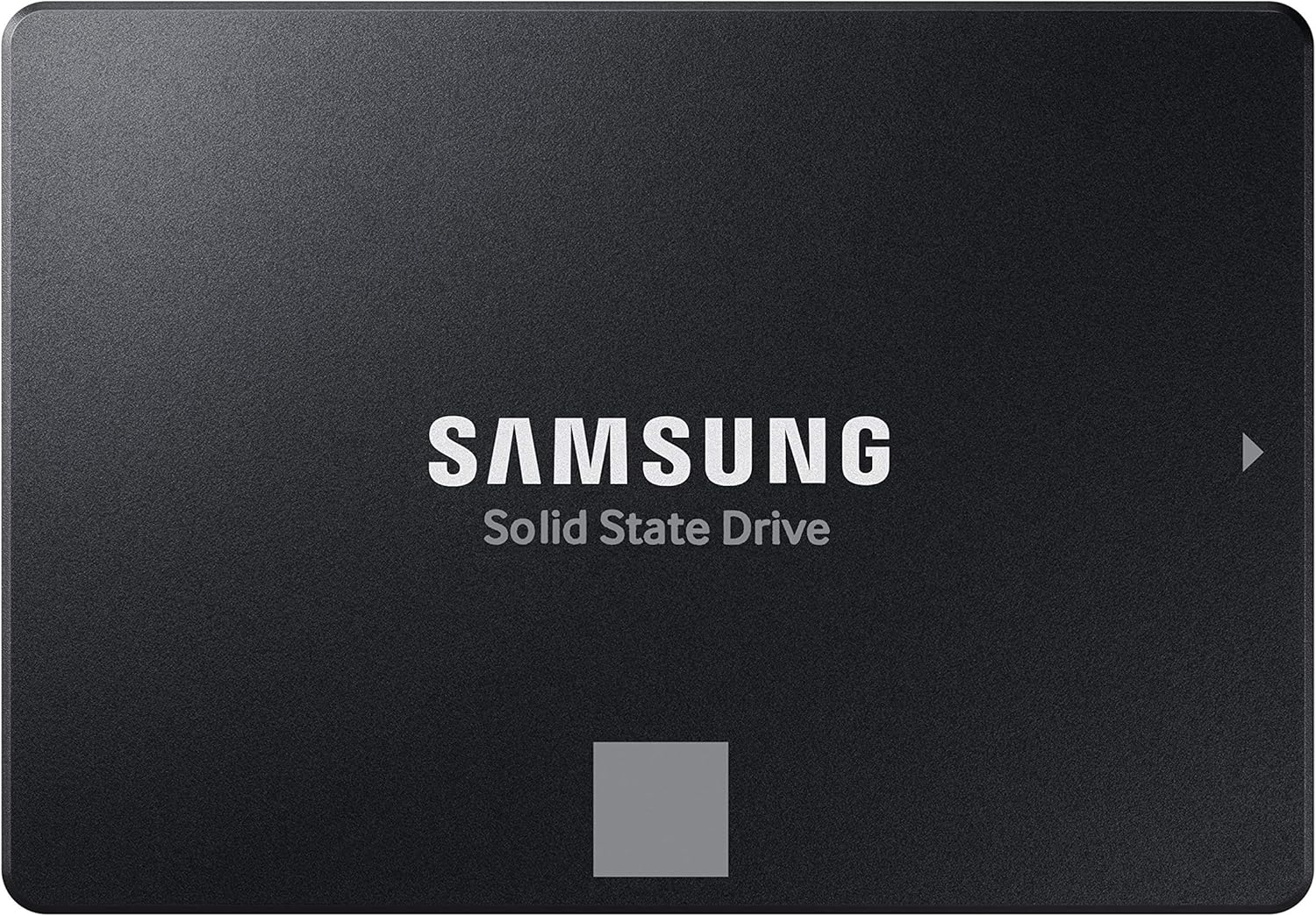
What You Get With the Samsung 870 EVO

The retail package for this drive provides a focused, hardware-centric solution designed to upgrade existing desktop towers, editing laptops, or external drive enclosures with reliable solid-state performance.
- Samsung 870 EVO 500GB 2.5-inch internal solid-state drive
- Samsung MLC V-NAND flash memory architecture
- SATA 6 Gbps hardware connectivity interface
- Integrated 1 GB DRAM cache memory module
- Compatibility with Samsung Magician 6 drive management software
- Support for Samsung data migration software
- Integrated S.M.A.R.T. drive health monitoring capabilities
- Endurance rating of up to 600 TBW backed by a 5-year limited warranty
Key Specifications
| Attribute | Detail |
|---|---|
| Digital Storage Capacity | 500 GB |
| Hardware Interface | SATA 6.0 Gb/s (SATA 3 Gb/s and 1.5 Gb/s compatible) |
| Form Factor | 2.5-inch (0.27 inches thin) |
| Sequential Read Speed | Up to 560 MB/s |
| Sequential Write Speed | Up to 530 MB/s |
| NAND Flash Type | Samsung MLC V-NAND Technology |
| Installed Cache Memory | 1 GB DRAM |
| Endurance & Warranty | Up to 600 TBW under a 5-year limited warranty |
| Device Dimensions | 3.94 x 2.76 x 0.27 inches |
| Unit Weight | 3.04 ounces |
Sustained Write Speeds for Video Editing Timelines
Demanding production suites like Premiere Pro, DaVinci Resolve, and Final Cut Pro place continuous strain on storage subsystems during export passes and timeline playback. Evaluating the samsung 870 evo for video editing begins with understanding how its sequential throughput interacts with high-bitrate video streams. With sequential read limits hitting 560 MB/s and sequential write maximums of 530 MB/s, the drive thoroughly saturates the SATA 6 Gbps pipeline. For editors working primarily with compressed codecs such as standard 8-bit or 10-bit H.264, H.265, or moderate ProRes 422 files, this throughput guarantees snappy timeline navigation and brisk clip indexing without stutter. It follows the lineage established by the older samsung 860 evo ssd, upgrading buffer responsiveness to prevent dropped frames during active playback.
During heavy rendering exports or bulk file transfers from camera memory cards, write speed consistency becomes far more critical than short burst benchmarks. Analyzing the samsung 870 evo write speed under sustained load highlights the utility of Samsung’s variable buffer architecture. When moving large 4K file batches, the drive leverages its fast write buffer to swallow incoming data immediately. Once the buffer fills during prolonged transfers of hundreds of gigabytes, the drive writes straight to the V-NAND flash. Unlike budget DRAM-less solid-state units that drop down to mechanical hard drive transfer rates when overwhelmed, the in-house controller and dedicated 1 GB DRAM cache keep write rates predictable and stable.
Real-world testing of the samsung 870 evo 500gb performance indicates that this capacity point is ideally tuned for standard 1080p timelines, YouTube episodic edits, and independent commercial video projects. Creators managing massive multi-stream raw 8K productions will understandably find the SATA interface bandwidth limiting compared to high-end NVMe options like the samsung evo 990 4tb. Nevertheless, for intermediate proxy workflows, background rendering, and general media asset manipulation, this 500GB drive delivers an unwavering floor of sustained performance that keeps creative applications operating smoothly.
Using the Drive as a Dedicated Scratch Disk
One of the most effective strategies for improving workstation stability is configuring a dedicated secondary volume for temporary application data. Deploying the drive as a samsung 870 evo scratch disk isolates timeline caches, optical flow calculations, waveform peaks, and Photoshop temporary files away from your operating system partition. In intensive visual effects workflows where applications write dozens of temporary render files simultaneously, segregating these write-heavy operations shields your primary OS drive from fragmentation, heavy drive wear, and unexpected storage exhaustion.
Examining the technical samsung 870 evo sata ssd specs shows why it serves scratch disk roles with such proficiency. The integration of 1 GB of onboard DRAM cache allows the controller to map file allocations and update directory tables quickly during high-frequency random read and write requests. Creative applications generating hundreds of micro-caches per minute rely heavily on rapid random I/O response rather than pure sequential speeds. Because this unit maintains responsive latency under mixed random loads, timeline playheads scrub cleanly across complex audio-video arrangements without pausing to rebuild wave previews or clip indices.
For creators who also rely on external portable storage such as the samsung t5 evo for moving field captures between studio machines, housing a fixed internal SATA drive strictly for scratch duties simplifies asset hygiene. Once a commercial cut or documentary project is finished and delivered, the scratch directory on this 500GB volume can be completely purged without risking the deletion of core system configurations or essential application assets. This process keeps editing software responsive project after project.
Long-Term Reliability and Drive Health Management
Workstation drives in production facilities undergo significantly more stress than drives inside standard office machines, rendering samsung 870 evo reliability a paramount concern. Content creation routines involve daily data churn: ingesting gigabytes of raw footage, rendering dynamic previews, and exporting intermediate master files. Samsung addresses this rigorous duty cycle by engineering this drive family with an endurance rating of up to 600 terabytes written (TBW) paired with a 5-year limited warranty. For an independent video creator generating 40 to 60 gigabytes of new writes and caches every working day, reaching this endurance ceiling would take more than a decade of uninterrupted operation.
Component vertical integration plays a substantial part in this hardware durability. Samsung produces all drive components in-house, including the controller firmware, DRAM cache, and MLC V-NAND flash packages. This end-to-end manufacturing reduces unexpected firmware anomalies, interface lockups, and thermal controller throttling that often affect drives constructed from mismatched third-party parts. Creators upgrading legacy hardware from earlier generations such as the 850 evo 250g will find that the mature controller firmware in this iteration maintains consistent stability even across long rendering sessions.
Monitoring drive condition over years of production is handled cleanly through the companion samsung magician 870 evo software application. Samsung Magician 6 allows creators to inspect remaining endurance life, examine operating temperatures, check real-time S.M.A.R.T. health attributes, and run diagnostic performance scans. The software simplifies essential firmware updates, ensuring that host system stability improvements are applied safely without jeopardizing stored media assets. It also incorporates secure data management tools for creators who must sanitize proprietary client footage from drive sectors upon project sign-off.
System Compatibility and Hardware Installation
Storage flexibility is critical for creators working across mixed hardware setups, and samsung 870 evo compatibility ranks among the highest in the solid-state market. Built to the standard 2.5-inch 7mm form factor, the drive slots directly into desktop PC drive caddies, legacy editing notebooks, workstation drive sleds, and home studio network-attached storage (NAS) towers. It interfaces with standard SATA data and power headers, eliminating the complex lane-sharing restrictions and BIOS bifurcation settings frequently encountered when populating multiple M.2 NVMe drives on older workstation motherboards.
Beyond traditional desktop and laptop enclosures, this drive has been compatibility tested for host systems and video recording equipment. Many professional field video monitors, external camera recording decks, and broadcast studio switchers use standard 2.5-inch SATA bays to capture live uncompressed camera feeds directly to removable media. The drive’s high sustained write speed and low operating temperatures make it a dependable option for recording video feeds directly from production switchers and external camera recorders on commercial sets.
Physical integration into your workflow is painless due to the drive’s compact, lightweight build. Weighing just 3.04 ounces and measuring 0.27 inches thick, the unit fits effortlessly into ultra-slim laptop bays or portable external 2.5-inch USB enclosures for mobile offloading. The included data migration software enables seamless cloning of legacy hard drives or older solid-state boot drives, letting users transition their entire operating system and creative software suite without performing clean system reinstallations.
Check Samsung 870 EVO on Amazon
Is the Samsung 870 EVO Worth It
Determining whether this drive makes sense for your production space comes down to evaluating your workstation’s available interface pathways. So, is samsung 870 evo worth it for modern creators? If your editing PC or studio laptop features an open 2.5-inch SATA bay, this drive remains one of the absolute best SATA options available. It maximizes the 6 Gbps bus with 560 MB/s reads and 530 MB/s writes, includes 1 GB of onboard DRAM cache, and features exceptional endurance ratings that withstand intensive daily media caching.
For creators building an entirely new top-tier rig with numerous empty PCIe 4.0 or 5.0 M.2 slots, primary storage duties are naturally better served by NVMe drives that exceed 5,000 MB/s for multi-camera 8K raw workflows. However, modern motherboards often share PCIe lanes between M.2 slots and graphics cards. Utilizing a SATA drive like this 870 EVO bypasses PCIe lane contention completely, giving you a distinct, high-speed physical volume for scratch files, sound libraries, or archival backups without compromising graphics card bus bandwidth.
Ultimately, this 500GB drive delivers outstanding utility for editors seeking a dependable, thermally stable secondary drive. With its robust V-NAND architecture, integrated DRAM buffer, broad system compatibility, and polished Magician software suite, it provides a dependable, fuss-free storage foundation for everyday content creation workflows.
FAQ
Can I use the Samsung 870 EVO for 4K video editing?
Yes, the drive handles standard compressed 4K footage editing efficiently, delivering read speeds up to 560 MB/s and write speeds up to 530 MB/s. It is well-suited for timelines utilizing standard H.264, H.265, or ProRes 422 files, though extremely high-bitrate uncompressed raw multi-cam streams may benefit from faster NVMe storage.
How does the drive perform when used as an editing scratch disk?
It performs exceptionally well as a dedicated scratch disk because it includes 1 GB of dedicated DRAM cache. This cache accelerates random I/O transactions, allowing video editing programs to rapidly read and write temporary waveform peaks, optical flow files, and render cache elements without stuttering the timeline.
What does Samsung Magician software do for this drive?
Samsung Magician 6 allows you to monitor the drive’s health, track total terabytes written, view operating temperatures, and check S.M.A.R.T. diagnostic status. It also facilitates firmware updates, runs performance benchmark tests, and provides data optimization and secure erase tools.
Is the drive compatible with Mac computers?
The drive is compatible with Mac hardware that accommodates standard 2.5-inch SATA storage or through external 2.5-inch USB-to-SATA enclosures and docks. The drive requires formatting into an Apple-compatible file system such as APFS or Mac OS Extended via Disk Utility before use on macOS.
Does this drive require additional cables for installation?
The retail package includes the bare 2.5-inch drive. Installing it inside a desktop PC requires a standard SATA data cable and an available SATA power connector from your power supply, which are typically supplied with your PC case, motherboard, or power supply unit.


