As Amazon Associates, we earn from qualifying purchases. This means we may receive a small commission at no extra cost to you if you click through and make a purchase.
If you are hitting the strict two-hour boundary of your standalone virtual reality headset, upgrading your gear with a dedicated power accessory is an immediate priority. The KIWI design H4 Boost is built specifically to address the dual challenges of rapid power depletion and front-heavy chassis strain on the Meta Quest 3 and Quest 3S. By adding an integrated secondary power source directly onto an ergonomic framework, this accessory intends to give creators, simulator enthusiasts, and long-session players the endurance they need without tethering themselves to a wall outlet mid-game. If you are debating whether this particular kiwi h4 boost quest 3 setup solves your runtime limitations, understanding its power architecture and support structure is the first step.
Choosing the right headgear involves balancing battery capacity, power delivery speed, facial relief, and physical adjustability. While some players compare standard rigid replacements like a meta quest 3 elite head strap to halo-style mounts, this unit bridges the gap with a dedicated front headrest and a counterbalanced battery pack. In this comprehensive review, we examine the published technical specifications, evaluate the DualBoost charging system, analyze the physical ergonomics across gaming and seated media playback, and determine whether this upgrade justifies a spot in your virtual reality toolkit.

What You Get With the KIWI design H4 Boost

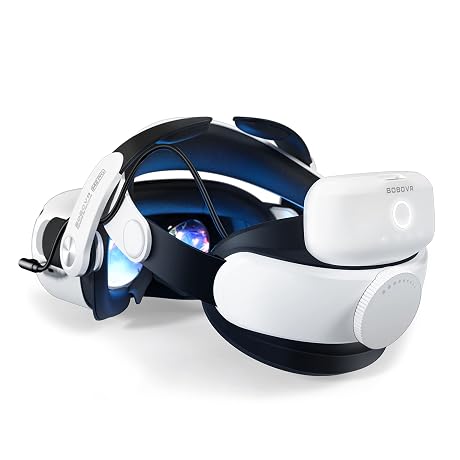
The KIWI design H4 Boost package brings together an ergonomic counterweighted harness and a synchronized battery architecture engineered specifically for the Meta Quest 3 and Meta Quest 3S ecosystems. According to the manufacturer data, the unit is constructed in a clean white finish and incorporates integrated electrical routing alongside multi-axis mechanical adjustment points to simplify your hardware configuration.
- Integrated rear battery module providing up to 3 hours of additional operational playtime.
- DualBoost charging system that powers the headset and battery strap simultaneously via USB Type C.
- Adaptive front headrest mechanism engineered to redistribute headset weight and enable zero facial pressure use.
- Elastic side straps combined with a soft rear cushion and an adjustable top strap for personalized stabilization.
- Damping slider assembly for front-to-back field of view calibration.
- Headset lever adjustment knob for precise up-and-down visual alignment.
- Forehead cushion featuring an integrated ventilation design to promote passive airflow during extended sessions.
- Low-profile integrated rear adjustment knob tailored for comfortable couch and bed use.
Key Specifications
| Specification Attribute | Listing Detail |
|---|---|
| Brand | KIWI design (KIWIdesignUS) |
| Compatible Headsets | Meta Quest 3, Meta Quest 3S (Not compatible with Quest 2) |
| Battery Average Life | Up to 3 hours additional runtime |
| Charging Technology | DualBoost Fast Charging via USB Type C |
| Charging Input Support | 45W adapter delivering 25W output to headset |
| Recharge Cycle Duration | Full charge in 2.5 hours; 65% charge in 60 minutes |
| Adjustment Mechanisms | Rear adjustment knob, damping slider, headset lever knob |
| Ergonomic Contact Points | Adaptive front headrest, adjustable top strap, soft rear cushion |
| Ventilation System | Fore cushion passive ventilation structure |
| Color Finish | White |
Battery Life and Dual Fast Charging Performance
Power delivery remains the defining bottleneck for standalone spatial computing. The standard internal battery inside the Meta Quest 3 often drains completely within two hours of demanding mixed reality or wireless PC VR rendering. The kiwi h4 boost battery life specification indicates an additional three hours of operational runtime, effectively more than doubling your active uninterrupted window. For creators streaming virtual production or players running long multiplayer raids, this added capacity transforms the device from a short-burst toy into a viable platform for prolonged workflow and entertainment.
What separates this system from typical passive power banks is the DualBoost charging integration. Rather than forcing users to detach the battery pack or charge components in separate sequential steps, the strap accepts high-wattage input through its USB Type C interface. When paired with a 45W wall adapter, the system routes a dedicated 25W output directly to the headset while replenishing the rear auxiliary cell at the same time. The manufacturer specifications note that the complete package reaches a full charge in just 2.5 hours, while a rapid 60-minute session restores 65% capacity across both devices, yielding approximately 2.5 hours of immediate playtime.
This dynamic power management is critical because the Quest 3 draws substantially more wattage during intensive tracking and pass-through tasks than older headsets did. Users who previously relied on early-generation solutions, such as adapting a bobovr m2 pro from older hardware, frequently encountered slow power drain where the internal battery depleted even while plugged into an external cell. The 25W delivery profile specified for the H4 Boost is engineered specifically to prevent that slow drain, ensuring your primary battery level stays sustained during active use.
Ergonomics and Facial Pressure Relief
The factory fabric strap bundled with modern VR headsets places the entire physical weight of the display against your cheekbones and forehead. Over extended play periods, this direct clamping pressure causes facial fatigue, red pressure marks, and persistent neck strain. The kiwi h4 boost comfort fit addresses this balance dilemma through an adaptive front headrest design. By transferring the cantilevered mass away from sensitive facial tissues and distributing it across the upper brow and crown of the skull, the strap establishes a secure foundation that stabilizes the device during sudden head motions.
A major design benefit noted in the official specifications is the ability to operate the headset with zero facial pressure, even allowing users to remove the facial interface entirely. This open-periphery configuration is a major advantage for augmented reality and productivity scenarios where you need peripheral room awareness without feeling boxed inside a dark mask. The structural framework combines elastic side straps with an adjustable top strap and an enlarged soft rear cushion, cradling the occipital bone at the back of the head to establish an even counterweight against the front optics.
For users assessing different mounting philosophies, this hybrid approach blends the rigid stability of an elite-style harness with the gentle contact dynamics of halo designs like the bobovr m3 pro. By balancing the physical load between the front headrest and the rear battery casing, the H4 Boost reduces the need for aggressive side tightening, keeping the headset firmly seated without inducing tension headaches during multi-hour creative sessions.
Field of View Calibration and Heat Management
Achieving optimal optical clarity in VR depends heavily on eye relief and lens positioning. The kiwi design h4 boost specs outline a dual-adjustment system tailored specifically to solve alignment difficulties. A front-to-back damping slider allows players to fine-tune how close the optical assembly sits relative to their eyes, directly affecting the perceived field of view. By dialing the lenses closer, users can maximize display clarity, while moving them outward accommodates prescription eyewear inserts without scratching optical elements.
Vertical alignment is governed by an integrated headset lever knob that controls up-and-down angling. This mechanism allows you to find the optical sweet spot of the pancake lenses effortlessly, eliminating chromatic aberration and edge blurriness caused by an off-center headset angle. Rather than physically wrestling with rigid side arms to adjust display pitch, the dedicated lever enables smooth, incremental corrections while you are wearing the unit.
Thermal buildup is another primary cause of discomfort during intense gaming, as trapped body heat fogs lenses and warms the forehead pad. KIWI design integrates an innovative ventilation structure directly into the front cushion. This channel geometry facilitates passive heat dissipation, allowing air to circulate around the upper brow contact surface. By mitigating sweat accumulation and keeping your skin cool, the strap helps maintain visual focus and lens clarity over the entire span of your session.
Couch Gaming and Lie Down VR Usability
Many counterweighted battery head straps incorporate bulky rear battery housings and protruding adjustment dials that make leaning back against a pillow or headrest impossible. For users who enjoy watching theatrical movies, browsing virtual desktops, or playing casual titles from a reclined posture, rigid rear bulk can be an immediate dealbreaker. The kiwi h4 boost lie down vr design intentionally addresses this restriction through a streamlined, low-profile rear geometry.
The integrated adjustment knob is recessed smoothly into the rear cushion housing, minimizing rearward projection. This configuration allows you to rest your head against high-backed chairs, sofa cushions, or bed pillows without driving hard plastic into the back of your skull or forcing your cervical spine into an unnatural forward bend. The flat curvature ensures that resting backward does not accidentally spin the tension dial or loosen your custom strap sizing.
This thoughtful physical layout expands the usability of your Quest 3 or Quest 3S well beyond active standing simulations. Whether you are using the headset as a personal virtual monitor for creative productivity, relaxing with high-resolution video streams, or winding down with seated puzzle games, the low-profile rear structure lets you transition seamlessly between standing room-scale locomotion and fully reclined relaxation.
Check KIWI design H4 Boost on Amazon
Is the KIWI design H4 Boost Worth It
When deciding whether the KIWI design H4 Boost is the right upgrade, your individual usage pattern is the deciding factor. If your VR sessions are limited to quick twenty-minute fitness apps or casual check-ins, the stock strap and an external cable may suffice. However, for power users, simulation hobbyists, and virtual creators who routinely exceed the native two-hour battery barrier, this all-in-one quest 3 battery head strap delivers substantial quality-of-life improvements that justify the investment.
The combination of synchronized DualBoost fast charging, simultaneous 25W power delivery, and three hours of extra runtime solves the core functional limitation of Meta’s hardware. Simultaneously, the counterbalanced weight profile and zero facial pressure capability eliminate the cheekbone fatigue that cuts long creative sessions short. The product’s dual-platform compatibility makes the kiwi h4 boost for quest 3s and Quest 3 an enduring accessory even if you shift between headset tiers.
It is important to consider the trade-offs before purchasing. The listing data specifies compatibility strictly with Meta Quest 3 and Quest 3S, meaning legacy Quest 2 owners cannot adapt this harness. Furthermore, the listing does not specify whether a 45W wall charger is included in the package, meaning you may need to supply your own high-wattage charging brick to achieve the advertised 2.5-hour recharge speeds. If you prioritize long, uninterrupted sessions with minimal facial pressure, this strap stands as one of the best quest 3 head strap for extended play options available.
FAQ
How much extra playtime does the KIWI design H4 Boost provide?
According to the official product specifications, the integrated battery module delivers up to 3 hours of additional battery life. When combined with the headset’s internal battery, users can expect roughly five hours of total operational runtime depending on screen brightness, refresh rate, and processing load.
Does the H4 Boost support simultaneous dual fast charging?
Yes, the DualBoost charging system is designed to power both the H4 Boost battery strap and the Meta Quest 3 or 3S headset simultaneously through a single USB Type C connection. When connected to a 45W power adapter, it routes 25W directly to the headset while charging the rear battery, reaching a complete charge in 2.5 hours.
Is the KIWI design H4 Boost compatible with the Meta Quest 2?
No. The manufacturer specifications explicitly state that the H4 Boost is compatible only with the Meta Quest 3 and Meta Quest 3S. It is not compatible with the Meta Quest 2 due to differences in side-rail mounting geometry and chassis dimensions.
Can you use the headset without the facial interface using this strap?
Yes. The adaptive front headrest design supports zero facial pressure usage by bearing the weight of the headset across the forehead and crown. This allows players to remove the facial interface entirely for an open-periphery mixed reality experience that keeps the face cool and unobstructed.
Can you lie down comfortably while wearing the H4 Boost?
Yes. The strap features a low-profile rear cushion with an integrated adjustment knob designed to sit flush against the back of the head. This streamlined rear profile allows users to rest comfortably against couch cushions, pillows, or recliner headrests without awkward pressure points.