As Amazon Associates, we earn from qualifying purchases. This means we may receive a small commission at no extra cost to you if you click through and make a purchase.
For creators and videographers building an agile camera setup, carrying a bulky mid-range zoom often works directly against speed, balance, and mobility on location. The Sony FE 24-50mm F2.8 G addresses this exact dilemma by pairing a bright, constant f/2.8 maximum aperture with a trimmed standard zoom range. By capping the telephoto reach at 50mm rather than pushing outward to 70mm, this lens creates a lightweight, compact footprint that integrates cleanly with full-frame Sony E-mount camera bodies. Shooters who spend long production days operating handheld or balancing cameras on motorized gimbals get the low-light light-gathering power and shallow depth of field of a fast zoom without the physical strain associated with larger flagship optics.
Choosing a lens with a narrower focal spread requires understanding how a 24mm to 50mm view integrates into your daily production workflow. This review evaluates the real-world utility of the sony 24-50 f2.8, breaking down its mechanical drive systems, optical layout, and close-up capabilities. We examine how its dual linear autofocus motors perform during rapid movement, how the lack of built-in stabilization affects shooting setups, and whether the 2.1:1 zoom ratio provides sufficient flexibility to replace prime lenses in your everyday gear bag.
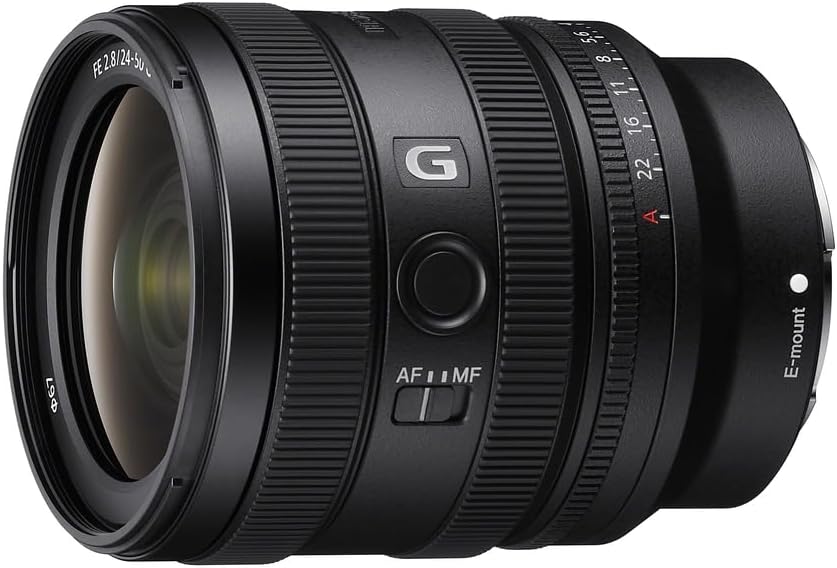
What You Get With the Sony FE 24-50mm F2.8 G

The Sony FE 24-50mm F2.8 G provides a specialized optical design focused on combining constant-aperture performance with everyday travel convenience. While the listing does not specify included package accessories like carry pouches or lens hoods, it confirms the lens incorporates core G-series optical and mechanical components engineered for high-resolution stills and smooth video production.
- Standard zoom focal range spanning 24mm wide angle to 50mm standard perspective
- Constant f/2.8 maximum aperture throughout the entire 2.1:1 zoom range
- Minimum aperture setting of f/22 across all focal lengths
- Dual Linear Motors dedicated to fast, quiet, and precise autofocus tracking
- Circular aperture mechanism constructed with 11 diaphragm blades
- Fluorine coating on the front glass element to repel dust, water, and oil
- Close-up shooting capability down to 18 centimeters (7.09 inches) at 24mm in manual focus
- Full compatibility with full-frame Sony E-mount camera models
Key Specifications
The official sony fe 24-50mm f2.8 g specs emphasize a balance between optical speed, high-end motor integration, and physical compactness for Sony E-mount cameras.
| Feature | Specification |
|---|---|
| Lens Mount | Sony E |
| Focal Length Range | 24 to 50mm |
| Maximum Aperture | f/2.8 |
| Minimum Aperture | f/22 |
| Zoom Ratio | 2.1:1 |
| Real Angle of View | 84 degrees |
| Diaphragm Blades | 11 |
| Lens Coating | Fluorine Coating |
| Focus Mechanism | Two Linear Motors |
| Optical Stabilization | No image stabilization |
| Minimum Focus Distance | 18 cm (7.09 inches) at 24mm manual focus |
Gimbal Balance and Video Workflows
Operating a camera on a motorized gimbal requires constant attention to center of gravity and front-heavy balance shifts. Large standard zoom lenses often extend significantly during zooming or feature heavy front optical elements that tax small gimbal motors, forcing operators to rebalance their rigs between shots. With the sony 24-50 f2.8 for video, the compact f2.8 sony lens profile maintains a predictable distribution of mass across its 24mm to 50mm range. Camera operators can adjust framing from an environmental establishing shot to a tighter portrait perspective without overloading gimbal axes or recalibrating motor strength mid-take.
Because the lens listing states there is no image stabilization built directly into the barrel, steady handheld video relies entirely on the host camera’s in-body image stabilization system. Modern full-frame Sony E-mount bodies handle pitch and yaw corrections well, but creators who shoot aggressive walk-and-talk sequences must plan their movement technique accordingly. Working with a stabilized sensor bridges the gap, allowing you to capture stable handheld B-roll without the added physical bulk that internal optical stabilization elements usually introduce to a lens chassis.
For hybrid creators comparing mid-range zoom options, stepping down from the physical size of lenses like the sony fe 24-70mm f/2.8 gm ii changes the entire operating experience on set. A lighter front element reduces forearm fatigue over twelve-hour production days and keeps overall camera rig weight low enough for single-handed capture. While you forfeit the 50mm to 70mm telephoto segment, gaining effortless balance on compact gimbals and lightweight shoulder rigs represents a major operational advantage for solo filmmakers.
Autofocus Speed and Motor Drive Capabilities
Focus accuracy during fast-paced documentary and commercial filming demands actuators capable of moving internal glass elements instantly. The sony fe 24-50mm linear motors utilize two independent drive units engineered to deliver rapid, whisper-quiet focus adjustments. In practical video production, this motor configuration eliminates distracting mechanical whirring from onboard audio recordings while maintaining precise alignment during sudden subject motion. Whether tracking an athlete crossing the frame or following a subject walking directly toward the lens, the dual linear motors react without stutter or hunting.
Stills photographers also benefit from the rapid drive system when shooting spontaneous candid moments or dynamic street scenes. The sony 24-50mm f2.8 autofocus system works harmoniously with Sony’s real-time eye and subject-detection algorithms, locking on targets quickly and holding focus even at the maximum aperture of f/2.8 where depth of field is shallow. The quiet nature of the drive makes the lens inconspicuous during quiet ceremonies, corporate presentations, and indoor environmental portrait sessions where loud autofocus mechanisms can disrupt the room.
For creators managing complex setups where larger glass like a 28-70mm sony lens might require heavy focus pulling hardware, having fast internal linear motors simplifies the workflow. The electronic response allows smooth manual focus operation alongside responsive autofocus tracking, ensuring that focal transitions remain seamless whether controlled through camera buttons, touch tracking on monitor displays, or direct rotation of the focus ring.
Field of View and Framing Trade-Offs
Evaluating the focal range of this zoom means looking closely at how its 24mm to 50mm coverage translates to everyday scenes. At 24mm, the lens offers an 84-degree real angle of view, providing sufficient breadth to capture wide interior architecture, expansive landscape vistas, and tight interview spaces. Creators utilizing the sony 24-50mm f2.8 for vlogging will appreciate that 24mm allows arm-length framing that keeps the presenter’s face visible while retaining essential background context, even after minor video crops applied by digital stabilization systems.
However, the 2.1:1 zoom ratio caps your reach at 50mm, which represents the standard perspective closest to natural human vision. Unlike conventional zooms that extend to 70mm or 105mm, this lens cannot isolate distant subjects or deliver the intense perspective compression typical of short telephoto glass. If your visual style leans heavily on tight headshots, event stages shot from the back of an auditorium, or distant detail isolation, the 50mm boundary forces you to physically move closer to your subject or rely on in-camera crop modes.
For shooters who require expansive wide-angle perspectives beyond the 84-degree field of view, specialized wide zooms such as the sony 12-24mm f/2.8 gm remain necessary tools in the kit. The 24-50mm range is engineered deliberately to sit right at the center of documentary storytelling, handling everything from an establishing wide shot at 24mm to a balanced waist-up medium portrait at 50mm. Acknowledging this bounded focal scope prevents frustration and helps creators decide whether pairing this compact zoom with a dedicated telephoto prime fits their production style better than carrying one massive all-in-one zoom.
Close-Up Shooting and Optical Handling
Versatility in commercial and content creation often hinges on how closely a lens can focus on products, food, or hands-on demonstrations. The sony 24-50 f2.8 close-up performance stands out thanks to its minimum focus distance of 18 centimeters (7.09 inches) at 24mm when using manual focus. This close working distance allows creators to push the front element right up to objects, rendering dramatic foreground textures while throwing the background out of focus using the bright f/2.8 aperture.
Optical rendering and out-of-focus background quality are shaped directly by the 11-blade circular aperture diaphragm. Standard budget zooms often employ 7 or 9 aperture blades, which can produce polygonal background highlights when stopped down. The 11 diaphragm blades in this G-series lens help keep specular highlights smooth and round throughout intermediate f-stop values, creating pleasing bokeh that isolates subjects naturally during portraiture and B-roll product cutaways.
To withstand demanding outdoor environments and run-and-gun shoots, the front element features a protective fluorine coating. This surface treatment actively repels water droplets, oily fingerprints, and airborne dust, allowing operators to wipe the glass clean quickly in the field without leaving heavy smears. Whether shooting along dusty trails, near ocean spray, or in misting rain, the coating adds practical durability that safeguards the front optics during heavy daily usage.
Check Sony FE 24-50mm F2.8 G on Amazon
Is the Sony FE 24-50mm F2.8 G Worth It
Deciding if the sony 24-50 constant aperture zoom is worth it comes down to how much you prioritize physical agility over telephoto reach. If you are a travel content creator, vlogger, or documentary filmmaker who finds traditional 24-70mm f/2.8 lenses too bulky for all-day handheld work or compact gimbal balance, this optic solves your problem. It preserves the constant f/2.8 light gathering you need for dim interiors and creamy background separation while shedding substantial bulk from your camera bag.
On the other hand, traditional event, wedding, and sports photographers who depend on the 50mm to 70mm focal range for tight ceremony shots or candid portraits across a crowded room will find the 2.1:1 zoom ratio limiting. For those workflows, swapping lenses frequently or cropping heavily into 50mm files can disrupt fast-paced shooting rhythms. In those scenarios, carrying a full-range zoom remains the more practical route despite the extra physical heft.
For creators invested in a nimble, run-and-gun production style on full-frame Sony bodies, the lens hits a remarkable sweet spot. It delivers pro-grade autofocus via two linear motors, an 11-blade aperture for refined background rendering, and an 18cm minimum focus distance for dynamic close-ups. When paired with a stabilized camera body, it acts as a dependable, fast workhorse lens that keeps your kit lightweight and your gimbal movements fluid.
FAQ
Does the Sony FE 24-50mm F2.8 G feature optical image stabilization?
No, the listing specifies that this lens does not feature built-in optical image stabilization. Handheld video stability and blur reduction for slow shutter speeds rely on the in-body image stabilization systems present in compatible Sony E-mount camera bodies.
What is the minimum focus distance of this zoom lens?
The lens achieves a minimum focus distance of 18 centimeters (7.09 inches) at the 24mm wide focal length when using manual focus, enabling close-up perspectives and macro-style product detail shots.
How does the autofocus system perform during video recording?
The lens uses two linear motors designed for rapid, precise, and quiet focus drive. This motor setup allows silent tracking during video capture so onboard microphones do not pick up operational motor noise.
What is the maximum aperture across the zoom range?
The lens features a constant maximum aperture of f/2.8 from 24mm through 50mm, allowing consistent exposure settings and shallow depth of field control regardless of your selected focal length.
How many aperture blades are built into the diaphragm?
The diaphragm contains 11 blades, which maintain a circular aperture shape across various f-stop settings to produce smooth, pleasing background bokeh and soft out-of-focus highlights.
What protective coating is applied to the front glass?
The lens includes a fluorine coating on the front element that helps repel water, oil, grease, and dirt, making the surface easy to wipe clean during outdoor shoots.